« back
08.31.21 | Health & Wellness

The art of meditation and how you can benefit from it

In today’s fast-paced society, rife with uncertainty and change, devoting time to self-care and introspection is more important than ever. At Sage Collective, we support and encourage participating in spiritual or religious experiences as part of our 9 Ways of Vibrant Living. Meditating can be one such practice, revealing a sense of discovery and heightened mindfulness. 

What is meditation?

Meditation is an ancient technique used by many for more than 3,500 years; historians have traced its utilization back to the formation of many world religions. The purpose of meditation is to help train oneself in practicing mindfulness while learning to better understand feelings and emotions to create a healthy perspective. 

Meditating can feel uncomfortable and challenging at first, since it uses techniques that may be unfamiliar. However, this ancient tradition can lead to immense personal growth and understanding for those who find their groove in the routine.

Health benefits

Research suggests that meditating can have enormous positive effects on managing symptoms of anxiety and depression and reducing stress. Other conditions that can benefit from meditation include chronic pain, insomnia, high blood pressure and IBS. And while experts have yet to completely understand how meditation works, research clearly demonstrates the holistic impact it has on one’s health and well-being.    

Tips for how to meditate 

  • Get comfortable. Find a place to sit upright with legs crossed instead of laying down, as it can be easy to find yourself falling asleep. However, comfort is key for meditation, so avoid positions that may prove uncomfortable after several minutes.
  • Keep a timer. It can be easy to worry about time as you start meditating; setting a timer for small increments of 5 to 10 minutes of meditation can be an easy way to avoid that. Scheduling a specific time of the day to meditate can also help with consistency — leading to more beneficial results. 
  • Focus on breathing. It can be an easy way to get into the flow of meditation. As you breathe, observe what it feels like as air enters your body and then leaves it. 
  • Be open-minded. As a new experience, it may be hard to empty your mind during meditation. Emotions and feelings that might be uncomfortable may arise, but don’t ignore them; acknowledge their presence and slowly bring your focus back to breathing. 
  • Don’t give up. It’s also important to remember that meditating takes time and practice to build as a habit, and expecting too much too fast can lead to disappointment. Hang in there, and discover just how much of a life-changer meditation can be!

There is no “right way” to meditate — it is a practice meant to be personalized for each individual and will feel different for everyone. For those looking to become more mindful, self-aware and gain better control over feelings such as anxiety and stress, meditation may be the technique for you. 

If the art of meditation interests you, check out the video below. The 10-minute tutorial guides beginners through their first meditation and is narrated by a mindfulness coach and teacher,  John Davisi.
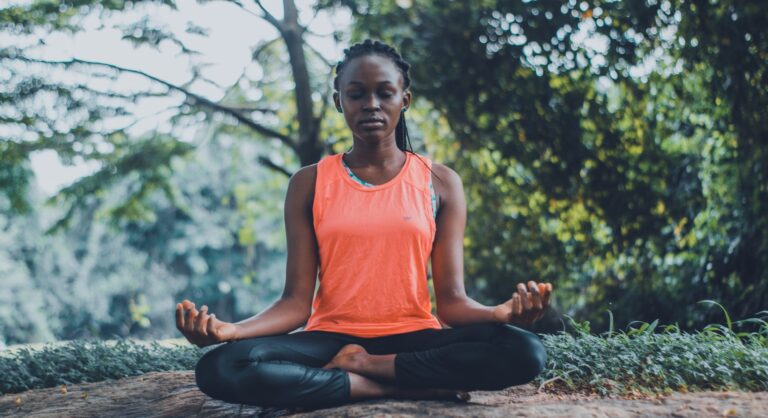
 

A woman sits cross legged with her hands resting on the top of her legs – meditating.
› Back to top
« back
08.24.21 | Community

The power of collective impact

Sage Collective was founded in 1978 as the Tabernacle Senior Citizens Project, Inc. (You can learn more about our story here.)  As the focus of our work has evolved over time, we took the opportunity to rebrand as Sage Collective in 2019.

Sage refers to the great wisdom and spiritual connection we strive to claim. Collective defines the sense of community engagement and interaction we seek, but it means much more than that. 

When we say “collective,” we make reference to the positive ways we can address the systemic challenges and inequities in our society — by forging connections among people and ideas. Joined together, we function as catalysts for change to lighten individual burdens, creating stronger and more purposeful communities along the way.

Moving forward from the essential meaning of “collective,” we embrace the powerful idea of collective impact, which recognizes the diverse strengths and weaknesses of communities, while working with neighborhood leaders and resources to achieve a more just and equitable future … particularly for older adults.  We are always seeking to align ourselves with conceptual frameworks and organizations that are taking bold and efficacious approaches to transformative change through collective impact. We believe that Together Chicago is such an organization:

Together Chicago came into being in 2017 as a mix of local leaders in business, faith, nonprofit and government questioning how they could do more to address the root cause of violence the city was experiencing.

The organization’s vision is to prevail as a catalyst of change and inspire hope within underserved and underrepresented Chicago communities. Together Chicago has five main areas of focus for creating change through the methodology of collective impact: economic development, education, violence reduction, gospel justice and faith community mobilization. Concentrating on these different areas, Together Chicago partners with a variety of local businesses, nonprofits, churches and schools to achieve equitable justice and further their mission of collective impact.

If you’re out and about the last weekend in August, Together Chicago is participating in Chicago Peace Week’s Peach Walk & Festival, to be held at the Dusable Museum of African American History on Saturday, August 28. The event will start at 9 a.m. at the museum’s sculpture garden with a gathering of faith leaders throughout the city for a Peace Walk, directly followed by the Peace Festival. You can learn about the Peace Walk & Festival here.

Collective impact is more of a movement than it is a phrase, providing a roadmap for communities to enable change by inviting everyone to take action together. And as we have seen in communities across our country and around the world, empowering and uplifting all voices is critical to ensuring the success of a collective goal.

Functioning as more than just part of our name, the term “collective” celebrates our rich identity and codifies our beliefs into a framework of mutual engagement for an equitable future.

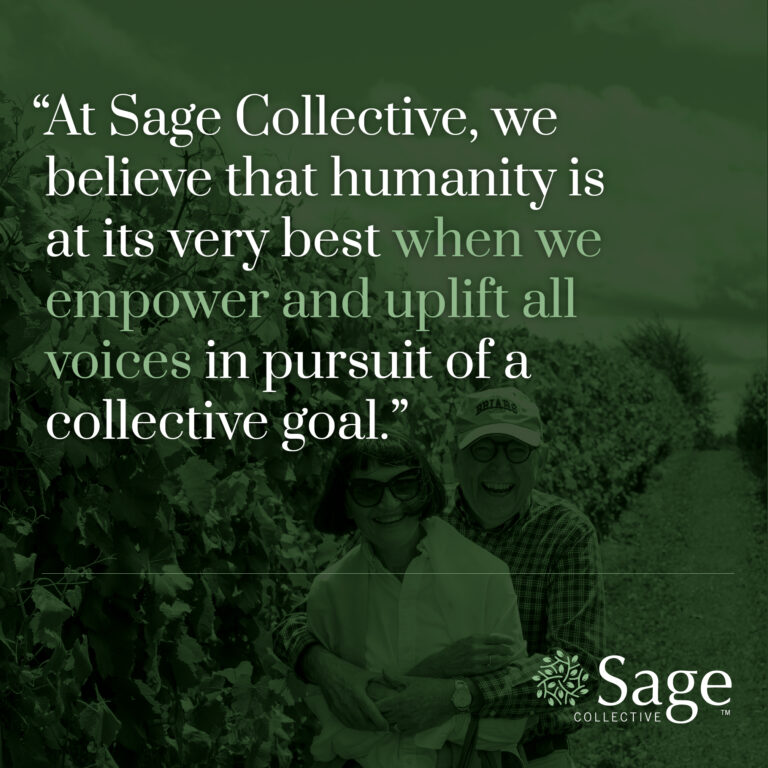
Text overlay reads "At Sage Collective, we believe that humanity is at its very best when we empower and uplift all voices in pursuit of a collective goal."
› Back to top
« back
08.19.21 | Community

Find the future of efficient workouts in “exercise snacks”

As part of our 9 Ways of Vibrant Living, Sage Collective advocates for moderate and regular physical activity. Developed in pandemic times when it was challenging to find ways to stay active, “exercise snacks” — a new and effective set of movements was born, and has become increasingly popular among older adults. Interestingly, research is demonstrating these snippets of exercise are equally or more effective than traditional workouts!

How to perform exercise snacks

“Exercise snacks” are short bursts of movement anyone can perform throughout the day, allowing people to arrange exercise as their time permits. Because the movements don’t require a fixed or dedicated location to “work out” as we normally define the act of exercising, you can find a host of spaces in your home or office to do squats, sit-ups, walking in place, lunges and more.  

Professor of Kinesiology Dr. Martin Gibala, argues that these brief bursts of exercise throughout the day can trigger the same reaction from our bodies that traditional workouts produce. In his study published by the International Journal of Exercise Science, Gibala and his partners introduced an 11-minute workout consisting of walking and running in place, lunges and other light calisthenics that improve cardiovascular health. One of the many thrilling findings was that the conditioning improved cardiovascular fitness by 7% for those who participated. 

Gibala explains that being rigorous with each movement is fundamental for exercise snacks. It is essential, however, to remember to cater to what works best for your body. 

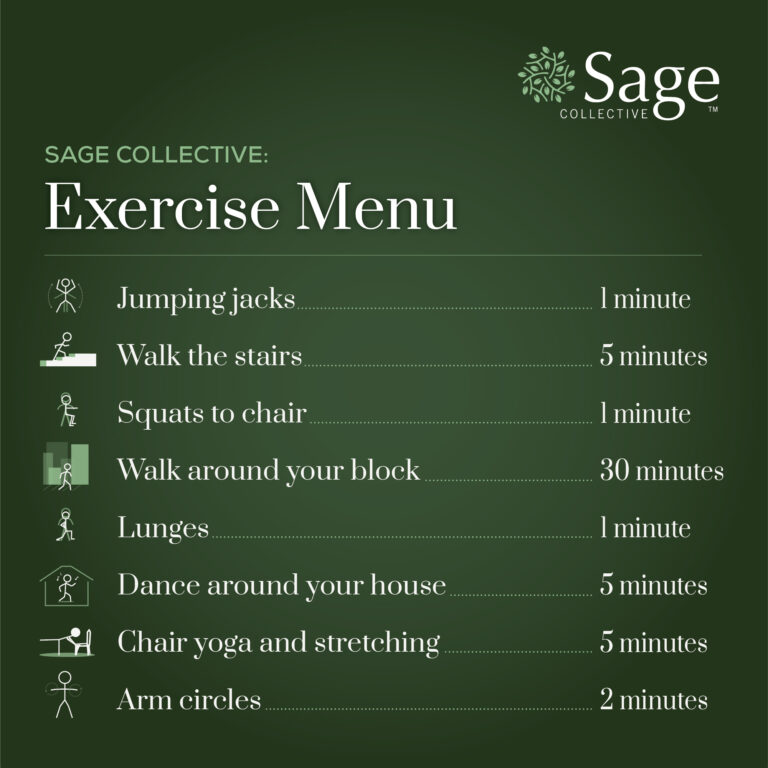
Sage Collective believes that incorporating exercise snacks into the lives of older adults and anyone looking to fulfill fitness needs can be a fundamental – and easy – way to live vibrantly. That’s why we produced our exercise snack menu based on Dr. Gibala’s workout plan below!


A graphic titled "Sage Collective: Exercise Menu" lists eight different "exercise snacks" and times allotted for people to take part in throughout their days.

A graphic titled "Sage Collective: Exercise Menu" lists eight different "exercise snacks" and times allotted for people to take part in throughout their days.
Sage Collective: Exercise Menu
› Back to top
« back
08.12.21 | Community

Strengthening Communities Through Community Gardens

With summer slowly fading and the harsh months of winter in the distance, the magnetic appeal of growing one’s own vegetables and herbs is more important than ever for many of us. Previously, we’ve talked about the health benefits of gardening and how to raise indoor houseplants, but one hobby we haven’t mentioned is community gardening. 

Community gardens begin as collective spaces managed as a collaborative effort that leverage the expertise, time and energy of fellow gardeners who come together to provide fruits, vegetables and all varieties of fresh produce for anyone in the neighborhood to enjoy. And by their very nature, community gardens also add green space and vibrant beauty to city blocks that may be defined by asphalt and concrete.

With people working closely — literally and figuratively — community gardens improve personal well-being through social connections and have even been found to decrease violence in some neighborhoods. 

Zoe Hansen-DiBello, program manager and visionary at Grow Education, helps promote healthy food access in neighborhoods by implementing community gardens. At TedxNewBedford, Hansen-DiBello explains the all-around engagement and respect that community gardens helped to encourage in a neighborhood close to her. Watch Hansen-DiBello’s talk below. 

Gardens galore in Bronzeville

The popularity of urban farming and the adoption of community gardens can be seen throughout neighborhoods in large cities across the country — including our very own Bronzeville. 

Situated at 4148-4156 S. Calumet Avenue, the Bronzeville Neighborhood Farm connects those living in the neighborhood with the use of green spaces and gardens. Managed by the Bronzeville Alliance and protected by NeighborSpace, the garden is a hub for community members to forge meaningful relationships built on the experience of working together towards a common purpose — tending the gardens and sharing the rich yield of fresh fruits and vegetables with each other and with the community writ large.

The neighborhood is also home to the Bronzeville Community Garden, located at 343 E. 51st Street. Supported by Build Bronzeville, the garden hosts many community events throughout the year including Volunteer Days and Crochet & Conversation meetups. Along with urban farming, the Garden is home to public art projects that enhance the outdoor spaces and provide additional reasons for neighbors to stop.

Starting your own garden

Thinking about starting your own community garden? One of the best places to start, The American Community Gardening Association provides a comprehensive education and resource platform for starting a garden of your own, along with a map of community gardens located across the country. 

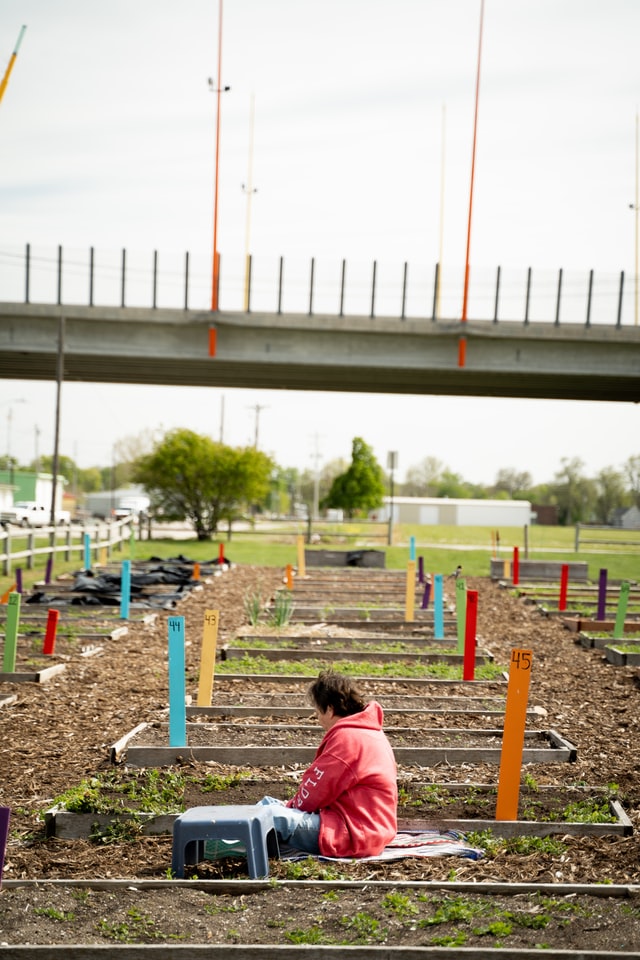
A person sits next to a foot stool in a large lot filled with community garden plots. Out of each plot sticks a brightly colored stakes that are numbered. Above the person appears a concrete bridge either for walking or driving.
› Back to top
« back
08.10.21 | Community

Embracing the cultural process of aging

As we articulate in the Sage Vibrant Living Manifesto, cultural perceptions of aging have an enormous impact on individuals and their communities. As we continue to fight ageism and the traditional American notions of aging that many of us still experience today, we look to the wisdom of others to share new ways of thinking and doing.

Carl Honoré, writer and activist, argues that in order to age better we must feel better about the process. Learning how to age better in a world where aging is presented in a negative frame can be extremely hard, but it only takes a few minutes to change your perspective. In his TED Talk, Honoré explains how to embrace the aging process. Honoré also delves into his method for combating ageist traditions and practices within our lives. Watch below to learn more:

A quote sits on top of an image of two older adults laughing. The quote reads "We need to feel better about aging in order to age better," and is attributed to Carl Honore. The sage logo sits in the bottom right corner.
› Back to top
« back
08.05.21 | Community

Understanding Mutual Aid: How It Can Support Community Success

At Sage Collective, we strive to foster feelings of value, engagement and community. One of the most impactful ways these shared values can be attained is through the action of practicing mutual aid in our everyday lives. 

The concept of mutual aid is something not talked about enough, specifically in shared environments. Looking back on the events of the past 18 months, the practice of mutual aid is more important than ever to the continued success and survival of communities like ours all around the world. 

What is it?

Mutual aid (often referred to as care webs)  is a form of public and political participation for neighborhoods, organizations and groups of all sizes. They provide an avenue for looking after and tending to each other’s health and well-being to create more livable, sustainable environments.

The process and goal of mutual aid is to create accessible and collective care by accepting and sharing mutual responsibility within one’s community space. 

Why is it important?

One of the most important reasons why enacting mutual aid in these spaces is such a key to survival is because it helps foster community engagement and social relationships through responsible, collective action. The more people who perform mutual aid in a shared community or group, the greater its tangible benefits spread.

The concept of mutual aid also parallels other values that we hold at Sage Collective, since it lessens the strain on individuals by strengthening the collective will and ability to ensure the success of all. Think about the expression “a rising tide lifts all boats.” That’s mutual aid in a nutshell.

How to practice it?

There are many ways to practice mutual aid in everyday life. Some may practice it in routine activities and others may spend time waiting for an event or specific cause they feel comfortable supporting. The most important thing to remember about mutual aid is that you shouldn’t feel pressured to offer more than you are capable of providing for yourself or your community.

Here are some examples of how to apply mutual aid in your own life:

Offering a space to share information, organizations and resources such as access to healthcare and food services, as well as transportation accessibility. 

Taking political action locally by volunteering for campaigns and vocally supporting policies that may help those in your community, or actively supporting movements, protests and funds that help benefit those in your care web.

Practicing mindfulness and sharing resources for anything from mediation guides to suggestions for dealing with anxiety, grief or anger.

Providing communication skills such as being open to offering translation services, if you are multilingual, to those in need. You can also help others with different technology devices and platforms you might better understand, or training and learning techniques in bystander intervention and/or steps for nonviolent communication. 

These are all ways in which we can help to foster a sense of connectedness and community among your neighbors and friends in support of uplifting the collective.  Everyone has something that they can share with those who could use a little help in the community.  Sage encourages you to engage your friends and family to initiate activities that provide others a chance to share their skills and experience with those in need.  This isn’t a new concept, it’s simply one that could use a little refreshing.

A group of people holding each other.
› Back to top
« back
08.03.21 | Community

The Science of Laughter

Laughing is something we do numerous times a day without a second thought. Whether we are with friends, watching a funny movie or simply reacting to something that catches us off guard. There is much more behind the infectious response than the loud, quirky and eccentric sounds that come with it. The power of incorporating laughter into your day-to-day routine has huge implications for the quality of your life in the broadest sense. Let’s look further.

Recognizing the impact of laughter’s effects on things such as stress, happiness and health, we at Sage Collective appreciate its importance, especially in relation to our 9 Ways of Vibrant Living

Why do we laugh?

Throughout history, laughter has been seen as a social signal. There are many factors that can affect what we find humorous including age, gender, culture or community. Laughter presents itself in most human interactions as the presence of connectivity, comfortability and the strengthening of a shared or mutual relationship. Furthermore, research shows that the more laughter that is present in those relationships, the stronger those connections or bonds become.

The prevailing theory is that there are three types of scenarios that make us laugh: incongruity, superiority and relief. Incongruity theory is rooted in the idea of expecting one outcome, and receiving a totally different one — resulting in laughter. Superiority theory explains that we might find someone else’s weaknesses or mistakes humorous, making us feel superior to them in the moment. Last, relief theory is the use of comedy in tough or uncomfortable situations in order to relieve stress or tension. If you reflect back on what made you laugh today, do you see the reasons falling into one of these categories?

The health benefits of laughing

There are tangible health and wellness benefits for individuals and communities when we all spend more time laughing. From a purely biological perspective, when we laugh, our bodies reduce the levels of stress hormones, in turn lowering our physical stress and anxiety. At the same time, the action also releases serotonin, which leaves us feeling euphoric. As stress hormones diminish, we lower blood pressure and increase blood flow — which directly leads to the oxygenation of our blood to provide us with more energy. 

Incorporating more laughter in your life

Wondering how to add laughter to your life? Start by considering the concept of humor and its relationship to laughter.

Merriam-Webster defines humor as “the mental faculty of discovering, expressing, or appreciating the ludicrous or absurdly incongruous: the ability to be funny or to be amused by things that are funny.” However, because humor is so subjective, it’s nearly impossible to give it a clear-cut definition. Let’s just say that laughter is the direct reaction or acknowledgment that someone has found something humorous.

For some, laughter may come easy. For others, it might be more difficult to find humor in life. Either way, here are some tips for learning to laugh more. 

One of the easiest ways to find laughter is to surround yourself with people who you find funny and entertaining, but with whom you already have a comfortable and strong relationship. Discovering things that make you laugh throughout your daily life and experiencing them more is also a great way to easily find humor. This might be found in the radio station you listen to on your daily drive, or a television show you play in the background while you do chores at home. And if laughter doesn’t come easily for you, consider laughter therapy — it’s a new form of searching for a chuckle by training yourself to look for humor in uncomfortable and difficult situations, rooted in laughter’s relief theory. There are lots of resources available online, and even apps you can download to your phone!

So even if you aren’t the traditional joking type of person or you find it hard to see the comedy in hard situations, dig deep and look for the laughter in your life. You won’t regret it.

A group of people stand around each other looking at a phone and laughing
› Back to top
« back
07.20.21 | Community

How to Become a Better Listener

Becoming an engaged listener can give you the power to strengthen relationships, validate feelings and empower others. It takes more than just sitting down with someone and hearing what they say to become a better listener, however. Listening is a skill that takes time to practice and master in order to fully appreciate its influence and capability within conversations.

The three C’s of effective listening: compassion, curiosity and courage 

When practicing to become better and more effective listeners, many follow a guide focusing on three main components: compassion, curiosity and courage. The ingredients in this recipe work independently as well as collectively to strengthen the skills needed to become a better listener. Let’s take a closer look.

One of the most important things to show when listening to others in an open and safe environment is compassion. Showing things such as empathy and understanding for someone’s situation—  instead of apathy or disregard — welcomes the opportunity for those sharing to feel more comfortable with the listener, but with their own story and experience, as well.

The presence of curiosity within conversation is also key for displaying interest and affection. Showing your interest and craving to learn more from those speaking can further the feeling of validation and in turn encourage them to continue being open and vulnerable.

You might be wondering how courage comes into play when practicing listening and instead may think it’s more important for speaking. Yet, having the courage to effectively listen to someone often require courage and vulnerability, more so than sharing your own voice. In fact, Winston Churchil famously once said, Courage is what it takes to stand up and speak; courage is also what it takes to sit down and listen.”

Beyond the three C’s, we should also all aim to apply compassionate witnessing and active listening to become a better and more effective listener.

Compassionate witnessing

Compassionate witnessing, an essential element in effective listening, goes one step beyond being empathetic and compassionate.

Compassionate witnesses understand the act of understanding as key to being a better listener. As a listener, your role isn’t to judge, interrupt or share your thoughts. Your main goal is to create a connecting and welcoming environment where you make the other person feel seen and important. By including compassionate witnessing into your listening environment, feelings and reactions of validity start becoming more familiar to all.

It is also important to enact compassionate witnessing techniques into how we treat ourselves. By making ourselves and others’ words visible and important, we have the opportunity to mold and revolutionize all relationships.

Active listening

Although being a compassionate witness and including the three C’s into your listening habits help you become a better listener, it isn’t enough to just simply sit and listen. Active listening is being fully engaged in the conversation you are a part of, going beyond being a compassionate witness.

There are many aspects of being an active listener, including the use of engaging body language. Opening your body up (not crossing arms and legs, for example) and showing assurance by leaning forward, nodding your head and smiling can all be signs to the speaker you are actively engaging and listening to them.

Another aspect of actively listening includes clarifying and paraphrasing without interrupting the speaker. Clarifying involves asking the speaker for additional information related to what you find interesting or unique in what they are sharing. And in the process of paraphrasing, you have the opportunity to summarize what was said in order to get confirmation and demonstrate that you are understanding the content of the conversation in real time. Both of these techniques are helpful and engaging for those listening, but for the speaker as well.

One of the last things you can offer as an active listener is giving feedback, especially if the person you’re conversing with is open to this kind of change. If they are looking for feedback, it’s important to actively share your thoughts, feelings and constructive advice if you have any.

Becoming a better listener is an ongoing process of building a toolkit of skills and actions, and continuing to draw upon these tools in ways that are uniquely appropriate to any given conversation. And as your listening improves, you’ll come to internalize the mechanics and have endless opportunities to experience the power of reciprocity — the simple pleasure of giving and receiving.

› Back to top
« back
07.15.21 | Sage Advice®

Radical ways to repair harm: restorative vs. transformative justice

The last year and a half marked a breaking point in the status quo. The combined stresses of a global pandemic, as well as increased national awareness of police brutality and racial injustice in America, made one thing clear: we need to radically reimagine our communal approach to safety and care.

As we collectively look to create a future where all people feel safe, longtime organizers and activists are pushing for two solutions: a turn towards restorative justice or transformative justice. These human-centric methods for addressing harm dispel the idea that people are disposable beings, or that punishment should be carceral. Learn more about the concepts, and what makes them different from one another, below:

Restorative Justice

Restorative justice acknowledges that when crime occurs, it causes harm to those that are involved. Rather than focusing solely on punishing the perpetrator of the crime, restorative justice is concerned with addressing the harm caused and the impact of that harm.

This is addressed by facilitating dialogue between all parties involved. Ideally, a conversation will be collectively held by all parties, including: the person who has caused the harm, the person who has been directly harmed, and the community where the harm occurs.

During this conversation, the person who has caused the harm should take accountability for their actions and make amends. The person who has been directly harmed may outline what they need in order to heal.

The community is an integral part of this process as well, because as the process of restorative justice seeks to route a path towards forgiveness and healing, its end goal is ultimately to reintegrate the person who has caused harm back into society, where they will have a second chance.

Transformative justice

In an article from Novel Hand examining the difference between restorative and transformative justice, and how transformative justice digs one step deeper, writing:

“…restorative justice attempts to restore to the condition before the harm took place. However, usually, that original condition is itself one that has a number of injustices built into it. Transformative justice aims to dig deeper: how can we also address the root causes of injustice and move toward an even stronger community?”

Essentially, restorative justice acknowledges the failings of our current carceral state, where the prison industrial complex puts people away for crime in a way that feels disposable rather than healing. But furthermore, transformative justice takes its critique of current systems further and acknowledges the failings of our current system to also address racism, sexism, ableism, and classism – and how these conditions contribute to where crime occurs, from whom it occurs, and how treatment/punishment differs across the spectrum.

Peace and Conflict scholar Anthony Nocella says on this subject: “Transformative justice…is about looking for the good within others while also being aware of complex systems of domination.”

This cursory overview of restorative and transformative justice is just the tip of what’s been said and what there is to learn about radically reimagining the ways we repair harm in our society. To learn more, we recommend reading the full article by Novel Hand and conducting your own research from there!


Illustration of outstretched hands
› Back to top
« back
07.13.21 | Community

How to become a “joyspotting” expert

Similar to taking an awe walk, joyspotting is the intentional act of going out into the world to look for things that spark joy in you. While the word may sound unusual, it’s actually amassed quite a cult following – with entire online groups dedicated to sharing in joyspotting (and their subsequent findings) together. Even if you’re not ready to join an online group just yet, find out how to become a joyspotting expert using our tips below.

The Origins of Joyspotting

Joyspotting is a term first coined by Ingrid Fetell Lee. As a designer, Lee began to notice the relationship between one’s surroundings and their mental health. For example: living in a home filled with bright prints and patterns provides an immediate mood booster. Lee knew this was a counterintuitive principle. So often, society tells us not to derive joy from the things that surround us, but from what’s within us.

In contradiction to this view, Lee sheds light on the relationship between our environment and our emotions, and shares inspiration and resources for living a more joyful life through design in her book, The Aesthetics of Joy. She has also created a website dedicated to this viewpoint, that shares the same name. There is also an online Facebook group that we referenced above, The Joyspotters’ Society.

As Lee became more and more tuned into what caused her joy from her surroundings, she began to develop the habit of intentionally seeking out – or looking to consciously observe – these causes of joy. And hence, joyspotting was born. As she says, “The world seemed to be teeming with tiny, joyful surprises. All I had to do was look for them… It was like I had a pair of rose-colored glasses, and now that I knew what to look for, I was seeing it everywhere. It was like these little moments of joy were hidden in plain sight.” Instead of seeing the world around us as beset with distractors, joyspotting is a way of creating a reservoir of positivity.

Twelve Ways of Joyspotting

To become an avid joyspotter is simple. Look around you and determine something that causes you joy. It could be a pair of colorful, patterned socks worn by the man next to you on the train, or the unexpected sidewalk chalk drawings on a walk around the block. But just in case you need a little bit of help getting started, Lee put together The Joyspotter’s Guide, which outlines her twelve tips for joyspotting. Below, we offer a brief description of those tips.

Look up. Joy often comes from things that float or fly in the sky, whether that’s shapes you find in the clouds, or a stray red balloon. Look down. Maybe you discover a rainbow in a puddle, or a vibrant pair of shoes on a passing pair of feet. Keep an eye out for color. What flashes of blue catch your eye? How does an abundance of green transform the environment? Follow the curve. Life is full of hardness, so where do things get soft around the edges?

Go where the wild things are. There’s always joy to be found in nature, whether it’s enjoying the smell of a rosebush, or listening to birdsong. Seek out symmetry. Where there are mirror patterns, there’s often a surprising sensation of randomness or harmony. Search for signs of abundance. Where do things feel lush and full? It could be a fruit bowl on a family member’s kitchen counter, or a few too many Christmas lights at the neighbor’s house. Joy has a way of spilling over. Watch for weirdness. Where are things out of place, or just out of the ordinary? It’s those standout details that often feel most special.

Zoom in. Focus your attention on the tiniest of details. Notice the invisible. What joy surrounds you that can be felt or heard, but not seen? These sightless observations hold a magic of their own. Similarly, use all your senses! And finally, take the scenic route. The paths you wouldn’t normally take often hold the most surprises, and within those, there’s much joy to discover.


Photo of man looking through a spotting scope
› Back to top