« back
02.18.21 | Community

Community Spotlight: Groups Making a Difference

The second half of our name, collective, is important to us — we’re a collective because what we do, we do together. It’s part of our DNA to share resources, ideas and successes with everyone in our ecosystem. That’s why today, we’re sharing a community spotlight to celebrate groups making a difference in our neighborhood, Bronzeville, and the surrounding areas. Here’s just a few:

Bright Star Community Outreach

Bright Star Community Outreach (BSCO) is proud of its nine-year history and by-us-for-us roots. They’re led by founder and CEO, Pastor Chris Harris Sr., who grew up in Bronzeville and saw a need to address systematic problems impacting the neighborhood — problems like “violence in our communities, poor economic opportunities, inadequate mental health services, homelessness, child safety, and drug abuse.” Through resource development and collaborative partnerships, BSCO is empowering Bronzeville residents to share in the responsibility of building community. You can learn more about BSCO programs here.

My Block, My Hood, My City

The second group in our community spotlight, My Block, My Hood, My City, also known as M3, was started by Jahmal Cole in 2015 with a mission to “break down the social and emotional barriers of segregation, empower people to meet and serve their neighbors, and inspire Chicagoans to pursue their dreams.” M3 has been nimble in its approach, providing everything from youth education to engaging adult programming. Just one example: as part of their Viral Response, M3 performs Senior Wellness Calls, where volunteers perform senior wellness checks to help provide proper PPE and even just to chat with older adults to help combat social isolation. You can visit their website to learn more about their efforts (and get involved) here.

Sacred Keepers Sustainability Lab + Bronzeville/Kenwood Mutual Aid Network

Food deserts are an ongoing concern on the South Side of Chicago, and as many faced food scarcity like never before during the pandemic, things got even worse when some grocery stores temporarily closed after the George Floyd protests in June. Seeing the need for increased access to resources, two Bronzeville organizations joined forces: Sacred Keepers Sustainability Lab and Bronzeville/Kenwood Mutual Aid Network. Since the summer, their efforts have continued to stay strong and to have meaningful impact on the neighborhood; you can read more at Block Club Chicago here. 
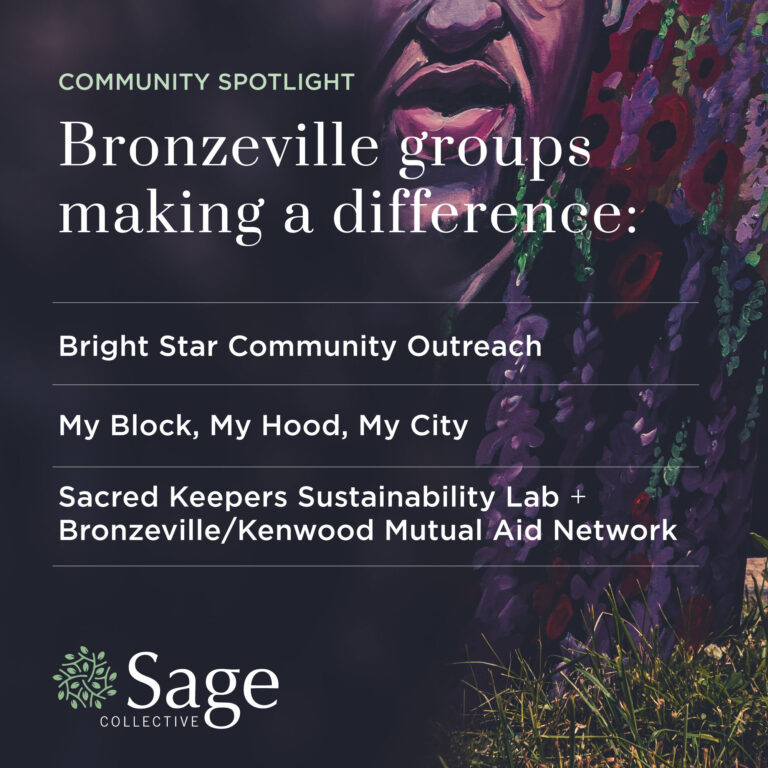
Text graphic reading: Community spotlight: Bronzeville groups making a difference: Bright star community outreach, my block, my hood, my city and sacred keepers sustainability lab + bronzeville/kenwood mutual aid network
› Back to top
« back
02.09.21 | Sage Advice®

A Brief History of Bronzeville

Sage Collective has begun the process of renovating the first two properties we acquired, since selling Willa Rawls Manor, a 123-unit property we owned and operated for more than 40 years. The two properties are located at  4108 S King Drive and 4112 S King Drive. With the buildings located side-by-side in Chicago’s historic Bronzeville neighborhood, it will provide a tangible benefit to the community by celebrating and uplifting Bronzeville’s dynamic history, current-day culture and residents alike. In honor of this effort and of Black History Month, today we take a moment to look at a brief history of Bronzeville.

Becoming Bronzeville

With the Great Migration beginning in 1916, African Americans fled lynchings and oppression in the rural South for brighter opportunities in cities in the North. Though segregation was outlawed after the Civil War, racist practices in hiring and housing practices remained steadfast. Many African Americans in Chicago landed in what became the Bronzeville area, there facing higher rent prices and population density (at its highest reaching 300,000 residents strong). 

Despite this, true to the African principle of ujamaa, Bronzeville residents created a tight-knit community that boasted a network of black-owned institutions and a cultural vivacity that, in its prime from the 1920s-1950s, even rivaled Harlem.

The community had been growing, but the name Bronzeville only entered the scene in the 1930s, suggested by theater editor for the Chicago Bee (an African American-led daily newspaper with national reach), James Gentry. Gentry posited that African American skin was closer to bronze than black, and selected the name as an empowering alternative to racist nicknames for the neighborhood that had emerged.

Center of Culture

Though the official boundaries of Bronzeville are often contested as spanning anywhere from 18th and 67th Street north-south to the Dan Ryan and Lake Michigan west-east, the pulsing heart of Bronzeville landed somewhere in the middle.

Dining, shopping, dance halls and nightclubs abounded. Jazz, blues and gospel were the sounds of Bronzeville, and when the Regal Theater opened in the 1920s, it attracted the country’s most glamorous and talented Black entertainers. Bronzeville also boasts being the home of renowned African American artists and intellectuals like journalist and social activist Ida B. Wells, jazz musician Louis Armstrong, poet Gwendolyn Brooks, women’s aviation pioneer Bessie Coleman, sociologist Horace Clayton and dancer Katherine Dunham.

WTTW put it best when they said businesses and community institutions like Provident Hospital (where Daniel Hale Williams, an African American, pioneered open-heart surgery), the Wabash YMCA (which established the first Black History Month), the George Cleveland Hall Library, Parkway Community House, Binga Bank (Chicago’s first Black-owned life insurance, realty, and financial institution), and more, “were more than alternatives to racially restricted establishments downtown”. They were pillars of the community which helped to instill pride and contribute to the upward mobility of African Americans.”

Through our vision for vibrant, high-quality and affordable housing for older adults, Sage Collective is proud to contribute to the legacy of African American culture, community and success that is the heart and soul of Bronzeville. 

Mural under the “El” tracks in Bronzeville
› Back to top
« back
02.04.21 | Sage Advice®

How Better Self-Control Leads to Life Longevity

What does good behavior have to do with life expectancy? More than you might think.

U.S. News recently reported on a study conducted on 1,000 New Zealanders, from newborns to 45 years old, tracking the correlation between self control and health in middle age. The study tracked self-control through behaviors related to goal-orientation and restraint in thoughts, behavior and emotion. The study’s analysis of health in middle age took into account both body and brain.

Overall, the study concluded that those who practiced better self control “aged more slowly,” resulting in better health outcomes during their middle-aged years. So why exactly does this correlation occur? Self-control is also directly related to self-regulation. The study considered the impact of a person’s ability to delay gratification. For example, were participants able to forego short-term indulgences in favor of long-term rewards? (i.e., would they give up the immediate gratification of a ‘smoke break’ in order to have better lung health later on in life?) 

Most importantly, while self-control and self-regulation may also be influenced by DNA makeup and unique life circumstances, individuals do have the capability to learn better self-regulation skills. Knowing the long term effects of such behavior on one’s body and brain health, the development and cultivation of these skills throughout life becomes critical.

You can read more about the study and its findings in the U.S. News article here.

A doctor's stethoscope
› Back to top
« back
02.02.21 | Sage Advice®

What We Mean When We Say “Older Adults”

You’ve probably noticed that at Sage Collective, we use the term older adults to describe our audience. But if you’ve ever wondered why exactly we use the term older adults, today we’ll take a closer look at the language and what it means to us.

Contentious debate surrounds the usage of alternative phrases like seniors, senior citizens, elders and elderly. For example, what do you think when you hear the word elderly? For most, it conjures images of someone frail and dependent. While one older adult could have health that renders them bedridden, another older adult could just as easily be ready to run a marathon. Weighted terms like elderly render such distinctions meaningless. 

Overall, the term elderly is outdated and ageist. The word has created a stereotype around aging that negatively influences the way older adults are perceived and therefore treated in our society. Consider too, the implications of words like seniors and senior citizens — we don’t call the younger generation juniors or junior citizens, right? 

Older adults aptly captures that this is indeed a population that is older — but without the hard underscore of the word old. Categorically, the phrase also leaves room for the many nuances of older adults’ varied experiences. There is no implication or preconceived notions of health, disposition, etc., attached; it’s simply a way of classifying an age group overall.

We also use the term older adults to celebrate the next chapter in aging adults’ lives. We believe that like any stage in life, older adulthood brings with it exciting and unique opportunities to learn, grow and thrive. The phrase brings with it a liberty and freedom for older adults to divine their own fate and lifestyle — and to embrace a life of vibrant living (if they should so choose). 

We want to hear from you too — what do you think of the term older adults? What does it mean to you? Let us know over at Sage Collective’s profiles on Facebook, Twitter, Instagram and LinkedIn.

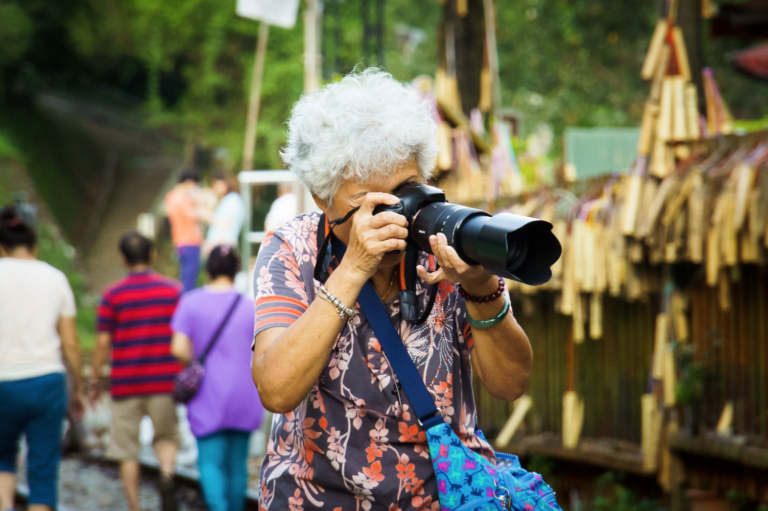
An older adult woman holds a DSLR camera with a hooded zoom lens up to her face, in the act of taking a photo
› Back to top
« back
01.14.21 | Community

Watching the 59th Presidential Inauguration Virtually

Though 2020 may be behind us, many of the changes we became accustomed to in the past year are here to stay (at least for a little while longer). The COVID-19 pandemic still rages, and we’re still encouraged to practice safety protocols such as wearing a mask, social distancing and staying home whenever possible.

That also means that large gatherings, like the upcoming Presidential Inauguration Ceremony, are looking a little different this time around. And in light of events at Capitol Hill last week, it’s now more important than ever to honor institutions of democracy and uphold our civic powers. That’s why today, we’re taking a closer look at how you can watch the Presidential Inauguration virtually.

The 59th Presidential Inauguration

President-Elect Joe Biden and Vice President-Elect Kamala Harris will be sworn in at the 59th Presidential Inauguration on January 20th. The inaugural ceremony is a tradition with an over 200-year-old history, but this year, a limited number of tickets were made available to congressional offices and Americans are being dissuaded from traveling to the nation’s capital to witness the event in person. Instead, the celebrations are going virtual. “This isn’t about politics,” said Biden. “This is about saving lives.” (You can read more about the in-process plans for the inauguration here.)

However the capitol decides to revise its typical celebrations, the majority of us will be watching the 59th presidential inauguration virtually from the comfort (and safety) of our couches at home. But how do we continue to keep this virtual viewing as celebratory as ever? 

Watching Along

The televised inauguration will kick off at noon EST on January 20th, with pre-event festivities beginning as early as 9:30 AM EST. The event will be televised on all major cable networks, news channel websites as well as aired live on the White House streaming website. (You can find an even more detailed list of places to watch the live streamed event here.) 

Following the official swearing-in, the traditional parade down Pennsylvania Avenue and through Washington D.C. has been transformed in a “virtual, nationwide parade.” Parade organizers promise that by going virtual, the parade will be more inclusive than ever, serving to “celebrate America’s heroes, highlight Americans from all walks of life in different states and regions and reflect on the diversity, heritage, and resilience of the country as we begin a new American era.” According to the parade’s organizing committee, it will feature “diverse, dynamic” performances in communities across the country.

To “watch along” with family, friends and community members virtually, we recommend taking advantage of video-chatting services such as Facebook video chat or Zoom. 

While much about our present circumstances remain the same, this is one concrete change we recommend celebrating safely and joyously. 

› Back to top
« back
01.12.21 | Sage Advice®

Feeling Exhausted? The Science Behind Pandemic Burnout

As part of our 9 Ways of Vibrant Living, we at Sage Collective advocate for stress reduction. We recognize stress as a natural, regular occurrence and aim to help our followers learn to manage, to control and to minimize stress.

But we’ll be the first to admit that since the onset of the COVID-19 pandemic (in March of what’s officially become last year), stress levels have been higher than ever. If you’ve been feeling excessively stressed, burnt out and unable to focus — you’re not alone. Today, we’re taking a closer look at the science behind pandemic-related stress and burnout. 

There’s a reason everyone’s been referring to COVID-19 as “unprecedented.” We’ve never experienced anything quite like this in our lives. Worrying about a global pandemic, public health and safety, our personal wellbeing and the wellbeing of those we love, not to mention financial concerns, food security struggles and more — it’s an inordinate amount of stress for human beings to take on all at once. And the demand of feeling all these things at once is taking a toll on our bodies.

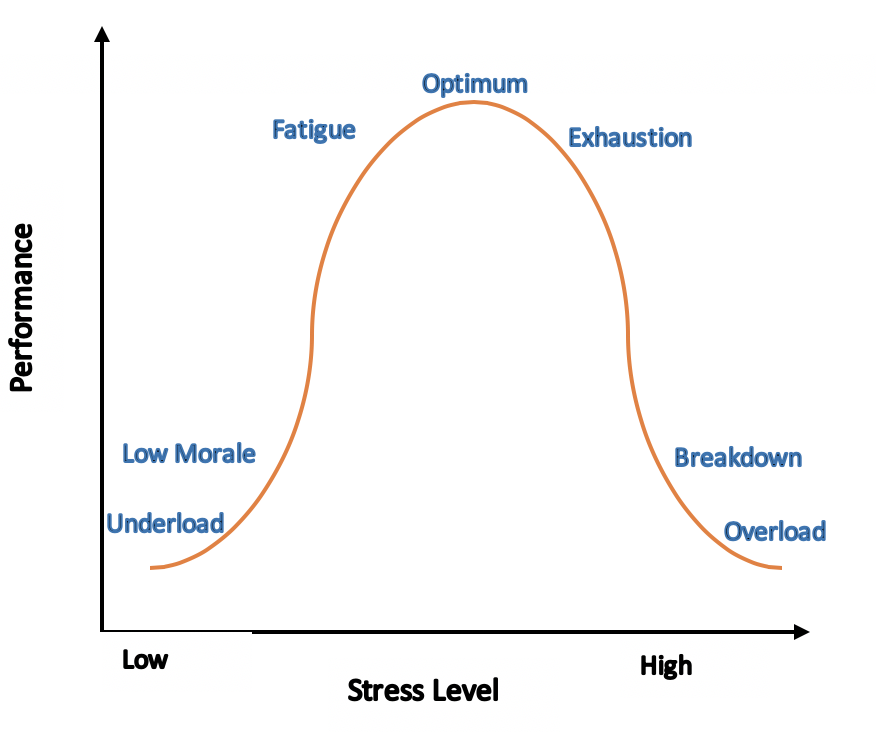
Allostatic load demonstrated visually

Allostatic load refers to the impact of cumulative wear and tear — the impact of carrying all that stress, for example. And allostatic overload refers to the point at which the demand of our stress overtakes the capability of our mind and body to keep up. As demonstrated above, we can look at our allostatic load as a bell curve. Too little stimulation from stress, we’ll be underloaded, understimulated and stagnant as  human beings. But too much stimulation from stress, and we’ll be overloaded, overstimulated and exhausted to the point of burnout.

Many of us are in the throes of allostatic overload. Our bodies have been constantly perceiving a potential threat, and therefore they’ve been producing hormones like adrenaline and cortisone, handy responses to temporary stressors.  However, in the case of a prolonged stressor such as the pandemic, our bodies continually overload themselves with these hormones, which are actually toxic to our physiological systems. 

So your feelings of stress, exhaustion and burnout — they’re only natural. But acknowledging the reality of the problem is only half the battle. How do we even begin to combat burnout and fatigue? 

First, self care is absolutely crucial. Prioritize taking care of your body through healthy habits like regular exercise, healthy diet and getting your best night’s sleep. Prioritize taking care of your mind, too, by making time to practice gratitude and indulge in doing things you love. And secondly, be mindful to take care of others, too. Finding ways to safely connect with friends, family and community will serve as a reminder that you’re not alone — we’re all in this together.

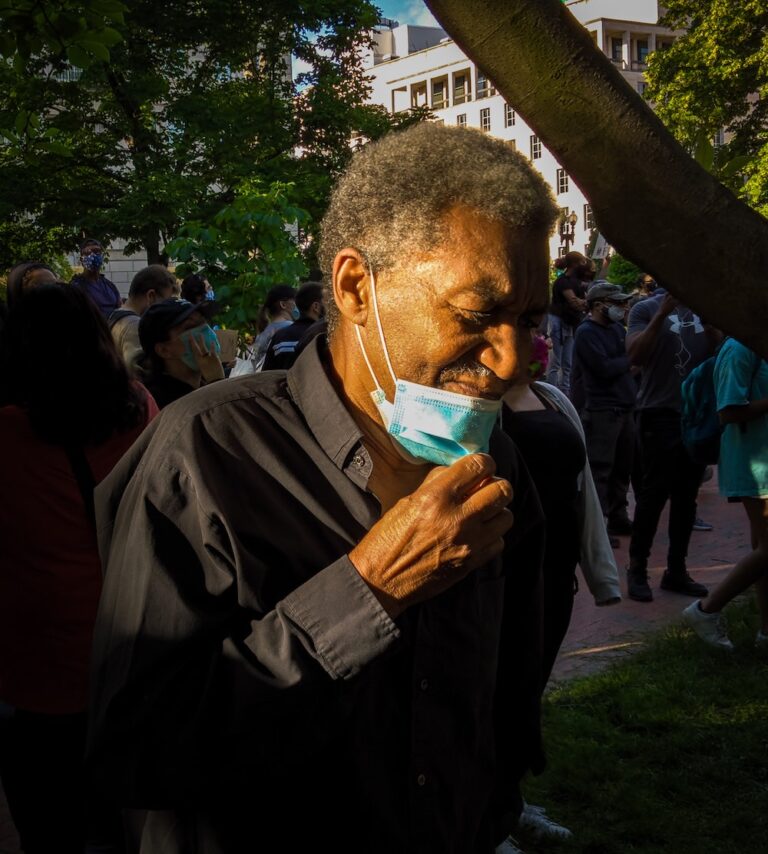
An older African American adult steps aside to take off his mask for a moment
› Back to top
« back
01.05.21 | Community

Sticking To Your New Year’s Resolutions

Just when you think the hard part is done — deciding on New Year’s resolutions — the clock strikes midnight and it’s time to follow through. You’re not alone, though. We all struggle to stick with our New Year’s resolutions. And luckily, with determination and the right strategy, you can keep your resolutions alive far past January’s gym membership. Here’s just a few helpful tips:

Make Incremental Goals

We often struggle to keep resolutions because they’re simply too daunting. A big-picture goal like “eat healthier” is much easier to tackle when broken down into small, digestible actions. Try making incremental goals, such as “include veggies in one meal per day.” This way, you have a tangible action to work towards, and once the action is completed, a victory to celebrate, too. 

Utilize Your Support System

Whether it’s an accountability buddy or just a loved one lending an ear, sharing your successes and struggles is an important part of the journey. Having a support system means others are there to share motivation and advice along the way, as well as helping to hold you accountable. 

Practice Patience + Forgiveness

Of course nobody is perfect. There will be days where your resolution falls to the wayside, and that’s okay, too. It’s important to practice patience and forgiveness, and not to beat yourself up for an off day (or two). Ups and downs are just a part of the journey. Studies even confirm: those who succeed in sticking with their resolutions actually slip up an average of 14 times.

Take Time to Reflect

Throughout the year, remember to take a step back and reflect. What made you choose this resolution in the first place? What does achieving this goal mean to you? Moments of meditation and mindfulness such as these help us realign with our own wants and desires.  

Keeping resolutions, like making any change occur, isn’t an overnight affair. But with the right approach, you’ll be able to stick to your goals all through 2021.

A pink planner with 2021 emblazoned on its cover in gold, next to an assortment of pens, notebooks and other desk supplies
› Back to top
« back
12.28.20 | Spirituality & Religion

The Importance of Practicing Gratitude

Gratitude is both a way of thinking and a way of doing. By definition, it’s the quality of being thankful, as well as the readiness and willingness to show appreciation for and to return kindness. And by practicing gratitude, we open ourselves up to being more connected, more happy and more healthy.

Finding the Good

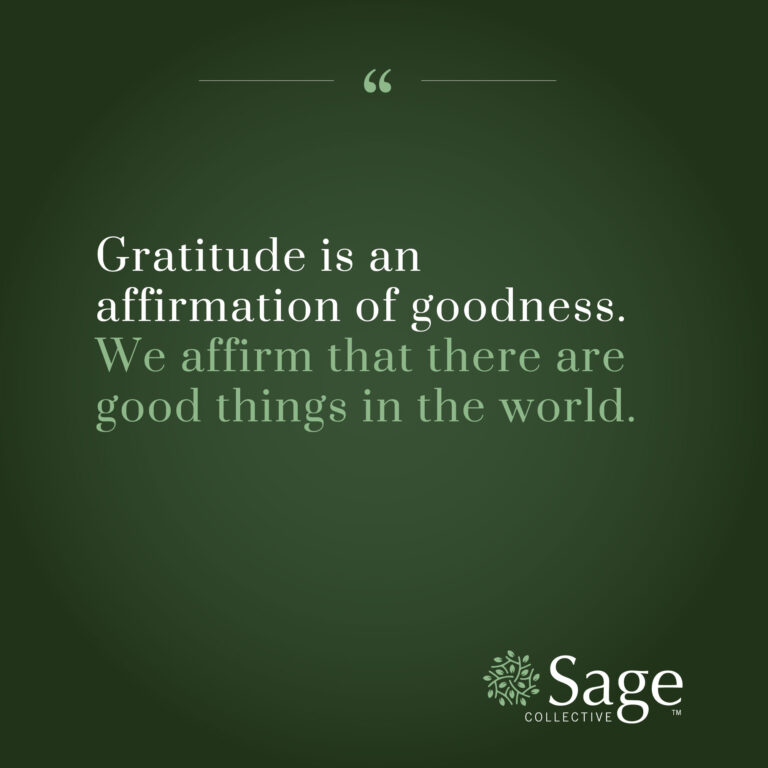
According to American psychologist Robert Emmons, there are two parts to gratitude. Firstly, it’s “an affirmation of goodness. We affirm that there are good things in the world, gifts and benefits we’ve received,” he says. While this doesn’t overwrite challenges or frustrations in our lives, it allows us to look at our lives wholly and to always find balance and goodness. Finding good in the world helps us to feel more positive emotions, relish good experiences, deal with adversity and even improve mental and physical health.

Becoming More Connected

Secondly, says Emmons, “we recognize that the sources of this goodness are outside of ourselves…. We acknowledge that other people—or even higher powers, if you’re of a spiritual mindset—gave us many gifts, big and small, to help us achieve the goodness in our lives.” In this way, Emmons describes gratitude as a “relationship-strengthening emotion, because it requires us to see how we’ve been supported and affirmed by other people.” Therefore, practicing gratitude allows us to feel more connected with our surroundings, whether that be nature, our spirituality or the people in our lives. This in turn leads to stronger, more positive relationships.

Practicing Gratitude

So how do we cultivate and strengthen our practice of gratitude?

First, we must notice our surroundings. What or who makes you feel good? This reflection can happen in-the-moment throughout your daily experiences, or later when you have a private moment to yourself for meditation. Many experts recommend keeping a gratitude journal and regularly listing things you’re grateful for.

Savor and absorb the things for which you’re grateful. Once you acknowledge the good things in your life, make sure you enjoy those experiences to the fullest and treat them with the utmost appreciation.

And finally, express your gratitude. Happiness is best when shared — and everyone likes to feel appreciated. Take the time to write a thank you note or voice your gratitude verbally. 

We all experience gratitude, but taking the time to acknowledge the feeling and become more intentional with how we engage with it and share with others will make all the difference in the world. 

White and green text over a dark green background, with quotation marks and the Sage Collective logo. Text reads: Gratitude is an affirmation of goodness. We affirm that there are good things in the world.
› Back to top
« back
12.23.20 | Arts & Culture

Learning From the Seven Principles of Kwanzaa

Kwanzaa is an annual African American and Pan-African holiday that brings people together globally to celebrate their cultural and ancestral roots. The holiday, created in 1966 by Dr. Maulana Karenga, derives its name from the Swahili phrase “matunday ya kwanza,” or “first fruits,” and was inspired by the harvest traditions of the Ashanti and Zulu. In honor of this culturally-rich event, today we’re exploring more of the holiday’s history and traditions.

The History of Kwanzaa

Dr. Karenga created Kwanzaa after the Watts riots in Los Angeles. As a major figure in the Black Power movement of the 1960s and 1970s, Dr. Karenga saw the celebration as a way to bring African Americans together as a community and to uplift Black Power. While the holiday began as a radical alternative to mainstream denominations, in a 1997 address, Dr. Karenga revised his stance so as not to alienate practicing Christians. Today, many African Americans celebrate Kwanzaa alongside their own religious holidays. 

The celebration of Kwanzaa takes place across a period of seven days from December 26 to January 1. Families gather to light the Kwanzaan candelabra, the Kinara, which holds seven candles, one for each night. The seven candles correspond to the seven principles of Kwanzaa, or Nguzo Saba. There are numerous other celebratory symbols and traditions in addition to the lighting of the Kinara.

The Seven Principles, Nguzo Saba

The Seven Principles, or Nguzo Saba, are reflective of important values in African culture. When lighting the Kinara each night, families reflect upon the principle that corresponds with that day. Nguzo Saba includes the following:

Umoja, or unity, means to strive for and maintain unity in the family, community, nation, and race.

Kujichagulia, or self-determination, means to define ourselves, name ourselves, create for ourselves for ourselves and speak for ourselves.

Ujima, or collective work and responsibility, means to build and maintain our community together and make our brother’s and sister’s problems our problems and to solve them together.

Ujamaa, or cooperative economics, means to build and maintain our own stores, shops and other businesses and to profit from them together.

Nia, or purpose, means to make our collective vocation the building and developing of our community in order to restore our people to their traditional greatness.

Kuumba, or creativity, means to always do as much as we can, in the way we can, in order to leave our community more beautiful and beneficial than we inherited it.

And Imani, or faith, means to believe with all our heart in our people, our parents, our teachers, our leaders and the righteousness and victory of our struggle.

As strong believers in the power of community and the collective, we at Sage Collective believe there is much to be learned from Nguzo Saba. To learn more about Kwanzaa, you can visit the website created for the holiday by Dr. Karenga here.

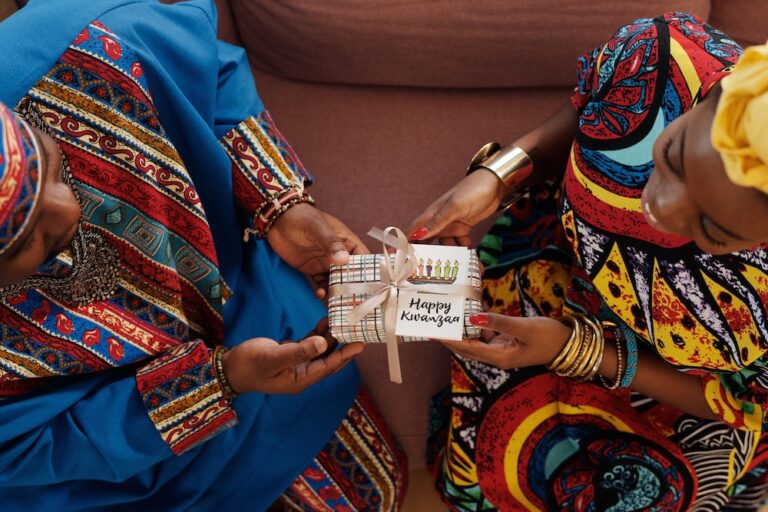
Two African American people wearing batik fabric hold a gift together that says Happy Kwanzaa
› Back to top