« back
12.10.20 | Arts & Culture

Discover Your New Winter Hobby for Seniors

Cultivating hobbies in older adulthood is a vital part of staying enriched and engaged. We’ve spent our entire lives making others happy, from partners to kids to bosses to friends. Now is the perfect time to indulge in activities for personal happiness and enjoyment, too. That’s why today, we’re talking about the benefits of finding a hobby that suits you — and sharing a few ideas to help get you started.

Fitness Hobbies

As we’ve discussed before, it’s vital that older adults partake in regular, moderate physical activity. Hobbies such as yoga, tai chi, swimming and even gardening are great ways to get those minutes in while also enjoying the task. Choosing these forms of exercise will help transform the experience of working out from a chore to a treat. 

Social Activities

Loneliness and social isolation are major challenges older adults face. Incorporating social activities into your life is a great way to meet new people and learn new things at the same time. Consider joining a choir, a local senior bowling (or other leisurely sport) league, taking a dancing class or even getting together for a game of cards every once and awhile.

Mental Engagements

One major benefit of hobbies is the opportunity to stimulate and engage your mind. For those that love a good challenge, or like to be whisked away in a story, try picking up a good novel from your library or grappling with a puzzle in the newspaper. Mentally engaging hobbies and activities are even proven to help keep your memory sharp.

Artistic Pursuits

For those seeking to express their artistic side, there are many artist hobbies available. For those that are good with their hands, knitting, crocheting or quilting are all exciting pursuits. Painting, drawing and scrapbooking are great ways to get creative and to create keepsakes, too. And for the wordsmiths among us, writing counts as an artform too!

There’s a hobby out there for everyone. Keep looking and trying new things until you find one that’s the right fit for you!

Three African American older adults smile together, wearing aprons at a painting class
› Back to top
« back
12.08.20 | Sage Advice®

Understanding the South African Philosophy of Ubuntu

Words from other cultures often encapsulate grand ideas that our own language simply struggles to communicate so succinctly, just like the Japanese concept of tsundoku, which describes having more books than one could ever read. Similarly, the Nguni Bantu term ubuntu is hard to even translate into English, though roughly it means “humanity.” Today, we’re exploring ubuntu and all that the word encompasses.

What It Means

The word ubuntu combines the root ntʊ̀, or “person/human being” with the abstract-noun-forming prefix ubu-, which is why the word is sometimes translated to mean “humanity” or, more extensively, “humanity towards others” and “I am because we are.” The Zulu phrase “Umuntu ngumuntu ngabantu” literally means that a person is a person through other people. Ubuntu encapsulates ideas of human kindness, mutual caring, connection, community and oneness. 

The word dates back as early as 1846 in South Africa, though first became popular during the period of decolonization in the mid 20th century. Ubuntu at that time was described as a form of African humanist philosophy, a moral compass for how we should behave towards one another. 

How Ubuntu Has Been Used

In the late 20th century, Desmond Tutu further popularized the term and brought it to Western audiences. He described it by saying, “My humanity is caught up, is inextricably bound up, in what is yours.” In truly ubuntu, or humanistic form, Tutu advocated that a democratic South Africa could reconcile from apartheid through restorative justice. Both oppressor and oppressed needed to have their humanity restored, to return to ubuntu and a more just, mutualistically caring society, together.

Nelson Mandela himself famously described ubuntu saying, “A traveller through a country would stop at a village and he didn’t have to ask for food or for water. Once he stops, the people give him food, entertain him. That is one aspect of Ubuntu but it will have various aspects.” Mandela embodied ubuntu by leading South Africa out of apartheid with compassion and understanding, rather than vengeance. 

We could all benefit from incorporating ubuntu into our vocabulary and philosophy. At Sage Collective, we believe in the power of humanity, community and kindness — and we celebrate all that ubuntu embodies.

A group of dark human figures are gathered, and their silhouettes are reflected on the ground below them
› Back to top
« back
11.19.20 | Arts & Culture

An Argument for the Antilibrary

Whether you’re an avid reader or the one-novel-a-year type, being surrounded by more books than you can read is good for you and leads to a more vibrant life. The desire to stockpile a library far beyond the limits of your reading speed is in fact so universal that there’s a word for it: tsundoku

The Japanese term is defined as the “stockpiling of books that will never be consumed.” Breaking the word down into its separate components: tsunde means to stack things, oku means to leave for a while and doku means to read. Those that “suffer” from tsundoku can’t help but pick up a few extra titles at a garage sale, or to browse the bookstore if they happen to stroll past. Having a specific word for it celebrates these tendencies and points out that hoarding books is not only fun, but good for the soul.

In fact, author and statistician Nassim Nicholas Taleb takes the idea of tsundoku one step further. He advocates for building your own antilibrary, a term coined in his bestselling book The Black Swan. Before introducing the concept of antilibrary, Taleb reflects on the library of Italian writer Umberto Eco, which contained a staggering 30,000 tomes. It wasn’t Eco’s intention to ever read his entire library — in fact, he purported that the library served as a reminder of everything he didn’t (and wouldn’t ever) know. That constant reminder is what kept Eco not only humble, but also intellectually hungry and perpetually curious.

Inspired by Eco, Taleb introduces the antilibrary in The Black Swan by saying:

“A private library is not an ego-boosting appendage but a research tool. Read books are far less valuable than unread ones. The library should contain as much of what you do not know as your financial means, mortgage rates, and the currently tight real-estate market allows you to put there. You will accumulate more knowledge and more books as you grow older, and the growing number of unread books on the shelves will look at you menacingly. Indeed, the more you know, the larger the rows of unread books. Let us call this collection of unread books an antilibrary.”

Practicing a little tsundoku and building your own antilibrary serves to set a goal for yourself: to never stop seeking knowledge and growth. Like Eco, it can keep you humble, hungry and curious. So the next time you wonder whether you should buy another book that will end up just sitting on your bookshelf, the answer is yes, you should. 

A bookstore with cluttered stacks of books
› Back to top
« back
10.27.20 | Sage Advice®

The Danish Philosophy of Hygge

With cold weather upon us, we all love the feeling of a steaming mug of hot cocoa nestled between our hands, or the comfort of a good pair of slippers on a chilly Sunday morning. But nobody knows this love better than the Danish — who have actually coined their own term to help describe it: hygge. And since then, the Danish philosophy of hygge has taken the world by storm.

What’s that?

Hygge is described as “a quality of cosiness and comfortable conviviality that engenders a feeling of contentment or well-being.” Pronounced “hoo-guh,” the modern day philosophy is derived from the Sixteenth-century Norwegian term hugga, to comfort or to console. But the word has far transcended its origins to become deeply embedded in Denmark’s national behavior and disposition, inspiring others globally to follow suit.

Meik Wiking, the CEO of the Happiness Research Institute in Copenhagen, goes so far as to say hygge is “a defining feature of our cultural identity and an integral part of the national DNA. In other words, what freedom is to Americans. . . hygge is to Danes.”

Hygge has been part of Danish culture since the early 1880s. The contagious philosophy has since spread to the UK in 2016, when several books were published on the topic, making it such a buzzword that it even appeared in the Collins Words of the Year for 2016. From there, hygge made its way to popular US culture, infiltrating the Pinterest-verse and becoming an integral aesthetic to home design (think roaring fireplaces, big knit blankets). 

How to live a hygge life

Hygge, like all things fun and enjoyable, doesn’t have a ton of rules. The word itself can be an adjective or a noun — hyggebukser is a pair of pants you wouldn’t dare wear in public, but adore at home, and hyggekrog describes a cozy seat, such as your favorite recliner or a good reading nook. To introduce hygge into your own life, you simply have to embrace moments of comfort and joy. 

There are lots ofl ways to do this, like surrounding yourself with candles and throw blankets. There are also deliciously indulgent ways to do this, like baking homemade bread, cakes or pies, binging on comfort food and enjoying a hot, buttered rum.  As proponents of vibrant, engaged living, we at Sage Collective believe the best way to embrace the hygge philosophy is amongst good company. Whether it’s a morning jaunt around the neighborhood with a good friend, or a board game played in the living room with loved ones, hygge can be found in the simplest and most pleasurable of moments, if only we learn to look.

A hygge setup of a red pillow, a lit candle, a mug of hot cocoa and a fuzzy blanket nestled in a window seat
› Back to top
« back
10.22.20 | Arts & Culture

The Sage Collective Story: From TSCP to Now

Sage Collective emerged in 2019 with the intention of pursuing affordable, vibrant and high-quality living for older adults. But before we were Sage Collective, we were Tabernacle Senior Citizens Project (TSCP) — and we wouldn’t be where we are today without the history that precedes us. To unpack the TSCP legacy, we spoke with Donna Gaines and Dwain J. Kyles, founding members of the Sage Collective Board of Directors.

TSCP: Faith Leads the Way

Tabernacle Senior Citizens Project began in 1978 as the brainchild of Reverend Louis Rawls, founder and pastor of Tabernacle Missionary Baptist Church on Chicago’s South Side. “Rev. Rawls was a prolific pastor and entrepreneur,” says Dwain J. Kyles. “In his efforts to address the needs of his congregation and the broader community, he established everything from hospitals to hotels to funeral homes. As Rev. Rawls grew older, his focus turned to elderly members of the congregation; and it was then that he decided to create a housing development that would offer safe, affordable and high-quality living for seniors.” Named after his wife, Dr. Rawls built Willa Rawls Manor, a 123-unit housing development adjacent to the Church.

“To say I was connected to Rev. Rawls would be an understatement,” says Kyles. “In the mid- 1950s, my father was the first youth pastor at Tabernacle Missionary Baptist Church, and Rev. Rawls and his wife Willa were my godparents! My mother later moved to Willa Rawls Manor in her golden years.” Deeply invested in the work and its caring intentions, Kyles was quick to jump into action when he realized Rev. Rawls was becoming overwhelmed by the enormity of work required to manage all of the church’s projects in the community.. 

“Willa Rawls Manor became my passion project,” explains Kyles. “I was working pro-bono, looking to reinvest the time, energy and resources necessary to reinvigorate a building that was falling behind. Luckily, I was dating this amazing woman at the time… Donna had been President of the Board and provided operational oversight for a co-op of considerable size on the South Side, and was a person perfectly equipped to help lead the project, not just with experience, but more importantly, with a strong sense of passion and integrity.”

Willa Rawls Manor: Developing Culture

In inheriting Willa Rawls Manor, Dwain Kyles and Donna Gaines also inherited a building that was in disrepair and a team that was struggling to keep pace with inadequate resources. “I knew we could fix the building’s physical infrastructure,” says Gaines, “but it didn’t mean we could immediately fix how people felt about themselves or how they were living. With my background in social work, and being certified in change management, I knew true changemaking begins and ends with culture. And so that’s where we had to start.” 

“We worked tirelessly to get our staff invested in the work they were doing, and to get our residents engaged in the activities and efforts aimed at improving the conditions where they were living. We wanted everyone to have a voice, to feel they were contributing to a broader vision and to invest themselves in that experience. So as we made proactive investments to improve building maintenance and care, we also began to cultivate a culture of staff and residents that really believed in what we did,” tells Gaines.

The impact was tangible: “When we eventually sold Willa Rawls Manor after several decades, what remained was a new culture, one rooted in genuine mutual respect and love,” reflects Gaines. “When we had Christmas parties, rather than hightailing it out of there at five, the maintenance staff would stick around and dance with the older women. It was just pure joy. And when we built a rec room and added a flatscreen TV and nice recliners, we saw the pride residents took in having that space, and caring for it. The culture began at the top with our phenomenal Board Members, but it trickled down and permeated every part of the building — and affected every person.”

Sage Collective: An Evolved Vision

“We made the decision to sell Willa Rawls Manor because we saw a greater need. Working within the operational parameters of the Department of Housing and Urban Development limited how far our innovation could go,” explains Gaines. “We had been good stewards of TSCP’s funds and had built up a solid replacement reserve, and there was now appreciable equity in the building. We saw an opportunity to utilize these existing assets, to take the vision of Rev. Rawls to the next level and, with the money acquired from selling Willa Rawls, to design and develop the kind of housing and ancillary programming we know residents need. Having ample finances to do so gave us a greater degree of freedom to be truly expansive in our thinking, and to unleash our vision creatively, passionately and fully.” 

Thus, Sage Collective was born. Building on the legacy of TSCP and Rev. Rawls’ vision for safe, affordable, high-quality housing for older adults, Sage Collective seeks to enhance the older adult experience by introducing more vibrant ways of living and experiencing culture, while inviting intergenerational involvement for all to thrive together. 

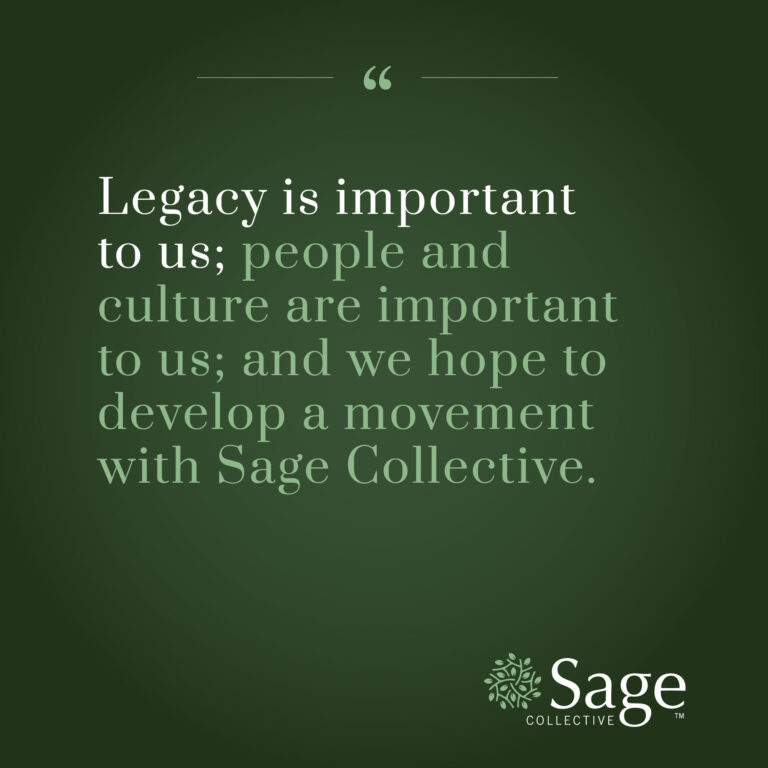
“The intergenerational component is vital to us,” says Gaines, “because just as we continue to carry the torch for Rev. Rawls, we hope to share our gained knowledge and experience with those who follow. Legacy is important to us; people and culture are important to us; and we hope to develop a movement with Sage Collective — a movement that brings like-minded people together as a collective, and a movement that people everywhere can share in and benefit from.”

Quote reads: Legacy is important to us; people and culture are important to us; and we hope to develop a movement with Sage Collective."
› Back to top