« back
12.23.21 | Sage Advice®

Best Winter Day Trips Close to Chicago

While Chicago brings a variety of enjoyable activities to partake in during the winter, sometimes a break from all the bustle and noise of the city is welcome. For our fellow Bronzeville residents who might need a getaway this winter, here are the best day trips you can take to brighten your perspective with a change in scenery:  

Lake Geneva, Wisconsin

Only a 1-½ hour drive away sits the quaint city of Lake Geneva, Wisconsin. The beloved destination has been a top destination for Chicago residents for generations and offers a variety of fun-filled activities and stops for all ages. While the summer months are Geneva’s most popular tourist times, winter brings a much tamer atmosphere. 

For lovers of the outdoors, Geneva’s Lake Shore trail is the perfect opportunity to enjoy spectacular views in the brisk air. Once February arrives, the famous lake becomes filled with extraordinary ice sculptures, bonfires on the beach and more. While it is the coldest season, don’t miss your chance to experience the incredibly warm community.  

Lake Geneva’s impressive ice sculptures

Michigan City, Indiana

An adorable city located just off of Lake Michigan’s shores, Michigan City should be high on everyone’s list to visit this winter. The town is only one hour away from Chicago and is surrounded by one of America’s most stunning national wonders, the Indiana Dunes State and National Parks. While winter isn’t typically the time of year many choose to visit the lakeside landscape, witnessing the sand-swept mounds covered in layers of soft snow is sure to delight all visitors.  

While many enjoy a stroll on one of the many trails found in the park, the town offers guests a variety of other ventures, including shopping at the Lighthouse Place Premium Outlets, dazzling architecture at Barker Mansion and an array of wineries and breweries. 

Take a Joyride up Lake Shore Drive 

Sometimes the best day trip is just hopping in the car and taking a drive to enjoy your surroundings, which is exactly what Lake Shore Drive delivers. Arguably the prettiest extended urban parkway in the nation, the 18-mile expressway runs from Ardmore Street on its north end to 71st Street on its south end, and lucky for Bronzeville residents, the best place to start the journey is from the south.  

The ride is filled with recognizable Chicago landmarks that include the Museum of Science and Industry, Soldier Field, Navy Pier and Lincoln Park alongside spectacular views of Lake Michigan. However, once you reach the end of the trip, don’t be afraid to stop there. Exiting on N Sheffield Road will take you through several alluring suburbs filled with even more attractions and impressive architecture. 

Whether you’re taking a thrilling trip to a neighboring state or simply enjoying a joyride down a historic street, we hope this inspires you to find your new favorite winter getaway from the city! 

The stunning view of Lake Michigan from the Indiana Dunes near Michigan City, Indiana
› Back to top
« back
12.21.21 | Sage Advice®

A Brief History of The Chicago Bee

The promotion of Bronzeville’s rich history is something we continuously advocate for and give voice to at Sage Collective. That’s why today, we’re spreading the word about The Chicago Bee, a local paper that dominated the press for decades while distinguishing itself by its promotion of Black history.

History

The Chicago Bee, often referred to as Chicago Sunday Bee, was founded by Anthony Overton in 1925. Overton was a successful banker and manufacturer, and the first African American to lead a major conglomerate (Overton Hygienic Company, which was a cosmetics business). After its founding, the Bee moved into the now-famous Art Deco building located at 3647-55 S. State St., which is now on the U.S. National Register of Historic Places and recognized as a Chicago Landmark. 

The Bee’s staff included many esteemed members of Chicago’s community of writers and journalists at the time. Chandler Owen, a talented writer, became editor of the Bee after moving to Chicago in the 1920s and worked with other savvy editors including Ida B. Wells and Olive Diggs. During the World War II years, when men were in active military duty, the majority of the writing staff were women, which allowed them unprecedented autonomy and opportunity for advancement. 

The Bee covered a wide range of issues of the day. It was the first newspaper to support the efforts of the Brotherhood of Sleeping Car Porters, the nation’s first all-Black labor union created during conflicts at The Pullman Company. It also supported and covered the Black women’s club movement, and gained distinction from other newspapers in the Chicago press in their publicity of Black history and literature.  

Following Overton’s passing in 1946, the Bee was briefly run by his two sons but ceased operation in 1947. Even though very little of the historic newspaper has survived today, it is still recognized as one of the most influential and acclaimed papers of the 20th century. 

Through Sage Collective’s vision, we are proud to contribute to the legacy of African American culture, community and success that is, and always has been, the heart and soul of Bronzeville.

The Chicago Bee front page from May 4, 1941
The Chicago Bee Building
› Back to top
« back
12.02.21 | Sage Advice®

Exploring Bronzeville: The Little Black Pearl’s New C47 Work and Experiment Lounge

Bronzeville is a community whose residents are known to appreciate and demonstrate their love for their community. Sage Collective has been a part of Bronzeville since 1978, and we certainly aren’t the only organization that shares a deep respect for the historic persons and events that lived and transpired there.  Little Black Pearl, a thriving nonprofit found near Kenwood, is just one of the many other organizations actively engaged in bringing inspired change to the people of Bronzeville and its surrounding areas. 

The Little Black Pearl is popularly known as a ground-breaking educational program that provides youth with a safe environment within which to learn new skills, explore various programming and be surrounded by positive leaders and role models. The organization has been at the forefront of change on Chicago’s South Side for nearly 30 years. 

With this track record now established, Little Black Pearl is using its experience,  knowledge and appreciation for its community, to expand its programming initiatives to an older audience. Little Black Pearl’s founder Monica Haslap led the organization in its launch of  C47 Work and Experiment Lounge in November 2021. 

The lounge, which is found at 1060 East 47th Street, invites adults into a collaborative space to inspire creativity and explore new passions. Built with innovation in mind, this new environment includes fully operational workshops that range from culinary classes, to art projects and office spaces where anyone looking to escape the hardships of the past two years will gladly find tranquility.

Members who join the C47 Work and Experiment Lounge will be exposed to numerous creative visionaries and experts in music, technology, fashion and finance. For adults interested in becoming a member, memberships range from $50-$200 per month, and all offer a variety of different opportunities within the lounge. 

With hopes of serving longtime members of the community as a safe, creative space where unconventional ideas can thrive, C47 Work and Experiment Lounge embodies the values that Little Black Pearl has demonstrated for decades. And, like Sage Collective, the organization will likely continue leading change in the community for decades to come.

C47 Work and Experiment Lounge Interior, Photo Courtesy of Armand Morris
› Back to top
« back
10.14.21 | Healthy Eating

Pass Your Time With Podcasts: What You Should Be Listening to Right Now

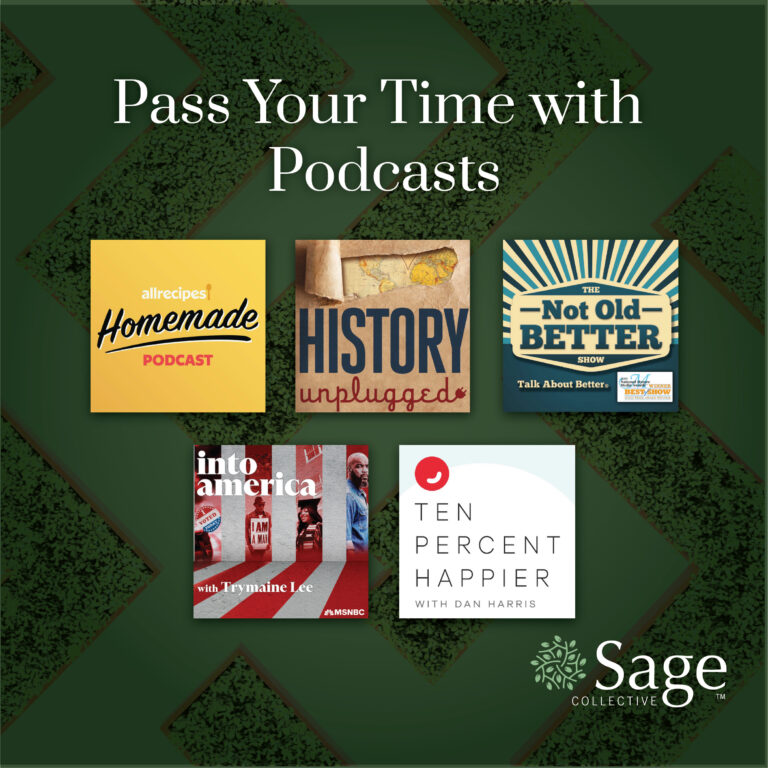
While autumn is a favorite time for many to pick up new books and revisit forgotten ones, podcasts also serve as a great choice for those looking for a mix of entertainment, education and reflection. Podcasts are usually free to listeners and extend knowledge on everything from how to cook healthier meals to entertaining history facts to current government and public policy news. Here are the top five podcasts Sage Collective believes you should be listening to right now: 

Ten Percent Happier

Hosted by Dan Harris, a famed journalist who suffered a panic attack live on national television, Ten Percent Happier explores how keeping your spirits up is imperative to aging well. After his traumatic on-air experience, Harris discovered meditation and now invites experts on the subject, scientists and celebrities to share their own epiphanies and experiences of success. Topics on the show vary from What to do About Eco-Anxiety to Joy Vs. Happiness. Anyone interested in hearing motivational stories about coming back from what seems like life’s lowest points will enjoy this outstanding selection. 

Into America

Into America is a podcast that sheds light on what it’s like to be Black in America. Trymain Lee, Pulitzer Prize and Emmy Winning journalist hosts the enlightening show. The MSNBC-produced podcast explores how public policy and government action, and the lack thereof, affects Black Americans’ lives. Previous topics include The Vaccine Gap, Justice for Black Farmers and The Black Firefighters of 9/11. Into America produces an in-depth look into the continued injustice that Black Americans endure and what it means to hold the country to its obligations.

History Unplugged

A show that celebrates obscure historical facts and events, History Unplugged uncovers and revisits lost stories that changed the world. History buffs and amateurs alike will enjoy the unique narratives, expert interviews and call-ins that make up the podcast. Previous episodes of the show include The Japanese-Americans Who Fought Nazis in Europe, Electric City: Ford and Edison’s Vision of Creating a Steampunk Utopia and An Alternate History of the Lincoln Assassination Plot. Chocked full of amusement, myth-busting and a range of wisdom, almost everyone is guaranteed to relish over History Unplugged.

Not Old – Better

Award-winning journalist Paul Vogelzang hosts the fascinating, high-energy podcast, Not Old – Better. The inspiring show reminds its audience weekly that it is never too late to pursue your passion and purpose in life. Vogelzang invites a mix of well-known entertainers, intriguing role models and ordinary people to discuss aging and how to overcome the stereotypes and stigma that come with it. Previous guests have included actress Octavia Spencer, Dr. Anthony Fauci and activist Khary Lazarre-White. Listeners and critics alike have praised the podcast as a perfect choice for middle-aged and older adults.

Homemade

Homemade is the paramount podcast for anyone looking to explore the food world. Foodies and amateur cooks alike will enjoy the entertainment show hosted by industry insider Sabrina Medora and author Martie Duncan. Each week the hosts invite celebrated cooks from all walks of life to discuss and share their memories behind their favorite recipes. Past topics on the show include growing ingredients at home, delicious vegan options, repurposing leftovers and rethinking prep time. Get your cooking gear ready, put on your apron and prepare to join the fun with Homemade

Whether you need something to listen to on your way to work or while doing chores around the house, don’t hesitate to press PLAY on any of these wonderful podcasts. You can listen to each of the podcasts on their websites, Spotify, Apple Music, Amazon Music or Google Podcasts. 

› Back to top
« back
10.05.21 | Sage Advice®

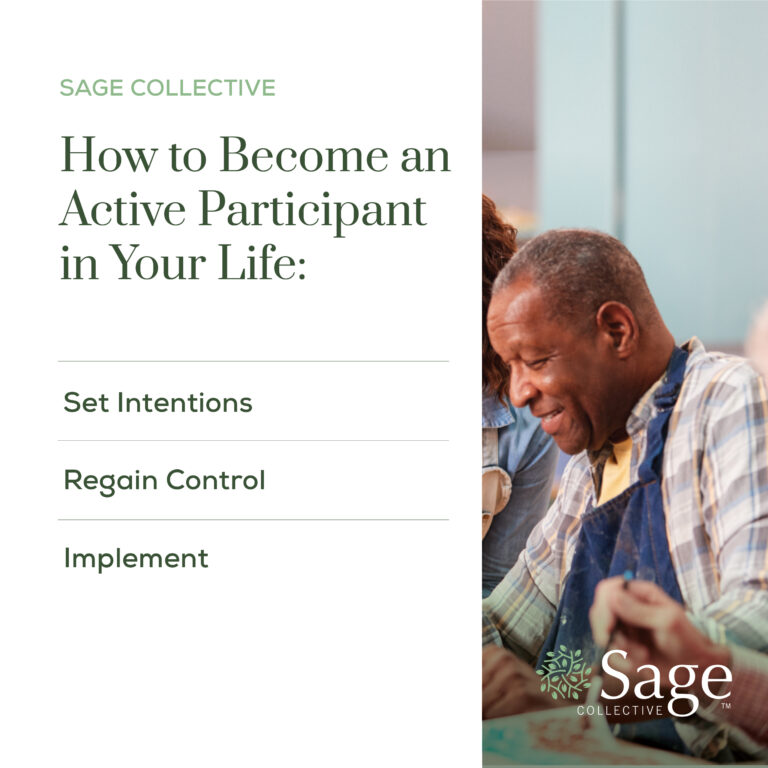
How to Become an Active Participant in Your Life

For many older adults, feeling like they’re losing control of their lives is all too common. While this can be a normal reaction to aging, it can also leave people feeling overwhelmed when confronted with the stigma of getting older. Actively participating in your life is a powerful way to combat these feelings and stigmas, leading to a more vibrant life. So, how can you learn to become an active participant in your life? Let’s take a look. 

Set Intentions

First, set goals to transition from a passive participant to an active participant in life. It can be challenging to reflect on what aspects of life might be obstructing your progress, but it’s imperative for regaining control. Your intentions and goals act as a foundation for the rest of the process for becoming active participants. So, honesty with yourself is essential.

To keep yourself motivated and engaged, write down each of your intentions and keep them in a place you will regularly see. Remember, each person’s intentions are unique to their own personal experience and goals. 

Regain Control

Adjusting your thought process to become less passive can be challenging, but the more you do it, the easier it becomes. By believing in yourself and your words, you regain control and take power away from negative thoughts.

Again, writing down your thoughts is an effective resource for change. Make a list of words that come to mind that diminish your power, confidence or ability. Once you have a few written down, modify the language to become active and uplifting. The next time you feel control shrinking, revisit the list and remind yourself that you have the power to enact change in any way.

Implement

It’s easier to enact change once you set intentions and understand that you can control involuntary thoughts. If wanting to go back to school is on your list, enroll in your first class. If eating more nutritious meals is your goal, start researching recipes with healthier foods. At first, taking steps to live actively may feel uncomfortable and daunting, but remember that years of passive living are being dismantled. 

While being an active participant in life is the ultimate goal, it’s important to be kind to yourself on the journey. Even if your path changes, the experiences and tools you learned along the way are something of which you can  be proud.

At Sage Collective, we believe actively participating in your life is an aspect of vibrant living that helps find purpose, shepherd confidence, and inspires goals for older adults. It’s never too late to become active participants in our lives.

› Back to top
« back
08.10.21 | Community

Embracing the cultural process of aging

As we articulate in the Sage Vibrant Living Manifesto, cultural perceptions of aging have an enormous impact on individuals and their communities. As we continue to fight ageism and the traditional American notions of aging that many of us still experience today, we look to the wisdom of others to share new ways of thinking and doing.

Carl Honoré, writer and activist, argues that in order to age better we must feel better about the process. Learning how to age better in a world where aging is presented in a negative frame can be extremely hard, but it only takes a few minutes to change your perspective. In his TED Talk, Honoré explains how to embrace the aging process. Honoré also delves into his method for combating ageist traditions and practices within our lives. Watch below to learn more:

A quote sits on top of an image of two older adults laughing. The quote reads "We need to feel better about aging in order to age better," and is attributed to Carl Honore. The sage logo sits in the bottom right corner.
› Back to top
« back
08.05.21 | Sage Advice®

Understanding Mutual Aid: How It Can Support Community Success

At Sage Collective, we strive to foster feelings of value, engagement and community. One of the most impactful ways these shared values can be attained is through the action of practicing mutual aid in our everyday lives. 

The concept of mutual aid is something not talked about enough, specifically in shared environments. Looking back on the events of the past 18 months, the practice of mutual aid is more important than ever to the continued success and survival of communities like ours all around the world. 

What is it?

Mutual aid (often referred to as care webs)  is a form of public and political participation for neighborhoods, organizations and groups of all sizes. They provide an avenue for looking after and tending to each other’s health and well-being to create more livable, sustainable environments.

The process and goal of mutual aid is to create accessible and collective care by accepting and sharing mutual responsibility within one’s community space. 

Why is it important?

One of the most important reasons why enacting mutual aid in these spaces is such a key to survival is because it helps foster community engagement and social relationships through responsible, collective action. The more people who perform mutual aid in a shared community or group, the greater its tangible benefits spread.

The concept of mutual aid also parallels other values that we hold at Sage Collective, since it lessens the strain on individuals by strengthening the collective will and ability to ensure the success of all. Think about the expression “a rising tide lifts all boats.” That’s mutual aid in a nutshell.

How to practice it?

There are many ways to practice mutual aid in everyday life. Some may practice it in routine activities and others may spend time waiting for an event or specific cause they feel comfortable supporting. The most important thing to remember about mutual aid is that you shouldn’t feel pressured to offer more than you are capable of providing for yourself or your community.

Here are some examples of how to apply mutual aid in your own life:

Offering a space to share information, organizations and resources such as access to healthcare and food services, as well as transportation accessibility. 

Taking political action locally by volunteering for campaigns and vocally supporting policies that may help those in your community, or actively supporting movements, protests and funds that help benefit those in your care web.

Practicing mindfulness and sharing resources for anything from mediation guides to suggestions for dealing with anxiety, grief or anger.

Providing communication skills such as being open to offering translation services, if you are multilingual, to those in need. You can also help others with different technology devices and platforms you might better understand, or training and learning techniques in bystander intervention and/or steps for nonviolent communication. 

These are all ways in which we can help to foster a sense of connectedness and community among your neighbors and friends in support of uplifting the collective.  Everyone has something that they can share with those who could use a little help in the community.  Sage encourages you to engage your friends and family to initiate activities that provide others a chance to share their skills and experience with those in need.  This isn’t a new concept, it’s simply one that could use a little refreshing.

A group of people holding each other.
› Back to top
« back
08.03.21 | Community

The Science of Laughter

Laughing is something we do numerous times a day without a second thought. Whether we are with friends, watching a funny movie or simply reacting to something that catches us off guard. There is much more behind the infectious response than the loud, quirky and eccentric sounds that come with it. The power of incorporating laughter into your day-to-day routine has huge implications for the quality of your life in the broadest sense. Let’s look further.

Recognizing the impact of laughter’s effects on things such as stress, happiness and health, we at Sage Collective appreciate its importance, especially in relation to our 9 Ways of Vibrant Living

Why do we laugh?

Throughout history, laughter has been seen as a social signal. There are many factors that can affect what we find humorous including age, gender, culture or community. Laughter presents itself in most human interactions as the presence of connectivity, comfortability and the strengthening of a shared or mutual relationship. Furthermore, research shows that the more laughter that is present in those relationships, the stronger those connections or bonds become.

The prevailing theory is that there are three types of scenarios that make us laugh: incongruity, superiority and relief. Incongruity theory is rooted in the idea of expecting one outcome, and receiving a totally different one — resulting in laughter. Superiority theory explains that we might find someone else’s weaknesses or mistakes humorous, making us feel superior to them in the moment. Last, relief theory is the use of comedy in tough or uncomfortable situations in order to relieve stress or tension. If you reflect back on what made you laugh today, do you see the reasons falling into one of these categories?

The health benefits of laughing

There are tangible health and wellness benefits for individuals and communities when we all spend more time laughing. From a purely biological perspective, when we laugh, our bodies reduce the levels of stress hormones, in turn lowering our physical stress and anxiety. At the same time, the action also releases serotonin, which leaves us feeling euphoric. As stress hormones diminish, we lower blood pressure and increase blood flow — which directly leads to the oxygenation of our blood to provide us with more energy. 

Incorporating more laughter in your life

Wondering how to add laughter to your life? Start by considering the concept of humor and its relationship to laughter.

Merriam-Webster defines humor as “the mental faculty of discovering, expressing, or appreciating the ludicrous or absurdly incongruous: the ability to be funny or to be amused by things that are funny.” However, because humor is so subjective, it’s nearly impossible to give it a clear-cut definition. Let’s just say that laughter is the direct reaction or acknowledgment that someone has found something humorous.

For some, laughter may come easy. For others, it might be more difficult to find humor in life. Either way, here are some tips for learning to laugh more. 

One of the easiest ways to find laughter is to surround yourself with people who you find funny and entertaining, but with whom you already have a comfortable and strong relationship. Discovering things that make you laugh throughout your daily life and experiencing them more is also a great way to easily find humor. This might be found in the radio station you listen to on your daily drive, or a television show you play in the background while you do chores at home. And if laughter doesn’t come easily for you, consider laughter therapy — it’s a new form of searching for a chuckle by training yourself to look for humor in uncomfortable and difficult situations, rooted in laughter’s relief theory. There are lots of resources available online, and even apps you can download to your phone!

So even if you aren’t the traditional joking type of person or you find it hard to see the comedy in hard situations, dig deep and look for the laughter in your life. You won’t regret it.

A group of people stand around each other looking at a phone and laughing
› Back to top
« back
07.13.21 | Community

How to become a “joyspotting” expert

Similar to taking an awe walk, joyspotting is the intentional act of going out into the world to look for things that spark joy in you. While the word may sound unusual, it’s actually amassed quite a cult following – with entire online groups dedicated to sharing in joyspotting (and their subsequent findings) together. Even if you’re not ready to join an online group just yet, find out how to become a joyspotting expert using our tips below.

The Origins of Joyspotting

Joyspotting is a term first coined by Ingrid Fetell Lee. As a designer, Lee began to notice the relationship between one’s surroundings and their mental health. For example: living in a home filled with bright prints and patterns provides an immediate mood booster. Lee knew this was a counterintuitive principle. So often, society tells us not to derive joy from the things that surround us, but from what’s within us.

In contradiction to this view, Lee sheds light on the relationship between our environment and our emotions, and shares inspiration and resources for living a more joyful life through design in her book, The Aesthetics of Joy. She has also created a website dedicated to this viewpoint, that shares the same name. There is also an online Facebook group that we referenced above, The Joyspotters’ Society.

As Lee became more and more tuned into what caused her joy from her surroundings, she began to develop the habit of intentionally seeking out – or looking to consciously observe – these causes of joy. And hence, joyspotting was born. As she says, “The world seemed to be teeming with tiny, joyful surprises. All I had to do was look for them… It was like I had a pair of rose-colored glasses, and now that I knew what to look for, I was seeing it everywhere. It was like these little moments of joy were hidden in plain sight.” Instead of seeing the world around us as beset with distractors, joyspotting is a way of creating a reservoir of positivity.

Twelve Ways of Joyspotting

To become an avid joyspotter is simple. Look around you and determine something that causes you joy. It could be a pair of colorful, patterned socks worn by the man next to you on the train, or the unexpected sidewalk chalk drawings on a walk around the block. But just in case you need a little bit of help getting started, Lee put together The Joyspotter’s Guide, which outlines her twelve tips for joyspotting. Below, we offer a brief description of those tips.

Look up. Joy often comes from things that float or fly in the sky, whether that’s shapes you find in the clouds, or a stray red balloon. Look down. Maybe you discover a rainbow in a puddle, or a vibrant pair of shoes on a passing pair of feet. Keep an eye out for color. What flashes of blue catch your eye? How does an abundance of green transform the environment? Follow the curve. Life is full of hardness, so where do things get soft around the edges?

Go where the wild things are. There’s always joy to be found in nature, whether it’s enjoying the smell of a rosebush, or listening to birdsong. Seek out symmetry. Where there are mirror patterns, there’s often a surprising sensation of randomness or harmony. Search for signs of abundance. Where do things feel lush and full? It could be a fruit bowl on a family member’s kitchen counter, or a few too many Christmas lights at the neighbor’s house. Joy has a way of spilling over. Watch for weirdness. Where are things out of place, or just out of the ordinary? It’s those standout details that often feel most special.

Zoom in. Focus your attention on the tiniest of details. Notice the invisible. What joy surrounds you that can be felt or heard, but not seen? These sightless observations hold a magic of their own. Similarly, use all your senses! And finally, take the scenic route. The paths you wouldn’t normally take often hold the most surprises, and within those, there’s much joy to discover.


Photo of man looking through a spotting scope
› Back to top
« back
01.05.21 | Community

Sticking To Your New Year’s Resolutions

Just when you think the hard part is done — deciding on New Year’s resolutions — the clock strikes midnight and it’s time to follow through. You’re not alone, though. We all struggle to stick with our New Year’s resolutions. And luckily, with determination and the right strategy, you can keep your resolutions alive far past January’s gym membership. Here’s just a few helpful tips:

Make Incremental Goals

We often struggle to keep resolutions because they’re simply too daunting. A big-picture goal like “eat healthier” is much easier to tackle when broken down into small, digestible actions. Try making incremental goals, such as “include veggies in one meal per day.” This way, you have a tangible action to work towards, and once the action is completed, a victory to celebrate, too. 

Utilize Your Support System

Whether it’s an accountability buddy or just a loved one lending an ear, sharing your successes and struggles is an important part of the journey. Having a support system means others are there to share motivation and advice along the way, as well as helping to hold you accountable. 

Practice Patience + Forgiveness

Of course nobody is perfect. There will be days where your resolution falls to the wayside, and that’s okay, too. It’s important to practice patience and forgiveness, and not to beat yourself up for an off day (or two). Ups and downs are just a part of the journey. Studies even confirm: those who succeed in sticking with their resolutions actually slip up an average of 14 times.

Take Time to Reflect

Throughout the year, remember to take a step back and reflect. What made you choose this resolution in the first place? What does achieving this goal mean to you? Moments of meditation and mindfulness such as these help us realign with our own wants and desires.  

Keeping resolutions, like making any change occur, isn’t an overnight affair. But with the right approach, you’ll be able to stick to your goals all through 2021.

A pink planner with 2021 emblazoned on its cover in gold, next to an assortment of pens, notebooks and other desk supplies
› Back to top