« back
06.17.26 | Uncategorized

Juneteenth 2026: Bringing Balance to America’s Celebration of Freedom

Each year on June 19, Juneteenth invites us to pause, remember, and reflect on one of the most significant moments in American history. It marks the day in 1865 when Union troops arrived in Galveston, Texas, and announced that enslaved African Americans in Texas were free — more than two years after the Emancipation Proclamation had been issued.

The 2026 national theme, “Juneteenth Brings Balance to America’s Celebration of Freedom,” offers a powerful way to understand the meaning of this day. Juneteenth does not diminish America’s broader celebration of liberty. It deepens it. It reminds us that the story of American freedom cannot be fully told without acknowledging those who were denied it, those who fought for it, and those who continued to expand its meaning across generations.

For many, Juneteenth is a celebration of freedom. It is a day of family gatherings, music, food, prayer, storytelling, education, and community pride. But it is also a day that asks us to sit with the complexity of history. Freedom was declared before it was fully delivered. The law changed before lived reality did. And for generations of African Americans, the work of freedom has meant not only liberation from slavery, but the continued pursuit of dignity, justice, opportunity, and full participation in American life.

At Sage Collective®, Juneteenth holds deep meaning. As an organization committed to supporting vibrant living among older African Americans, we recognize the power of memory, history, and intergenerational wisdom. Juneteenth reminds us that the stories we inherit shape the lives we build. It also reminds us that freedom is not only a historical event. It is an ongoing practice — one carried forward through care, resilience, community, and the determination to create better futures.

A Fuller Story of Freedom
The story of Juneteenth begins with delayed freedom, but it does not end there.

When General Gordon Granger arrived in Galveston on June 19, 1865, the announcement brought long-withheld news to enslaved people in Texas. The Civil War had ended. The institution of slavery was collapsing. A new chapter was beginning.

Yet that moment did not erase the harms of slavery, nor did it guarantee equality. The decades that followed brought Reconstruction, resistance, racial terror, segregation, disenfranchisement, and systemic barriers that shaped the lives of Black families across generations. Still, through every era, African Americans built communities, preserved culture, pursued education, created art, organized for justice, cared for one another, and passed down stories of strength.

This is where the idea of balance becomes essential. For too long, America’s freedom story has often been told from a limited perspective — one that celebrates independence while leaving out the experiences of those who were not yet free. Juneteenth helps restore balance by expanding the story. It asks us to hold celebration and truth together. It reminds us that freedom is not complete when only some people can claim it.

For older adults, especially those who have lived through profound social change, Juneteenth can carry personal as well as historical meaning. It may call to mind family stories, migration stories, church traditions, civil rights struggles, neighborhood memories, and the quiet acts of perseverance that rarely make their way into history books but have shaped generations.

Celebration as Remembrance
One of the most powerful aspects of Juneteenth is the way it holds joy and remembrance together.

The holiday has long been marked by community gatherings, parades, picnics, music, prayer, readings, and shared meals. These traditions are not incidental. They are part of the meaning of the day. To gather is to affirm belonging. To tell stories is to resist forgetting. To celebrate is to honor the lives, labor, faith, creativity, and courage of those who came before.

Food, music, and fellowship have always been ways communities carry memory. They connect past and present. They create space for elders to share what they know and for younger generations to ask, listen, and learn. In this way, Juneteenth becomes not only a day on the calendar, but a living bridge between generations.

At Sage Collective®, we see this as central to vibrant living. A vibrant life is not disconnected from history. It is enriched by it. When we know where we come from, we gain a deeper understanding of who we are, what we have survived, and what we are still called to build.

Freedom and Vibrant Living
Juneteenth also invites us to think more expansively about freedom.

Freedom is the ability to live with dignity. It is access to health, education, safety, housing, creativity, rest, and opportunity. It is the freedom to age with respect. It is the freedom to belong. It is the freedom to contribute, to be heard, to remain visible, and to continue growing at every stage of life.

For older African Americans, vibrant living is deeply connected to this broader vision of freedom. It includes physical health and emotional well-being, but also cultural pride, purpose, connection, lifelong learning, and the ability to pass wisdom forward. It includes the right to joy. The right to beauty. The right to community. The right to be honored not only for what one has endured, but for the fullness of one’s life.

This is another way Juneteenth brings balance. It widens the meaning of freedom beyond a single historical moment and invites us to consider the everyday conditions that allow people to thrive. Freedom must be lived in real lives, in real communities, across real generations. It asks us to support not only survival, but flourishing.

Carrying the Story Forward
As Juneteenth 2026 approaches, we are invited to honor the day in many ways: by learning its history, attending a local celebration, supporting Black cultural institutions, listening to elders, reading works by African American writers, sharing family stories, or simply taking time to reflect on what freedom means today.

But perhaps the most important invitation is to carry the story forward.

Juneteenth teaches us that freedom delayed is still worth claiming. That memory matters. That community sustains. That joy can be an act of resilience. And that the American story becomes stronger, not weaker, when it is told more truthfully.

At Sage Collective®, we honor Juneteenth as a day of remembrance, celebration, and renewed commitment. We honor the ancestors who waited for freedom, the generations who fought to expand it, and the elders whose lives continue to carry its lessons.

May this Juneteenth be a time to gather, reflect, celebrate, and recommit to the conditions that allow every person to live fully, freely, and vibrantly.
 

› Back to top
« back
06.18.25 | Spirituality & Religion

Juneteenth 2025: Freedom to Flourish

At Sage Collective®, we believe that Juneteenth is not only a historical milestone—it is a living practice. As we prepare to honor Juneteenth 2025 on Thursday, June 19, we’re holding space for remembrance, reflection, and renewal. This year, we invite our community to consider five powerful themes that speak to the enduring legacy of this day and the vibrant futures we continue to shape.

Freedom Is a Practice, Not Just a Past
On June 19, 1865—more than two years after the Emancipation Proclamation—news of freedom finally reached the enslaved people of Galveston, Texas. But freedom did not arrive all at once, and it still hasn’t fully arrived for many. That’s why we say: freedom is not a moment; it’s a movement. It’s a practice. It lives in the choices we make every day—how we care for ourselves, how we show up in community, and how we demand dignity at every age. For older adults, practicing freedom can mean living life on your terms, unlearning limiting beliefs, or embracing joy and self-expression in bold new ways.

Inheritance of Hope: What We Carry, What We Pass Down
Juneteenth reminds us that we are the living legacy of those who dreamed before us. The stories, values, and hard-earned wisdom of older generations carry the weight of history—and the promise of healing. At Sage Collective®, we see our elders not just as keepers of memory, but as visionaries shaping the future. Whether it’s sharing family history, mentoring a young neighbor, or leading with quiet strength, every act of intergenerational connection is an act of liberation.

Joy as Liberation
Freedom doesn’t only live in laws or headlines—it lives in laughter, music, movement, and love. This Juneteenth, we celebrate Black joy as a form of resistance and resilience. For those of us who have seen decades of change, choosing joy—especially in a world that often asks us to shrink—is revolutionary. Throw on that bright outfit. Dance in your kitchen. Sing with your grandkids. Joy is not frivolous; it’s a declaration: I am here. I am whole. I deserve delight.

The Future We Deserve: Aging Boldly, Living Freely
While Juneteenth honors the past, it also challenges us to imagine a future where every person—especially older African Americans—can age with safety, creativity, and care. At Sage Collective®, that future includes access to emerging wellness tools, like virtual reality to support cognitive health. It means equitable healthcare, culturally relevant housing, and opportunities for lifelong learning. Liberation is not just about breaking chains—it’s about building a world where we are free to thrive at every stage of life.

We Are the Storytellers
Who better to preserve the spirit of Juneteenth than those who’ve lived through its echoes? Our elders are our griots—our living archives. When you share your story, you don’t just remember—you teach, you inspire, you light the path forward. Whether it’s through a Zoom call with family, a community oral history project, or a quiet conversation on the porch, we encourage you to speak your truth and honor your voice.

This Juneteenth, Let’s Celebrate the Ongoing Journey
We are not just looking back—we’re moving forward. With each story, song, protest, and prayer, we continue the work of making freedom real. At Sage Collective®, we believe that it’s never too late to live boldly, love deeply, and lead with wisdom. Juneteenth is a reminder that freedom is a flame passed from one generation to the next. May we continue to carry it forward—together.

› Back to top
« back
06.22.23 | News

Juneteenth: Honoring the Past, Embracing the Present, Envisioning a Vibrant Future

In the spirit of learning and understanding that fuels the Sage Collective, we’re delving into a significant moment in our shared American history, a moment that anchors us to our past as it guides us towards a more inclusive future – Juneteenth.

The essence of Juneteenth is one of freedom and liberation, dating back to 1863 when the Emancipation Proclamation declared enslaved African Americans free. The truth of this newfound freedom, however, took two years to permeate every state, with Texas being the last to hear the news. Hence, Juneteenth was born, officially recognized by President Joe Biden on June 17, 2021.

The celebration of Juneteenth, while filled with joy and reverence for the resilience of freedmen and freedwomen, was not devoid of strife. However, the spirit of determination and unity endured. By pooling resources, formerly enslaved people bought land in 1950, creating Emancipation Park in Houston, Texas, a testament to their collective resilience and a place for future Juneteenth celebrations.

The Juneteenth flag, designed by Ms. L.J. Graff, embodies this shared history and vision. Its colors echo the American flag, asserting the rightful place of freed people and their descendants as American citizens. The central star pays homage to Texas, while the bursting new star symbolizes a new dawn and new freedom.

As we honor Juneteenth, we also acknowledge the complex emotions that accompany this day of celebration. The weight of history can bring feelings of anxiety and stress, emotions we at Sage Collective encourage our members to acknowledge and discuss. We are committed to creating a safe space for these dialogues, believing that understanding our past is a crucial step toward shaping a vibrant and inclusive future.

Juneteenth, much like our mission at Sage Collective, is about embracing freedom and fostering vibrant living for all. It reminds us that freedom is also about the liberation of the mind and spirit. It’s about the courage to acknowledge the pain of our past, the determination to celebrate the progress of our present, and the vision to foster a future of justice, inclusivity, and vibrant living for everyone.

Join us as we commemorate Juneteenth this month and every month, and let its history and values inspire us as we continue to work towards a future where everyone can live vibrantly.

› Back to top
« back
06.17.21 | Community

Juneteenth Officially Declared a National Holiday

After the protests in June 2020 that followed the murder of George Floyd, a national reckoning with racial justice has dominated conversations in governments, workplaces, schools, neighborhoods and homes alike. As part of that reckoning, America as a whole is asking itself: how do we better support, celebrate and uplift African Americans and African American culture? One way: making Juneteenth a recognized holiday.

Juneteenth – also known as Freedom Day, Jubilee Day, Liberation Day, and Emancipation Day – is a holiday celebrating the emancipation of those who had been enslaved in the United States. It’s an occasion that’s been long celebrated in African American communities, but now attention is being brought to the holiday at the national, state and local level.

In 2020, Cook County officially recognized Juneteenth as a paid holiday for its government employees. Cook County is the largest county in Illinois, and became the largest county in the country to make such a declaration. After this milestone event, the state of Illinois wanted to be the next to follow. 

Legislation was unanimously approved by the Illinois House and the state Senate to make June 19th a paid holiday off for all state employees, as well as a school holiday. The legislation states that if June 19th falls on a Saturday or Sunday, the holiday will be observed on the following Monday. After J.B. Pritzker officially signed off on the bill on June 16th, it became official. Juneteenth is an official state holiday in Illinois, beginning on January 1, 2022. Unfortunately, Juneteenth falls on a Sunday in 2022, and the holiday will have its first chance to be formally recognized in 2023 as a paid day off for state employees as well as a holiday off from school. 

The Illinois bill was first sponsored by Representative La Shawn Ford. He’s also sponsored similar legislation in the past, but told the Chicago Tribune, there “wasn’t an appetite” for passing the legislation previously. He then told the Tribune that all changed after the murder of George Floyd by a white police officer in Minnesota, saying, “Now, post-George Floyd, this is the time,” Ford said. “Some would say this is an African American holiday, but it’s an American holiday.”

Illinois isn’t the only one taking action. On Tuesday night (June 15th), The Senate unanimously passed a resolution on Tuesday establishing June 19 as Juneteenth National Independence Day, a US holiday commemorating the end of slavery in the United States.

The recognition of Juneteenth was a long time coming and hopefully marks a turning point in how the United States – on local, state, and national levels – begins to reckon with its history and present, and create a better future for all.

From Sage Collective to you and yours, Happy Juneteenth!

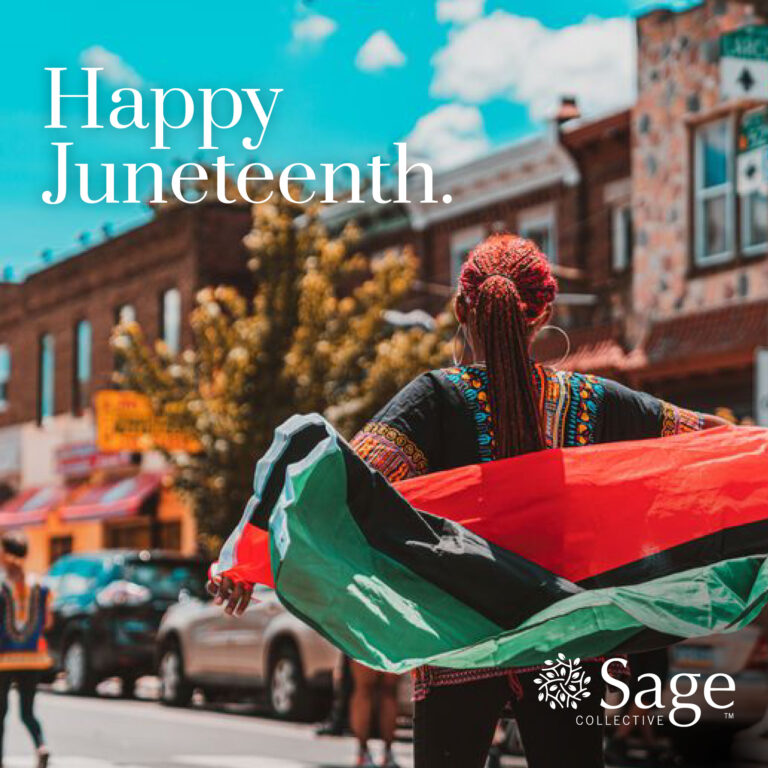
A photo of an African American woman in a dashiki with the African flag draped over her shoulders. She's walking down the street triumphantly. Text over the image reads Happy Juneteenth, with the Sage Collective logo
› Back to top