« back
10.19.21 | Arts & Culture

How Museums Might Reduce Your COVID-19 Stress

One of the largest challenges in modern-day life is finding a treatment for the frequent burnout that most of us feel daily. At Sage Collective, one of our most cherished beliefs is that wellness, health and empowerment should be made priorities in every community. That’s why today, we’re exploring how museums might be the perfect answer to your post-pandemic stress and burnout. 

Many individuals, especially older adults, have faced higher stress levels over the past year and a half than ever before. Feelings of uncertainty and unpredictability due to COVID-19 have also led to many feeling alone, anxious and burnt out, with little reprieve. However, there is growing research that offers tangible steps toward alleviating these negative feelings. 

Often in the present day, many feel like time is limited, and burnout is constant. However, solace can be found in the relaxing and revitalizing spaces of a museum. For many, the knowledge that curated spaces of art and history can provide a wealth of benefits for mental and physical health is new.

Recently, doctors in Belgium received permission to prescribe museum visits to combat the mental health crisis in their country, and similar actions have been implemented in Canada. Patients who get the prescriptions can go anywhere from an intimate art gallery to a fashion exhibition at a history museum. 

The goal behind the three-month-long trial is to promote an engaging learning experience and shift people away from the stress of their daily routines in hopes of having a positive impact on mental and physical health. The museums and exhibitions act as safe and welcoming places for patients to unwind from their day-to-day responsibilities and explore new ideas and areas of interest. Not only does the time off allow patients to catch their breath and spend time with loved ones, but it also acts as a moment of respite from the harsh realities of the pandemic. 

Instead of relying on drug therapies, this mode of enrichment has the possibility to be expanded to other areas of mental health beyond pandemic-related stress and anxiety to alleviating symptoms of depression, psychiatric disorders, anxiety and more. 

Numerous museums, galleries and art centers around Bronzeville present the perfect opportunity for anyone looking to combat stress and relax — in person or virtually. The South Side Community Arts Center, Gallery Guichard, Smart Museum of Art, DuSable Museum of African American History, and Chicago’s Museum of Science and Industry are all wonderful choices to spend an afternoon enhancing your wellbeing and expanding your mind. 
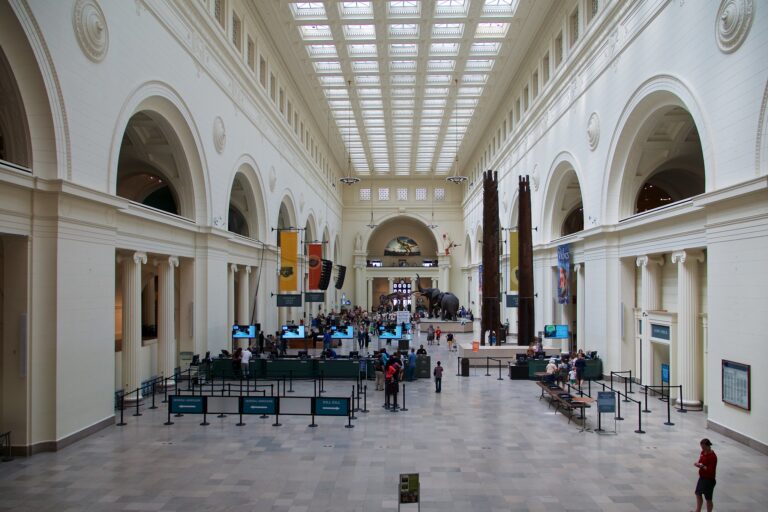
Furniture and a crowd of people fill a bright museum interior.
› Back to top
« back
10.07.21 | Community

October is Eat Better, Eat Together Month

October is National Eat Better, Eat Together Month, an annual tradition that celebrates a basic human need that many of us don’t think twice about — eating. While the history behind this special day is elusive, its aim is noble, and encourages us throughout the month to share meals with family and friends, and to promote healthier eating habits. 

When was the last time you ate a meal with your family? Today, it isn’t uncommon for families to take meals separately due to busy schedules and increasing commitments. However, making the time to share a meal with family and friends is something we should all make more of an effort to do. Breaking bread with others has long been associated with improved social skills and allows you to reconnect with the people you care about. Since engaging in social life and family life are part of our 9 Ways of Vibrant Living, we encourage you to make it a priority to carve time out of your month to plan a thoughtful meal (or two) with family, friends or for your community.

Dining together is also linked to better eating habits and reduced stress levels. Preparing meals with a number of food options encourages people to fill their plates with a mixture of nutritious eats. Previously, we explored a number of “superfoods” that can easily be incorporated into any meal, which you can read about here. For those concerned about time constraints, planning preparation for multiple meals is a perfect way to produce sizable servings of healthy meals without the added pressure of making them last minute. To discover more healthy eating tips to implement this month and throughout the future, explore one of our former blogs here

This month, Sage Collective encourages you to dedicate a few nights a week to eating better and eating together. Make a meal with your family, organize a community dinner or simply clean your cupboards of unhealthy snacks and replace them with smarter alternatives.

A family sits around a dinner table serving food to one another.
› Back to top
« back
09.30.21 | Community

The Importance of Checking In

It’s easy to assume that someone may be happy just from the smile on their face. However, behind closed doors, many people are dealing with heightened feelings of isolation, anxiety and depression. At Sage Collective, we believe that connection, engagement and shared relationships are vital to our health and well-being, as well as that of many other folks in our community. Checking in on friends, family and neighbors can be an effective way of looking out for one another and fostering those connections.  

Checking in on someone you haven’t seen in a while, who works remotely or who recently lost a loved one is a powerful gift. The simplest way of checking in is just asking how someone is doing. Reaching out can be done in person, through text, email or phone, and these small efforts can go a long way to show support and invite them to share more with you.

Words are meaningful, but in many circumstances, actions can be even more powerful. Delivering meals is a thoughtful way of checking in during difficult times or extending a hand to those who may have trouble accessing healthy foods. Whether it’s some of your own leftovers or cookies you’ve baked, your thoughtfulness will bring joy and comfort. Offering a form of mutual aid, a topic we talk more about here, is another inspirational way to foster engagement and check in on neighbors, since we know that extending aid to others by sharing knowledge and skills is a great way to develop ‘care webs’ — an element of mutual aid — in the community.

It’s essential that while checking in on those around you, you do not forget about yourself. It can be dangerous to ignore your physical and mental health while helping others. Valuable practices to utilize for checking in on yourself include asking yourself how you are feeling, meditating and taking advantage of other mindful habits that benefit your health and happiness.

Cropped shot of a cheerful elderly woman hugging her husband who's in a wheelchair at home during the day
› Back to top
« back
09.23.21 | News

Bronzeville’s Renaissance

Bronzeville’s dynamic history is ever-shifting as time progresses. Originating in the early 20th century, the neighborhood became an epicenter for Black culture, a topic you can read more about here. Today, Bronzeville is experiencing a renaissance, and Sage Collective is proud to be a part of it. The community is growing in numbers that haven’t been seen for decades and it’s welcoming businesses that add a breath of fresh air to the neighborhood’s enduring culture.

Data provided by the 2020 Census show that while the larger city of Chicago continues to grow at slow rates, neighborhoods in and around Bronzeville are embracing populations at much faster rates. Between 2010 and 2020, Bronzeville and its surrounding communities increased their populations by nearly 15%. And while Black populations in Chicago decreased by nearly 10% over the decade, there is a resurgence of Black middle class communities contributing to the population boom in neighborhoods like Bronzeville. 

It’s not hard to understand why both individuals and families are choosing to make Bronzeville their next home. The epicenter of culture and arts not only continues to celebrate its historic roots through revitalization projects like the transformation of the old Marshall Fields Building, but it also welcomes new businesses, developments and organizations with open arms. Sage Collective, as an organization with deep roots in Bronzeville, is excited about this trend, even as upscale, luxury housing moves steadily into the neighborhood, our goal remains the same — providing vibrant, high-quality living through affordable housing for older adults.

Unprecedented developments like Hatch 41, a new coworking space, and future projects like Bronzeville Lakefront act as catalysts for the neighborhood’s expansion. And with each new development, the intersecting goals of exploration, enrichment and celebration are present. 

As we shepherd new families, entrepreneurs, artists and changemakers back to Bronzeville, our values remain clear; we are a neighborhood where relationships are nurtured, community thrives and culture prevails. The renaissance of Bronzeville is upon us, and Sage Collective is proud to be a leader in it, inspiring neighbors and residents alike to participate in our movement.

A sign reads, "Welcome to Bronzeville"
› Back to top
« back
09.16.21 | Sage Advice®

Why It’s Never Too Late to Go Back to School

As part of Sage Collective’s 9 Ways of Vibrant Living, we encourage everyone to take advantage of their unique talents and interests to help others in meaningful ways. However, for some, finding a purpose and exploring interests can be overwhelming or somehow inaccessible. Going back to school is one effective way for older adults to discover purpose, increase knowledge and realize a dream.

Today, the typical college student is starting to look less like a 20-year-old running late to class after a night out and more like a middle-aged adult seriously interested in furthering their education. In fact, according to the Lumina Foundation, almost half of the undergraduates from for-profit institutions and one in five undergraduates from four-year universities are over the age of 30. 

Flexibility is one of the key reasons why older adults are choosing now to return to school. Encouraged by COVID-19, many universities have adopted and significantly improved their online learning programs. Often, online programs encourage their students to take classes and earn their degrees at their own pace.

Furthering their education isn’t always the main reason older adults choose to go back to school. Changing career directions, cultivating purpose and interests, and even retaining a sharp brain are all motives for older adults to go back to school. Research has shown that continued intellectual engagement for seniors, like going back to school, can help protect them from certain cognitive disabilities like dementia. 

Going back to school for older adults is also more affordable than ever. Many states are now offering free or low-cost opportunities for older adults to access academic classes. AARP has assembled a list of financial assistance offered by each state that you can learn more about here

Universities across the country are welcoming older populations with open arms now more than ever enabling these ‘new’ students to experience the rewarding and self-validating experience of revisiting education. Whether you’re looking to further a career, explore your purpose, or want to learn something new, it is never too late to go back to school.

A group of older adults celebrate with high fives around a table.
› Back to top
« back
09.07.21 | Sage Advice®

The Cognitive Benefits of Scrapbooking

What might seem like an old-fashioned and outdated mode of documenting the past, scrapbooking is a pastime that can celebrate and relive memories while getting one’s creative juices flowing — especially for older adults. It is also a great way to curate family heirlooms for all to appreciate. Today, we’re sharing how immensely beneficial scrapbooking can be for improving cognitive function and reinforcing relationships. 

Scrapbooking provides a wealth of mental, emotional and physical benefits for older adults. Research has shown that the process of scrapbooking helps expand new neural pathways in the brain, a process called neuroplasticity. The hobby is a fantastic way for those suffering from dementia or memory loss to train their brains to be grounded in the present while still reflecting on the past. 

Scrapbooking is also a creative outlet, allowing participants to express emotions they might usually refrain from expressing. It permits people to revisit their past experiences, relieving their  negative emotions and regaining a sense of purpose. Scrapbooking also offers advantages for relieving stress as cognitive abilities deteriorate. 

Scrapbooking can also be fun to do with others. As a social experience, it fosters communication, lightening the effects of loneliness and creating the opportunity to explore common interests with others. Scrapbooking is also a marvelous way to bring families together and engage in an intergenerational activity that strengthens bonds. By helping older adults sort through the memorabilia of the past — photos, letters, drawings, etc. — to build scrapbooks from their own documented memories, younger generations also have the opportunity to establish their own connections to their family histories that will last long after the scrapbook is finished. 

When looking for engaging, emotionally-rich and creative activities to keep your mind active and revel in the past, put scrapbooking at the top of the list!

If you want to learn more about how to scrapbook, check out the video below.


A table is laid out with material used for scrapbooking.
› Back to top
« back
08.26.21 | Sage Advice®

Bronzeville Spotlight: Ida B. Wells & The Light of Truth National Monument

The neighborhood of Bronzeville, where our 4108 and 4112 S. King Drive properties are located, is home to a variety of monuments and structures honoring legends from the community. Today, we’re spotlighting one of the neighborhood’s newest additions: The Light of Truth Ida. B. Wells National Monument.  

Ida B. Wells

Wells was born into slavery during the Civil War in 1862, Holly Springs, Mississippi. She wrote for newspapers – under the pen name Iola – attacking Jim Crow policies, criticizing education in Black schools, and most notably exposing the lynchings of many Black citizens in and around her community. After establishing herself as a force in the journalism world, Wells became an editor and co-owner of The Free Speech and Headlight – a Black-owned newspaper based at the Beale Street Baptist Church in Memphis.

In 1893, Wells moved to Chicago and furthered her activism as a leader for Black feminism. She continued publishing famous works like Southern Horrors and The Red Record for the anti-lynching campaign and suffrage movement. Wells later participated in the National Afro-American Council and the founding of the National Association for the Advancement of Colored People and was awarded a posthumous Pulitzer Prize in 2020 for her reporting.

Ida. B Wells great-granddaughter Michelle Duster stands next to a plaque of her at The Truth of Light monument.
Michelle Duster stands next to a plaque of her great-grandmother Ida B. Wells at The Truth of Light National Monument, Photo by Antonio Perez of the Chicago Tribune

The Monument

Officially titled The Light of Truth Ida B. Wells Monument, the impressive structure honors the outstanding legacy of its namesake and is the first monument in Chicago to honor a Black woman. It is the work of brilliant Chicago-native artist Richard Hunt, a legendary force who has  broken barriers in the art world throughout his career and is known as the foremost African-American abstract sculptor and artist of public sculpture in America. You can view more of Hunt’s exemplary work here

The 20-foot structure was dedicated in July 2021. It has three bronze columns shooting from the ground and supports an intertwining of braided bronze metal resembling flames at its top. The site where the monument lives is located just outside of Ellis (Samuel) Park at 37th Street and South Langley Avenue. It was the former home of Chicago public housing project (the Ida B. Wells Homes) in the 1930s, which was taken down in 2011 and replaced with new apartment complexes.

Organizers hope the new monument can be a gathering spot for neighbors and visitors alike and will serve as a backdrop for the future of the Bronzeville community. Be sure to check out the remarkable sculpture for yourself before Chicago’s winter approaches!

The photo is of Richard Hunt's: The Light of Truth Ida B. Wells National Monument. Three golden steel pillars hold up twists of braided gold steel sitting on a platform above them.
The Truth of Light Ida B. Wells Monument, Photo by Antonio Perez of the Chicago Tribune
› Back to top
« back
08.24.21 | Community

The power of collective impact

Sage Collective was founded in 1978 as the Tabernacle Senior Citizens Project, Inc. (You can learn more about our story here.)  As the focus of our work has evolved over time, we took the opportunity to rebrand as Sage Collective in 2019.

Sage refers to the great wisdom and spiritual connection we strive to claim. Collective defines the sense of community engagement and interaction we seek, but it means much more than that. 

When we say “collective,” we make reference to the positive ways we can address the systemic challenges and inequities in our society — by forging connections among people and ideas. Joined together, we function as catalysts for change to lighten individual burdens, creating stronger and more purposeful communities along the way.

Moving forward from the essential meaning of “collective,” we embrace the powerful idea of collective impact, which recognizes the diverse strengths and weaknesses of communities, while working with neighborhood leaders and resources to achieve a more just and equitable future … particularly for older adults.  We are always seeking to align ourselves with conceptual frameworks and organizations that are taking bold and efficacious approaches to transformative change through collective impact. We believe that Together Chicago is such an organization:

Together Chicago came into being in 2017 as a mix of local leaders in business, faith, nonprofit and government questioning how they could do more to address the root cause of violence the city was experiencing.

The organization’s vision is to prevail as a catalyst of change and inspire hope within underserved and underrepresented Chicago communities. Together Chicago has five main areas of focus for creating change through the methodology of collective impact: economic development, education, violence reduction, gospel justice and faith community mobilization. Concentrating on these different areas, Together Chicago partners with a variety of local businesses, nonprofits, churches and schools to achieve equitable justice and further their mission of collective impact.

If you’re out and about the last weekend in August, Together Chicago is participating in Chicago Peace Week’s Peach Walk & Festival, to be held at the Dusable Museum of African American History on Saturday, August 28. The event will start at 9 a.m. at the museum’s sculpture garden with a gathering of faith leaders throughout the city for a Peace Walk, directly followed by the Peace Festival. You can learn about the Peace Walk & Festival here.

Collective impact is more of a movement than it is a phrase, providing a roadmap for communities to enable change by inviting everyone to take action together. And as we have seen in communities across our country and around the world, empowering and uplifting all voices is critical to ensuring the success of a collective goal.

Functioning as more than just part of our name, the term “collective” celebrates our rich identity and codifies our beliefs into a framework of mutual engagement for an equitable future.

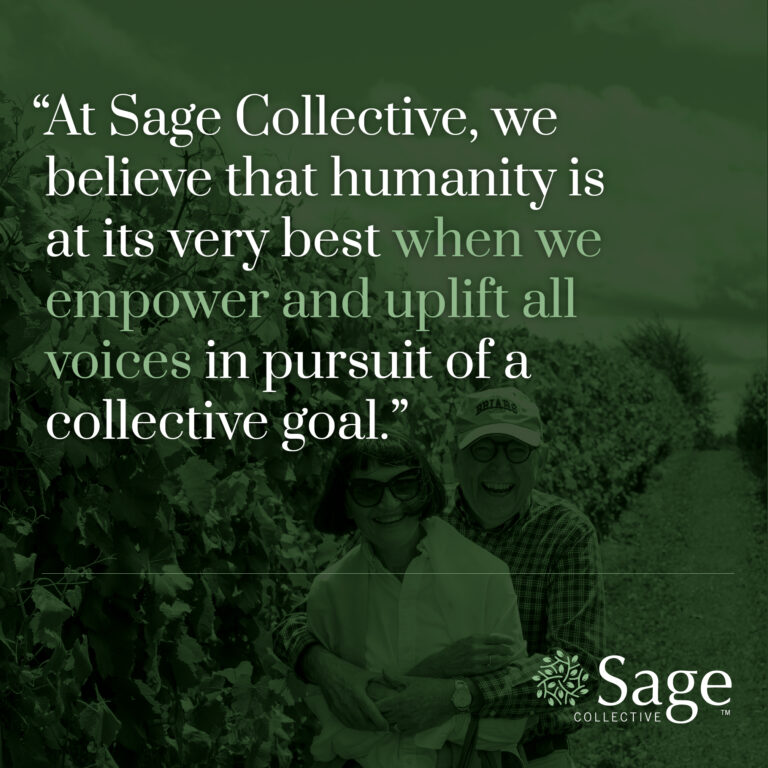
Text overlay reads "At Sage Collective, we believe that humanity is at its very best when we empower and uplift all voices in pursuit of a collective goal."
› Back to top
« back
08.19.21 | Fitness & Activity

Find the future of efficient workouts in “exercise snacks”

As part of our 9 Ways of Vibrant Living, Sage Collective advocates for moderate and regular physical activity. Developed in pandemic times when it was challenging to find ways to stay active, “exercise snacks” — a new and effective set of movements was born, and has become increasingly popular among older adults. Interestingly, research is demonstrating these snippets of exercise are equally or more effective than traditional workouts!

How to perform exercise snacks

“Exercise snacks” are short bursts of movement anyone can perform throughout the day, allowing people to arrange exercise as their time permits. Because the movements don’t require a fixed or dedicated location to “work out” as we normally define the act of exercising, you can find a host of spaces in your home or office to do squats, sit-ups, walking in place, lunges and more.  

Professor of Kinesiology Dr. Martin Gibala, argues that these brief bursts of exercise throughout the day can trigger the same reaction from our bodies that traditional workouts produce. In his study published by the International Journal of Exercise Science, Gibala and his partners introduced an 11-minute workout consisting of walking and running in place, lunges and other light calisthenics that improve cardiovascular health. One of the many thrilling findings was that the conditioning improved cardiovascular fitness by 7% for those who participated. 

Gibala explains that being rigorous with each movement is fundamental for exercise snacks. It is essential, however, to remember to cater to what works best for your body. 

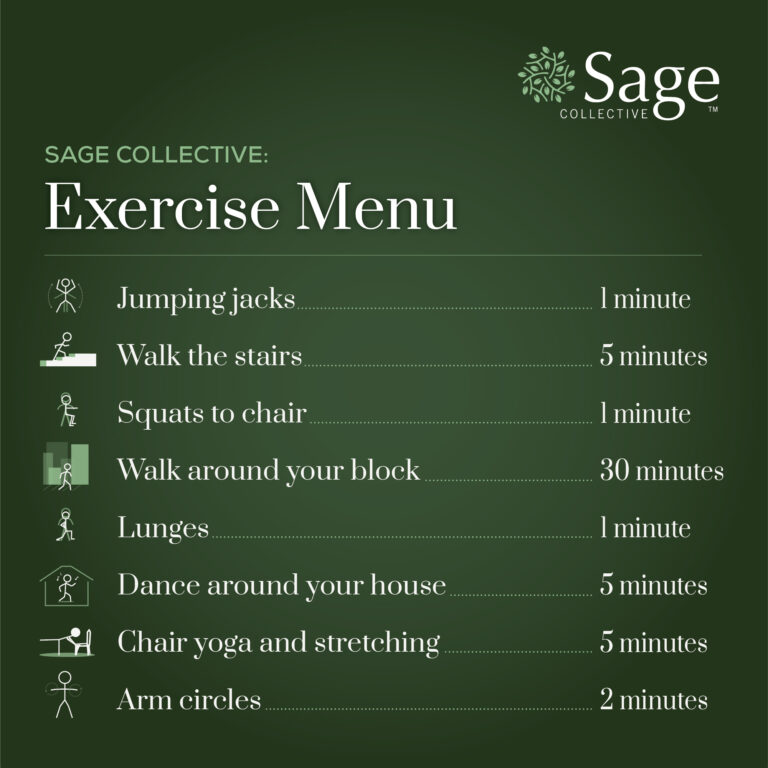
Sage Collective believes that incorporating exercise snacks into the lives of older adults and anyone looking to fulfill fitness needs can be a fundamental – and easy – way to live vibrantly. That’s why we produced our exercise snack menu based on Dr. Gibala’s workout plan below!


A graphic titled "Sage Collective: Exercise Menu" lists eight different "exercise snacks" and times allotted for people to take part in throughout their days.

A graphic titled "Sage Collective: Exercise Menu" lists eight different "exercise snacks" and times allotted for people to take part in throughout their days.
Sage Collective: Exercise Menu
› Back to top