« back
10.10.24 | Health & Wellness

The Art of Growing Older: Reflections on Aging with Wisdom and Grace

The art of growing older is a topic that invites reflection, wisdom, and grace. At Sage Collective®, we celebrate vibrant aging, recognizing that each stage of life offers opportunities for growth, learning, and joy. Below are some thoughtful writings on the subject, offering different perspectives on aging as both an art and a journey of discovery.

Grace Paley on the Art of Growing Older
In her later years, writer Grace Paley offered a poignant perspective on growing older. She spoke not only about the physical changes of aging but also about the wisdom and clarity that come with experience. For Paley, aging was not merely a decline but a deepening—an opportunity to reflect, create, and engage with the world in new and meaningful ways. She embraced the reality of aging while continuing to focus on the relationships, activism, and creativity that had always been central to her life. Paley’s reflections encourage us to view aging not as an endpoint but as another chapter in an ongoing narrative of vitality and purpose.
(Read more from Pocket: Grace Paley on the Art of Growing Older)

Henry Miller on Turning Eighty
The renowned writer Henry Miller reflected on aging with a sense of awe and acceptance. In his essay on turning eighty, Miller acknowledged the physical limitations of growing older but marveled at the richness of his inner life. For Miller, age brought a sense of liberation and freedom, as the preoccupations of youth faded, allowing him to focus on the beauty of the moment. He celebrated aging as a time of personal fulfillment, creativity, and contentment, encouraging readers to embrace aging as a period of inner growth and exploration. Miller’s perspective reminds us that while the body may age, the spirit remains vibrant and full of potential.
(Learn more from Marginalian: Henry Miller on Turning Eighty)

Pablo Casals on Work and Age
The legendary cellist Pablo Casals continued to play his instrument well into his nineties, demonstrating that passion and dedication to one’s craft can transcend age. Casals believed that work—particularly creative work—was the key to maintaining a sense of purpose and vitality as one aged. He famously said that he felt as if he were still learning to play the cello, even in his later years. This humility and commitment to growth serve as a powerful example of how staying engaged with life’s passions can contribute to aging well. Casals’ life is a testament to the idea that age should never be a barrier to pursuing one’s goals or engaging with the world.
(Read more from Marginalian: Pablo Casals on Work and Age)

Joan Didion and the Loneliness of Aging
Though not directly cited in the sources above, writer Joan Didion’s reflections on aging and loss offer a contrasting but equally important perspective. In her later works, Didion explored the emotional aspects of aging, including loneliness and grief. Her raw, honest depictions of loss remind us that aging is a complex experience that includes both beauty and hardship. Didion’s reflections challenge us to confront the emotional realities of growing older while still finding meaning and connection.
(Read more from Time Magazine: “Joan Didion Wrote About Grief Like No One Else Could”)

The art of growing older is not defined by any single experience. As these writings illustrate, it is a journey that can be filled with creativity, wisdom, and growth. Whether through the continued pursuit of passions, reflection on life’s meaning, or embracing the changes that come with age, growing older offers opportunities for rich, vibrant living. At Sage Collective, we honor these perspectives as we support older adults in their own unique paths toward aging with purpose and vitality.

Photo by Master Unknown on Unsplash
› Back to top
« back
08.15.24 | Community

The Wisdom of Traditional Healing Practices

In the fast-paced, technology-driven world we live in today, it can be easy to overlook the ancient wisdom embedded in traditional healing practices. These practices, rooted in centuries-old knowledge and cultural heritage, offer a holistic approach to health and well-being that remains relevant and beneficial, especially for older adults. At Sage Collective, we believe in the importance of embracing diverse health practices that promote vibrant living. Let’s explore the wisdom of traditional healing practices and their enduring relevance.

A Holistic Approach to Health
Traditional healing practices often take a holistic approach to health, emphasizing the connection between the mind, body, and spirit. Unlike modern medicine, which often focuses on treating specific symptoms or illnesses, traditional healing seeks to address the root causes of health issues and promote overall well-being. This approach can be particularly beneficial for older adults, as it encourages a balanced lifestyle that supports physical, mental, and emotional health.

Ayurveda: The Science of Life
Ayurveda, a traditional healing system from India, is one of the oldest known medical systems, dating back over 5,000 years. Ayurveda emphasizes balance in the body through diet, herbal treatments, and yogic breathing. For older adults, Ayurveda offers personalized health recommendations based on individual constitution, known as “doshas,” which help maintain balance and prevent disease.

Ayurvedic practices such as gentle yoga, meditation, and specific dietary guidelines can improve flexibility, reduce stress, and enhance digestive health. Herbal treatments, like ashwagandha for vitality and turmeric for inflammation, provide natural ways to support health and well-being.

Traditional Chinese Medicine: Harmony and Balance
Traditional Chinese Medicine (TCM) is another ancient healing practice that has been used for thousands of years. TCM includes various practices such as acupuncture, herbal medicine, tai chi, and qigong. The central principle of TCM is the concept of balance and harmony within the body, achieved by regulating the flow of “qi” or life energy.

For older adults, TCM offers several benefits. Acupuncture can help manage pain and improve sleep quality, while tai chi and qigong are excellent low-impact exercises that enhance balance, flexibility, and mental clarity. Herbal remedies, such as ginseng for energy and ginkgo biloba for cognitive support, provide additional natural options for maintaining health.

Native American Healing: Connection with Nature
Native American healing practices are deeply rooted in a connection with nature and the belief in the interconnectedness of all life. These practices often involve the use of medicinal plants, spiritual ceremonies, and the guidance of healers or medicine people.

For older adults, incorporating elements of Native American healing can foster a sense of peace and connection with the natural world. Practices such as smudging with sage or sweetgrass to cleanse the environment, using herbal teas like echinacea for immune support, and participating in spiritual rituals or drumming circles can enhance emotional well-being and create a deeper sense of community.

Benefits of Traditional Healing Practices

Holistic Health: Traditional healing practices address the whole person, promoting balance and well-being across physical, mental, and spiritual dimensions.

Personalized Care: Many traditional healing systems offer personalized health recommendations based on individual needs, which can be particularly beneficial for older adults.

Natural Remedies: Herbal treatments and natural therapies provide alternatives to pharmaceuticals, with fewer side effects and a focus on preventive care.

Cultural Connection: Embracing traditional healing practices can foster a deeper connection with one’s cultural heritage and promote a sense of identity and belonging.

Community and Support: Many traditional practices emphasize community involvement and support, offering social benefits that are crucial for mental and emotional health.

Embracing Ancient Wisdom
The wisdom of traditional healing practices offers a wealth of benefits that remain relevant in our modern world. At Sage Collective, we celebrate the diversity of health practices that contribute to vibrant living. By embracing the holistic, personalized, and natural approaches of traditional healing, older adults can enhance their well-being and connect with ancient wisdom that has stood the test of time.

Incorporating these practices into daily life can provide a balanced, enriched, and meaningful approach to health. Whether through Ayurveda, Traditional Chinese Medicine, Native American healing, or other cultural practices, the journey towards wellness is deeply enriched by the wisdom of the past.


Ayurvedic Mulethi (licorice root stick) used in ayurvedic medicine. Credit: https://www.vecteezy.com/free-photos/ayurveda-medicine
› Back to top
« back
04.18.24 | Arts & Culture

Introducing Sage Vibrant Living —The Podcast: A New Chapter in Storytelling

In an ever-evolving world where connection and engagement stand as pillars of humanity, Sage Collective proudly announces the launch of an exciting endeavor: Sage Vibrant Living — The Podcast. This innovative series is more than just an addition to our platform, Sage Advice®; it is a bold step towards redefining the narrative around aging and celebrating the vibrancy of life at every stage.

Why podcasting?
At Sage, we believe in challenging the status quo and embracing innovative ideas that enrich the lives of older adults and the community at large. Podcasting offers a radical new framework where older adults are valued and engaged…where they experience a life lived vibrantly. It is a medium that transcends traditional boundaries, allowing us to connect, engage, and explore humanity’s boundless knowledge collaboratively. From how-to discussions and cultural perceptions of aging to dynamic storytelling and housing as health insights, Sage Vibrant Living — The Podcast covers a broad spectrum of topics that resonates with our mission: to promote a better quality of life for older adults and those who support them, to extend the reach of Sage, and to foster a sense of community and belonging.

Listening to inspirational voices|
Our inaugural series boasts a lineup of interviews that promises to captivate, educate, and inspire our listeners. Each guest brings a unique perspective to the table, sharing their journey, wisdom, and insights into living a life full of purpose, health, and joy.

Episode 1: Barbara Bates | Fashion and Philanthropy: Join us as we dive into the world of fashion with Barbara Bates, exploring how she weaves philanthropy into her work and remains a relevant force in the industry.

Episode 2: Alfred Edmond Jr. | Money & Muscle: Alfred Edmond Jr. reveals his secrets to building wealth and health post-60, offering listeners a blueprint for financial and physical wellness.

Episode 3: Cheryl Woodson, MD | A Journey Towards Joy: Dr. Cheryl Woodson shares her expert insights on navigating the challenges of aging and finding pathways to joy and fulfillment.

Episode 4: Dwain Kyles & Emilie McKendall | Speak Up!: This empowering conversation with Dwain Kyles and Emilie McKendall underscores the importance of self-advocacy and standing up for others.

Episode 5: Dr. Geneva Williams | How to Make Your “Dash” Mean Something: Dr. Geneva Williams discusses the significance of the ‘dash’—the time between our birth and death—and how to make every moment count.

Episode 6: Don Jones | The Power of Storytelling: In this compelling episode, Don Jones delves into the transformative power of storytelling, highlighting its role in preserving history, fostering connections, and inspiring change.

As we embark on this journey, we invite you to join us. Whether you’re a listener, a storyteller, or a supporter, your involvement is crucial to the success of Sage Vibrant Living—The Podcast. Together, we can change the experience of growing older and celebrate a life lived vibrantly, one story at a time.

To access all the podcast episodes, simply click on the link here.

Sage Vibrant Living Podcast
› Back to top
« back
03.13.24 | Spirituality & Religion

Interfaith Dialogues: Understanding and Celebrating Religious Diversity

In a world that is as beautifully diverse as it is interconnected, Sage Collective recognizes and celebrates the myriad ways in which individuals express their spirituality and faith. One of the most enriching avenues for promoting understanding, peace, and unity among this diversity is through interfaith dialogues. These conversations are not just about exploring the beliefs and practices of different religions; they are about weaving a tapestry of shared human experience that transcends individual faiths.

The Essence of Interfaith Dialogues

Interfaith dialogues are conversations that aim to bring people of different religious beliefs and backgrounds together to discuss their faiths, beliefs, and practices in an atmosphere of respect and understanding. These dialogues are pivotal in breaking down barriers, dispelling myths, and fostering a mutual respect that is crucial in today’s globalized society. They remind us that beneath the surface of our diverse expressions of faith lies a common quest for meaning, purpose, and community.

Why Engage in Interfaith Dialogues?

Promotes Understanding: At their core, interfaith dialogues are about understanding. They provide a platform for individuals to share their beliefs, listen to others, and learn from each other’s experiences. This understanding is the first step towards building a more cohesive and harmonious community.

Fosters Respect: Through open and honest conversations, interfaith dialogues cultivate a culture of respect. When we take the time to learn about the beliefs of others, we are more likely to respect those beliefs, even if they differ from our own.

Encourages Unity: By focusing on common values and shared experiences, interfaith dialogues can highlight the unity that exists amidst diversity. They remind us that, despite our different paths, we are all part of the larger human family.

Supports Peace-building: In a world often divided by religious conflicts, interfaith dialogues serve as a powerful tool for peace-building. They help in mitigating misunderstandings and tensions by promoting a message of peace and coexistence.

Creating Meaningful Interfaith Dialogues

Creating a space for meaningful interfaith dialogues starts with an open heart and an open mind. It requires participants to listen actively, speak respectfully, and approach each conversation with empathy and curiosity. Here are some ways to foster these dialogues:

Educate Yourself and Others: Begin with a willingness to learn about other faiths, and share knowledge about your own in a way that is informative and inclusive.

Participate in Interfaith Events: Join interfaith councils, forums, or celebrations in your community to experience the richness of diverse religious traditions.

Encourage Inclusivity: Advocate for inclusivity in your own religious or spiritual communities, encouraging leaders and members to engage in interfaith initiatives.

At Sage Collective, we believe that interfaith dialogues are essential for nurturing a society that values diversity, practices inclusion, and seeks unity in the beautiful mosaic of human spirituality. As we embark on these conversations, let us do so with the intention of not just coexisting, but thriving together in mutual respect and understanding. In celebrating our differences, we find our greatest strength — our shared humanity.

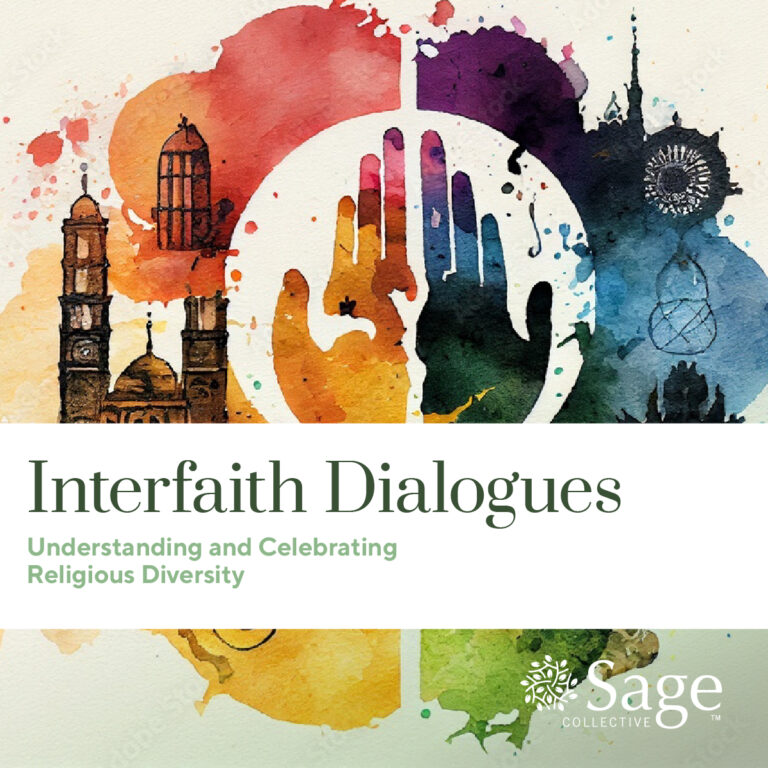
Sage Collective Interfaith Dialogues
› Back to top
« back
08.24.23 | Community

Forgiving Oneself and Others

Forgiveness is a cornerstone of one’s personal growth journey, and its importance can’t be overstated. At the very core, forgiving yourself starts as a choice, a conscious decision to release the weight of past regrets and to make peace with your actions and decisions, and with that choice comes the foundational elements of empathy, understanding, compassion, and kindness.

Empathy plays a crucial role in this journey. By putting oneself in another’s shoes, we not only gain perspective but also allow for healing to commence. It helps us to see beyond our narrow viewpoint and understand the broader picture. It reminds us that everyone, including ourselves, is fighting a battle that we may know nothing about.

Alongside empathy, understanding is pivotal. This means recognizing our mistakes, learning from them, and accepting that everyone has their journey filled with both ups and downs. Acceptance doesn’t mean we forget or condone mistakes, but rather that we recognize them as part of our growth.

When we look at our past with love and understanding, rather than judgment, we begin to heal. And once we show compassion towards others, even when it feels undeserved, we often find that we’re lightening our own burdens. It’s a mutual process of healing – for ourselves and for others.

Kindness is the thread that stitches together the fabric of forgiveness. It could be in small, daily acts or larger gestures. Whether it’s being gentle with oneself on a tough day or showing kindness to someone who might not have treated us well, these actions have a ripple effect. Kindness not only fosters an environment where forgiveness can thrive but also nurtures our own soul.

Despite understanding these foundational elements, we must remember that the act of forgiveness is fundamentally a choice. It’s a decision we make, transitioning from denial or resentment to a state of acceptance. This choice isn’t always easy; barriers often stand in our way. Yet, with determination, these barriers can be overcome.

Even after choosing forgiveness, the journey isn’t over. It’s essential to realize that forgiveness isn’t a one-time act or a destination but an ongoing process. Making peace with past mistakes, allowing ourselves the grace to move forward, and embracing the future with resilience are all parts of this continuous journey.

While the path of forgiving oneself and others can be strewn with challenges, it is a necessary step towards achieving inner peace and profound personal growth for your own Vibrant Living. So, as you move forward, reflect upon your journey, choose forgiveness, and embrace the healing that it brings!

› Back to top
« back
08.04.22 | Sage Advice®

How Sacred Spaces Can Directly Affect Community Wellbeing

As part of our 9 Ways of Vibrant Living, we support and encourage participation in spiritual and religious experiences for followers of all faiths at Sage Collective. Not only does spiritual engagement help with purpose and act as a hub for the community, but the spaces in which those engagements take place can also leave great impacts on our wellbeing. Take a closer look at just how sacred spaces can leave a direct impact on you: 

Research has always supported the fact that spiritual engagement or religious activities lead to better health – some claiming it leads to longer lives. However, more and more research is now pointing to the impact physical spaces that are home to religious activity have on the people that engage in them. 

Partners for Sacred Places, a Philadelphia non-profit, partnered with the University of Pennsylvania over the last decade to discover the economic and public impact places of worship have on their larger community in Philadelphia – labeling it the Halo-Effect. 

They found that through educational opportunities, catalytic impact, and direct spending, congregations in Philadelphia were extremely beneficial to their communities – contributing an average of more than $4,000,000 in economic value. Further, the study also found that nearly 80% of people who visit sacred spaces – and weren’t already members of the space – benefit from their offerings as well.  

Churches, temples, synagogues, mosques and other places of worship are the perfect spaces to come together, find peace and build community. The halo-effect proves the significance for individuals who spend time in sacred spaces and the benefit to the larger community. 

Read more about the halo-effect and other studies on the impact behind sacred spaces here

› Back to top
« back
07.21.22 | Sage Advice®

Personal Statements and Manifestos

As we continue our Vibrant Living Programming, we also want to resume sharing rich content that compliments our spirited training, and this month’s theme is freedom. Along with independence and opportunity, freedom can mean many things to many people. Today, we’re exploring how independence inspires purpose, how personal manifestos can propel that purpose even further and how you can create one of your own. 

A personal manifesto performs as a declaration of what you truly want from life, which makes it the perfect tool for engaging personal independence. Traditionally, you might know manifestos as published statements declaring the intentions or beliefs of organizations, similar to our Vibrant Living Manifesto. However, manifestos are fluid and can be similarly used by individuals to act as both a statement of ethics and a call to action and are powerful in giving life meaning and direction.

Whether you’re in search of a guiding compass, a frame, a reminder of your priorities or simply inspiration, creating a personal manifesto is sure to provide your life with a foundation of additional meaning and direction. Learn how to write your own below: 

Begin your manifesto by writing down your values, beliefs, behaviors you apply to life and other areas you want to address. If you’re having trouble thinking of what to write, it might be easier to ask yourself questions about those themes. Remember, personal manifestos are exactly how they sound, personal, so yours is likely to be unique to itself. 

After creating your list, start to transform each point of interest into active, declarative statements; use powerful language, don’t worry about the length and remember to keep it uplifting and positive. When finished, make a copy and put it somewhere you will see every day; your manifesto could be the perfect tool for vibrant living, write and live it now!

› Back to top
« back
12.16.21 | Sage Advice®

Chicago’s Adopt-A-Landmark Grant Makes Way for Repairs at Historic Bronzeville Church

In recent months, the city of Chicago has shown a growing interest in developing affordable housing and restoring historical structures across the city, and with the Citywide Adopt-A-Landmark Fund, they’re doing just that in Bronzeville. Located only a few blocks from our King Drive Properties, Bronzeville’s Ebenezer Missionary Baptist Church, found at 4501 S. Vincennes Avenue is one of the 12  landmarks chosen by the city to receive the grant. 

For more than 100 years, Ebenezer Missionary Baptist Church has served its membership in the heart of Bronzeville. The beloved church is said to have been one of the birthplaces of gospel music and has hosted a number of distinguished guests over the years, including the Rev. Dr. Martin Luther King Jr., Olympian and Congressman Ralph Metcalfe, Congressman Adam Clayton Powell, as well as renowned singers Dinah Washington and Mahalia Jackson. 

Thanks to unprecedented federal support from the Biden Administration, the Citywide Adopt-A-Landmark Fund, which is supporting Ebenezer Missionary Baptist Church’s renovation with a $900,000 grant,  will be awarding several Chicago landmarks with millions of dollars annually for essential renovation and preservation upgrades. Once funds approved by the City Council, the money will be awarded to these landmark buildings to cover extensive interior and exterior restoration and improvements,

Ebenezer Missionary Baptist Church’s elaborate, historic interior

For the nearly 120-year-old church, this means that its roof and damaged  stained glass windows, that have endured harsh weather for decades, can finally be restored to their original beauty. As with other churches, Ebenezer’s membership has dwindled since the beginning of the pandemic almost two years ago. The church hopes that with the new renovations, more community members will be incentivized to visit the historic site and participate in their services. 

An exciting undertaking in the Bronzeville neighborhood, the restoration is not only one of the many developments that are part of Bronzeville’s renaissance, but proves that the city is showing more interest in improving the quality of life in communities like ours. To learn more about other Citywide Adopt-A-Landmark Fund projects happening throughout the city, visit their website here

Ebenezer Missionary Baptist Church’s exterior
› Back to top
« back
11.30.21 | Mental Wellbeing

How Spirituality and Religious Involvement Can Help You Age Better

With aging comes many difficulties and moments of emotional turbulence, leaving some to believe they are alone on their journey. However, the aging process also introduces many people to new hobbies, fulfilling purposes and other approaches to life that they had never experienced before. Vibrant living is always at the forefront of our vision at Sage Collective, and one chief aspect of our inspired model is engagement in spirituality and religion. Today, we’re the significant impact that spiritual and religious involvement can have on the aging process.

Sometimes as you age, a sense of community and support is all you need. Churches, and other places of worship, are hubs for mutual respect and are the perfect places to discover connections, engage in thoughtful discussion and participate in meaningful action. 

Despite the anxieties that come with aging, like increased loneliness and isolation, religious attendance has been found to establish a stronger feeling of community support. A recent study published by Geriatrics Journal found that religion and spirituality played a variety of roles in the lives of older adults who participated in them, including strengthening emotional connections and enhancing feelings of comfort and hope during hard times. 

Because religious and spiritual institutions often encourage connecting with those around you, they are one of the best ways for older adults to immerse themselves in a supportive social network and embrace vibrant living. Many religious institutions practice a “door’s always open” policy and will gladly welcome anyone who walks through their entrance. 

Because of these uplifting benefits and more, we encourage you to explore your community and discover a faith of your own if you haven’t already. And no matter the religion, we’re sure that a vibrant community full of love will welcome you with open arms and help produce essential support that will lead to better aging. 

› Back to top
« back
02.25.21 | Fitness & Activity

The Health Benefits of Tai Chi

Tai chi is an internal Chinese martial art, practiced for defense training, health benefits and meditation. As one of the most gentle martial art forms, tai chi is a great exercise option for older adults across the health and mobility spectrum — bringing with it a slew of benefits, healthful and otherwise. Let’s take a closer look:

Tai chi

Tai chi, short for T’ai chi ch’üan or Tàijí quán (太極拳), is an ancient Chinese martial arts practice, rooted in a deep history and philosophy. (You can read more about that on CultureTrip, here.) According to MayoClinic, tai chi “is a noncompetitive, self-paced system of gentle physical exercise and stretching. Each posture flows into the next without pause, ensuring that your body is in constant motion.” The movements emphasize deep breathing, encouraging participants to slow down and get in touch with their body and feelings.

Because tai chi is low-impact, slow-motion and emphasizes the mind-body connection, it’s become a popular practice globally, attracting a broad spectrum of participants. And thanks to its wide array of health benefits, it’s since been adopted as a common practice at hospitals, community centers, older adult facilities and the like.

Health Benefits

Tai chi is often described as “meditation in motion,” but because its health benefits are so great, Harvard Women’s Health Watch jokingly calls it medication in motion.”

The low-impact exercise boasts physical health benefits such as improved lower- and upper-body strength, improved flexibility, improved balance (and possibly even decreased risk of falling), improved joint pain, enhanced immune system, enhanced quality of sleep, lowered blood pressure and healthy aerobic conditioning (where heart and lungs are trained to pump blood more efficiently, allowing more oxygen to be delivered to muscles and organs). All of the listed benefits are crucial to older adults seeking to maintain or better their health. 

In addition to its physical health benefits, the meditative aspect of tai chi brings with it an array of mental health benefits. These benefits include decreased stress, anxiety and depression; improved mood, energy and stamina and a general boost to wellness overall. 

Part of the appeal is that tai chi can be practiced independently or within a group setting, and it doesn’t require any equipment. If a low-impact, slow-motion and mindful form of exercise sounds like a good fit for you, then tai chi might just become part of your next fitness regimen routine.

Two people practice tai chi, silhouetted against a night sky and the moon
› Back to top