« back
07.15.21 | Sage Advice®

Radical ways to repair harm: restorative vs. transformative justice

The last year and a half marked a breaking point in the status quo. The combined stresses of a global pandemic, as well as increased national awareness of police brutality and racial injustice in America, made one thing clear: we need to radically reimagine our communal approach to safety and care.

As we collectively look to create a future where all people feel safe, longtime organizers and activists are pushing for two solutions: a turn towards restorative justice or transformative justice. These human-centric methods for addressing harm dispel the idea that people are disposable beings, or that punishment should be carceral. Learn more about the concepts, and what makes them different from one another, below:

Restorative Justice

Restorative justice acknowledges that when crime occurs, it causes harm to those that are involved. Rather than focusing solely on punishing the perpetrator of the crime, restorative justice is concerned with addressing the harm caused and the impact of that harm.

This is addressed by facilitating dialogue between all parties involved. Ideally, a conversation will be collectively held by all parties, including: the person who has caused the harm, the person who has been directly harmed, and the community where the harm occurs.

During this conversation, the person who has caused the harm should take accountability for their actions and make amends. The person who has been directly harmed may outline what they need in order to heal.

The community is an integral part of this process as well, because as the process of restorative justice seeks to route a path towards forgiveness and healing, its end goal is ultimately to reintegrate the person who has caused harm back into society, where they will have a second chance.

Transformative justice

In an article from Novel Hand examining the difference between restorative and transformative justice, and how transformative justice digs one step deeper, writing:

“…restorative justice attempts to restore to the condition before the harm took place. However, usually, that original condition is itself one that has a number of injustices built into it. Transformative justice aims to dig deeper: how can we also address the root causes of injustice and move toward an even stronger community?”

Essentially, restorative justice acknowledges the failings of our current carceral state, where the prison industrial complex puts people away for crime in a way that feels disposable rather than healing. But furthermore, transformative justice takes its critique of current systems further and acknowledges the failings of our current system to also address racism, sexism, ableism, and classism – and how these conditions contribute to where crime occurs, from whom it occurs, and how treatment/punishment differs across the spectrum.

Peace and Conflict scholar Anthony Nocella says on this subject: “Transformative justice…is about looking for the good within others while also being aware of complex systems of domination.”

This cursory overview of restorative and transformative justice is just the tip of what’s been said and what there is to learn about radically reimagining the ways we repair harm in our society. To learn more, we recommend reading the full article by Novel Hand and conducting your own research from there!


 

Illustration of outstretched hands
› Back to top
« back
07.13.21 | Health & Wellness

How to become a “joyspotting” expert

Similar to taking an awe walk, joyspotting is the intentional act of going out into the world to look for things that spark joy in you. While the word may sound unusual, it’s actually amassed quite a cult following – with entire online groups dedicated to sharing in joyspotting (and their subsequent findings) together. Even if you’re not ready to join an online group just yet, find out how to become a joyspotting expert using our tips below.

The Origins of Joyspotting

Joyspotting is a term first coined by Ingrid Fetell Lee. As a designer, Lee began to notice the relationship between one’s surroundings and their mental health. For example: living in a home filled with bright prints and patterns provides an immediate mood booster. Lee knew this was a counterintuitive principle. So often, society tells us not to derive joy from the things that surround us, but from what’s within us.

In contradiction to this view, Lee sheds light on the relationship between our environment and our emotions, and shares inspiration and resources for living a more joyful life through design in her book, The Aesthetics of Joy. She has also created a website dedicated to this viewpoint, that shares the same name. There is also an online Facebook group that we referenced above, The Joyspotters’ Society.

As Lee became more and more tuned into what caused her joy from her surroundings, she began to develop the habit of intentionally seeking out – or looking to consciously observe – these causes of joy. And hence, joyspotting was born. As she says, “The world seemed to be teeming with tiny, joyful surprises. All I had to do was look for them… It was like I had a pair of rose-colored glasses, and now that I knew what to look for, I was seeing it everywhere. It was like these little moments of joy were hidden in plain sight.” Instead of seeing the world around us as beset with distractors, joyspotting is a way of creating a reservoir of positivity.

Twelve Ways of Joyspotting

To become an avid joyspotter is simple. Look around you and determine something that causes you joy. It could be a pair of colorful, patterned socks worn by the man next to you on the train, or the unexpected sidewalk chalk drawings on a walk around the block. But just in case you need a little bit of help getting started, Lee put together The Joyspotter’s Guide, which outlines her twelve tips for joyspotting. Below, we offer a brief description of those tips.

Look up. Joy often comes from things that float or fly in the sky, whether that’s shapes you find in the clouds, or a stray red balloon. Look down. Maybe you discover a rainbow in a puddle, or a vibrant pair of shoes on a passing pair of feet. Keep an eye out for color. What flashes of blue catch your eye? How does an abundance of green transform the environment? Follow the curve. Life is full of hardness, so where do things get soft around the edges?

Go where the wild things are. There’s always joy to be found in nature, whether it’s enjoying the smell of a rosebush, or listening to birdsong. Seek out symmetry. Where there are mirror patterns, there’s often a surprising sensation of randomness or harmony. Search for signs of abundance. Where do things feel lush and full? It could be a fruit bowl on a family member’s kitchen counter, or a few too many Christmas lights at the neighbor’s house. Joy has a way of spilling over. Watch for weirdness. Where are things out of place, or just out of the ordinary? It’s those standout details that often feel most special.

Zoom in. Focus your attention on the tiniest of details. Notice the invisible. What joy surrounds you that can be felt or heard, but not seen? These sightless observations hold a magic of their own. Similarly, use all your senses! And finally, take the scenic route. The paths you wouldn’t normally take often hold the most surprises, and within those, there’s much joy to discover.


Photo of man looking through a spotting scope
› Back to top
« back
07.08.21 | Sage Advice®

Visiting the Obama Portraits at the Art Institute of Chicago

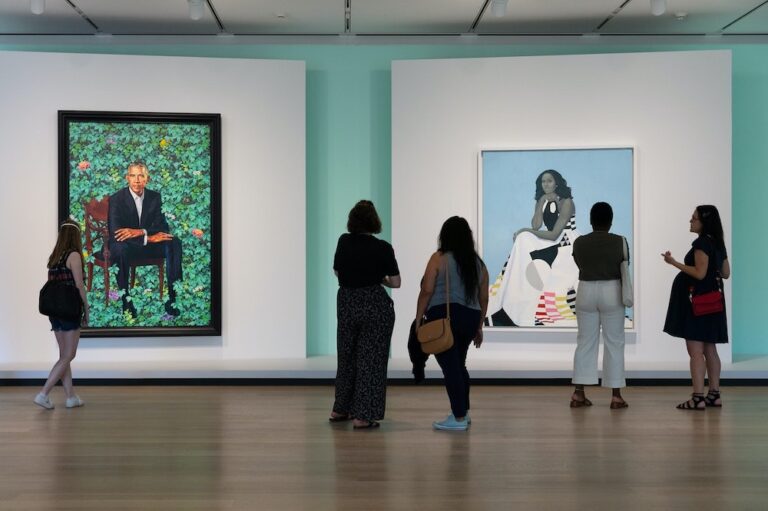
This summer, the beautiful and inspiring Obama portraits – depicting 44th president of the United States, Barack Obama, and first lady, Michelle Obama – will be gracing the walls of the Art Institute of Chicago for just eight brief weeks. With such a limited viewing period, below we’re outlining how to plan your visit to see these seminal works of art ASAP!

Visiting the Portraits

Access to viewing The Obama Portraits is included in General Admission for all Art Institute visitors. However, the exhibition does have a capacity-limit, and entry is first-come, first-served.

Tickets must be reserved in advance online, and entry to the exhibit on the day of your visit will be managed via virtual lines. General Admission tickets are being released in limited, timed batches, as outlined below:

  • Tickets for July 1–15 will be available on June 24.
  • Tickets for July 16–31 will be available on July 8.
  • Tickets for August 1–8 will be available on July 22.
  • Tickets for August 9–15 will be available on August 2.

A limited quantity of tickets will also be available onsite for qualifying groups. Learn more about free admission guidelines at the Art Institute of Chicago here.

Remarkable Works

While many other Presidential Portraits in the Smithsonian National Portrait Gallery have been traditional, head-and-shoulders portraits painted in classical styles, President Barack Obama took a notably different approach.

Barack Obama commissioned Kehinde Wiley to create his portrait. Wiley is an American portrait artist known for his placement of contemporary (typically African American) figures in the guise of powerful historical figures. Meanwhile, Michelle Obama commissioned Amy Sherald to create her portrait. Sherald is an American artist known for her arresting, otherworldly portraits that document the contemporary African-American experience.

Wiley and Sherald are the first African Americans to be commissioned by the National Portrait Gallery to create official portraits of a president or first lady. The resulting works are remarkably contemporary.

In the larger-than-life, head-to-toe portrait created by Wiley, a seated Obama is set against a backdrop of lush greenery. Each plant in the background holds a special significance, including chrysanthemums, the official flower of Chicago. The portrait of Michelle Obama, created by Sherald, was based on a posed photograph and is intentional down to every last detail, from the grey-scaling of Michelle’s skin to the intensity of her direct gaze.

You can visit the Obama Portraits at the Art Institute of Chicago now through August 15, 2021; tickets are available for purchase here.

And for those interested in a fascinating, rich conversation between Michelle Obama and Amy Sherald, hosted by The Studio Museum of Harlem Director + Chief Curator Thelma Golden, you’ll find it here.


Photo of Obama Portraits
(L) Kehinde Wiley. Barack Obama, 2018. Oil on canvas. (R) Amy Sherald. Michelle LaVaughn Robinson Obama (detail), 2018. Oil on linen. Photo courtesy of the Art Institute of Chicago.
› Back to top
« back
07.06.21 | Community

What we mean when we say “vibrant, high-quality, affordable housing”

There’s a lot of language we use at Sage Collective that’s uncommon for the world of senior living. For example, we prefer to use the phrase “older adults” rather than “seniors” – more on that in this blog post here. When discussing our vision for Sage Collective’s residences, we also use the phrase “vibrant, high-quality, affordable housing.” But just what exactly does that mean?

Everything we do at Sage Collective – from the partners we choose, the programming we design, to the residences we develop – is built upon our foundational philosophy: 9 Ways of Vibrant Living. Read more about this philosophy and how we intend to bring it to older adults in our Vibrant Living Manifesto here. Ultimately, we believe that older adulthood is just another in a series of life’s chapters, and that seniors deserve to live just as joyfully, vibrantly, and fully as their intergenerational counterparts.

Too often, senior housing lacks the passion and joy of this belief we hold so dear. Based on limited resources, and often bogged down by limited imagination, affordable senior housing is all too commonly not the enjoyable experience that it should be. We’re here to rewrite that narrative.

At Sage Collective, we encourage our residents and neighbors to experience the freedom and joy of choice by providing them with wellness support, cultural exploration, and spiritual enrichment. We’re in a privileged position to deliver on this promise based on the legacy we come from – more on that in this blog post here. From our past experience, we’ve learned the powerful impact that a strong vision and an even stronger culture has on the services and housing products we’re able to provide.

We can’t wait to share this vision with you. Our first residences, 4108 and 4112 South King Drive in the Bronzeville community on Chicago’s Southside, will bring affordable and market competitive housing units to our community, and will be set apart by our vibrant living philosophy and attention to detail and quality. Stay tuned for more details to come.


Photo of contemporary residential interior
› Back to top
« back
07.01.21 | Community

Vibrant Living Breakdown: Engagement in Social Life

Nine Ways of Vibrant Living is Sage Collective’s innovative model that champions more meaningful, engaged lives for older adults, and that serves as the backbone of our philosophy. We celebrate and uplift components of vibrant living that span from health and wellness, to arts and culture, to spiritual enrichment — but what makes all these life experiences truly shine is our ability to share them with others. That’s why our ninth component is engagement in social life.

Older adults in particular are a population at high risk of experiencing social isolation. The flip side of that risk – and the negative impacts it has on one’s physical and mental well being – means that older adults who are more socially connected often report a better quality of life all around.

The benefits of healthy social connection for older adults are all encompassing and include disease prevention, fewer physical health problems, longevity/length of life, improved cognitive function, better self-esteem, sense of belonging, and maintained purpose of life.

Therefore, at Sage Collective, we strive to provide daily opportunities for social connection and community engagement, whether that’s through our programming or residences. We intend to partner with a host of community organizations, including but not limited to: churches, schools, businesses, and cultural institutions, to provide co-teaching, educational, entrepreneurial and employment opportunities that both enrich and empower our residents.


Stay tuned for all these opportunities and more, and in the meantime, you can stay connected with us and our community online through our social media via Facebook, Instagram, Twitter, and LinkedIn.

Friends gathering to socialize and paint
› Back to top
« back
06.29.21 | Community

Harness the power of awe by taking “awe walks”

Vibrant life encompasses a variety of experiences, from healthy eating to regular fitness to engaging with the world around us. One particularly effective – and unusual – way to pursue vibrant living is to take “awe walks.” The end-goal of these walks is simple:  to simply inspire awe in those who participate. Let’s dig in.

How to take awe walks

“Awe walks” are a more intentional way to approach something as simple as a stroll around the block. The idea is to go for a walk and seek to experience awe along the way. How the walker chooses to experience awe is entirely up to them. Awe can be found in even the smallest of everyday moments, such as appreciating the flight path of a v of migrating geese above, or marveling at the many colors that make up fall foliage.

The study of awe – how it’s inspired, and the impact it has on a person’s wellbeing – has been a primary area of focus for psychologists since the early 2000s. Just recently, a 2020 study was published in the journal Emotion examining the impact of awe walks on a population of older adults.

In the study, sixty older adults took 15-minute awe walks for a period of eight weeks. Perhaps the most exciting finding of the study was the increasing feelings of compassion and gratitude in the control group that took such awe walks. Compared to the normal-walk-talking counterparts, the awe walkers were much more focused on observing the world around them.

“One of the key features of awe is that it promotes what we call ‘small self,’ a healthy sense of proportion between your own self and the bigger picture of the world around you,” explained Dr. Virginia Sturm, lead investigator and associate professor of neurology and psychiatry and behavioral sciences at the University of California at San Francisco.

You can trust the science – or you can just as easily try it out for yourself and see what awe you uncover.

View from above of people taking a walk
› Back to top