« back
09.09.26 | Community

The Spiritual Life of Aging

Aging changes many things: the pace of our days, the shape of our relationships, the way we understand time, even the questions we ask ourselves. For many people, it also changes the inner life.

As we grow older, spirituality can become less about certainty and more about meaning. Less about having answers and more about learning how to live with mystery. The questions may become quieter, but they often become deeper: What has mattered most? What do I believe now? What gives me peace? What am I still becoming?

At Sage Collective®, we believe vibrant living includes this interior dimension of life. Health, purpose, community, and creativity all matter, but so does the human need to make meaning of our experiences and to feel connected to something larger than ourselves.

Spirituality Takes Many Forms
For some people, spirituality is inseparable from religion. It may be expressed through prayer, worship, scripture, music, or participation in a faith community. For others, spiritual life may be found in nature, meditation, art, family traditions, service, gratitude, or moments of profound connection. Some people become more religious as they age. Others find themselves questioning beliefs they once accepted without hesitation. Still others discover new ways of understanding spirituality that feel more personal than institutional.

There is no single path. What matters is the search for meaning, connection, and a sense that life is part of something larger than the self.

Aging Can Deepen the Questions
Earlier in life, so much of our attention is directed outward. We are building careers, raising families, meeting obligations, establishing identities, and making plans for what comes next. Later life often creates more room for reflection. We begin to see our experiences not as isolated events, but as part of a larger story. Successes and disappointments take on different proportions. Relationships may matter more than accomplishments. Old grievances may feel heavier to carry. Gratitude may become more specific. Time itself can feel more precious. Spirituality can offer a way to hold these realizations without needing to resolve every contradiction, making room for both gratitude and grief, certainty and doubt, joy and regret.

Faith Can Change Without Disappearing
One of the myths about spiritual life is that faith should remain fixed. But belief can evolve just as people do. A person may find that the religion of childhood still provides comfort, but is now understood differently. Rituals that once felt habitual may acquire new meaning. Questions that seemed threatening earlier in life may become welcome companions. Loss, illness, injustice, caregiving, and mortality can also challenge long-held beliefs. These experiences may deepen faith, complicate it, or temporarily unsettle it. This doesn’t necessarily represent spiritual failure — sometimes, growth involves becoming more comfortable with not knowing.

Ritual Gives Shape to Time
Spiritual traditions have always understood the power of ritual. A prayer said each morning. A candle lit for someone who has died. Grace before a meal. Sunday worship. A favorite hymn. A walk taken at dusk. A few minutes of silence before the day begins. These practices may seem small, but repetition gives them weight. Ritual creates continuity in a life that is always changing.

For older adults especially, ritual can provide rhythm during periods of transition. Retirement, bereavement, changing health, relocation, or shifts in family life can disrupt familiar routines. A spiritual practice can become an anchor — a way of returning to what feels steady when other parts of life are in motion.

Community Matters, Too
Spiritual life may be deeply personal, but it is often strengthened through community. Faith communities have long provided much more than formal worship. They can offer friendship, mutual care, mentorship, opportunities for service, music, shared meals, and a sense of belonging across generations. This has particular significance within African American communities, where churches and other faith institutions have historically served as centers of spiritual life, cultural preservation, civic leadership, and collective care. As people age, these relationships can become especially meaningful. Being known, being needed, and having a place where one belongs are powerful forms of well-being.

Spirituality Can Make Room for Loss
Later life inevitably brings experiences of loss. We may lose people we love, physical abilities we once took for granted, familiar roles, cherished places, or assumptions about how life was supposed to unfold. And while spirituality can’t erase grief, it can provide a language for living alongside it. Prayer, ritual, music, storytelling, remembrance, and community can help us honor what has been lost without allowing loss to become the whole story.

Many spiritual traditions also teach that grief and gratitude are not opposites. We can mourn deeply and still recognize beauty. We can miss someone and remain thankful for having known them. We can experience sorrow and still feel connected to life.

Awe Has a Place in Aging
Spirituality is also about wonder. A piece of music that brings us to tears. Light moving across a room. A grandchild’s hand in ours. A tree we have watched through many seasons. A work of art that makes time seem to stop. These experiences of awe remind us that we do not need to understand everything in order to be moved by it. And perhaps that becomes one of the gifts of aging: the growing ability to notice what once passed too quickly.


› Back to top
« back
06.17.26 | Uncategorized

Juneteenth 2026: Bringing Balance to America’s Celebration of Freedom

Each year on June 19, Juneteenth invites us to pause, remember, and reflect on one of the most significant moments in American history. It marks the day in 1865 when Union troops arrived in Galveston, Texas, and announced that enslaved African Americans in Texas were free — more than two years after the Emancipation Proclamation had been issued.

The 2026 national theme, “Juneteenth Brings Balance to America’s Celebration of Freedom,” offers a powerful way to understand the meaning of this day. Juneteenth does not diminish America’s broader celebration of liberty. It deepens it. It reminds us that the story of American freedom cannot be fully told without acknowledging those who were denied it, those who fought for it, and those who continued to expand its meaning across generations.

For many, Juneteenth is a celebration of freedom. It is a day of family gatherings, music, food, prayer, storytelling, education, and community pride. But it is also a day that asks us to sit with the complexity of history. Freedom was declared before it was fully delivered. The law changed before lived reality did. And for generations of African Americans, the work of freedom has meant not only liberation from slavery, but the continued pursuit of dignity, justice, opportunity, and full participation in American life.

At Sage Collective®, Juneteenth holds deep meaning. As an organization committed to supporting vibrant living among older African Americans, we recognize the power of memory, history, and intergenerational wisdom. Juneteenth reminds us that the stories we inherit shape the lives we build. It also reminds us that freedom is not only a historical event. It is an ongoing practice — one carried forward through care, resilience, community, and the determination to create better futures.

A Fuller Story of Freedom
The story of Juneteenth begins with delayed freedom, but it does not end there.

When General Gordon Granger arrived in Galveston on June 19, 1865, the announcement brought long-withheld news to enslaved people in Texas. The Civil War had ended. The institution of slavery was collapsing. A new chapter was beginning.

Yet that moment did not erase the harms of slavery, nor did it guarantee equality. The decades that followed brought Reconstruction, resistance, racial terror, segregation, disenfranchisement, and systemic barriers that shaped the lives of Black families across generations. Still, through every era, African Americans built communities, preserved culture, pursued education, created art, organized for justice, cared for one another, and passed down stories of strength.

This is where the idea of balance becomes essential. For too long, America’s freedom story has often been told from a limited perspective — one that celebrates independence while leaving out the experiences of those who were not yet free. Juneteenth helps restore balance by expanding the story. It asks us to hold celebration and truth together. It reminds us that freedom is not complete when only some people can claim it.

For older adults, especially those who have lived through profound social change, Juneteenth can carry personal as well as historical meaning. It may call to mind family stories, migration stories, church traditions, civil rights struggles, neighborhood memories, and the quiet acts of perseverance that rarely make their way into history books but have shaped generations.

Celebration as Remembrance
One of the most powerful aspects of Juneteenth is the way it holds joy and remembrance together.

The holiday has long been marked by community gatherings, parades, picnics, music, prayer, readings, and shared meals. These traditions are not incidental. They are part of the meaning of the day. To gather is to affirm belonging. To tell stories is to resist forgetting. To celebrate is to honor the lives, labor, faith, creativity, and courage of those who came before.

Food, music, and fellowship have always been ways communities carry memory. They connect past and present. They create space for elders to share what they know and for younger generations to ask, listen, and learn. In this way, Juneteenth becomes not only a day on the calendar, but a living bridge between generations.

At Sage Collective®, we see this as central to vibrant living. A vibrant life is not disconnected from history. It is enriched by it. When we know where we come from, we gain a deeper understanding of who we are, what we have survived, and what we are still called to build.

Freedom and Vibrant Living
Juneteenth also invites us to think more expansively about freedom.

Freedom is the ability to live with dignity. It is access to health, education, safety, housing, creativity, rest, and opportunity. It is the freedom to age with respect. It is the freedom to belong. It is the freedom to contribute, to be heard, to remain visible, and to continue growing at every stage of life.

For older African Americans, vibrant living is deeply connected to this broader vision of freedom. It includes physical health and emotional well-being, but also cultural pride, purpose, connection, lifelong learning, and the ability to pass wisdom forward. It includes the right to joy. The right to beauty. The right to community. The right to be honored not only for what one has endured, but for the fullness of one’s life.

This is another way Juneteenth brings balance. It widens the meaning of freedom beyond a single historical moment and invites us to consider the everyday conditions that allow people to thrive. Freedom must be lived in real lives, in real communities, across real generations. It asks us to support not only survival, but flourishing.

Carrying the Story Forward
As Juneteenth 2026 approaches, we are invited to honor the day in many ways: by learning its history, attending a local celebration, supporting Black cultural institutions, listening to elders, reading works by African American writers, sharing family stories, or simply taking time to reflect on what freedom means today.

But perhaps the most important invitation is to carry the story forward.

Juneteenth teaches us that freedom delayed is still worth claiming. That memory matters. That community sustains. That joy can be an act of resilience. And that the American story becomes stronger, not weaker, when it is told more truthfully.

At Sage Collective®, we honor Juneteenth as a day of remembrance, celebration, and renewed commitment. We honor the ancestors who waited for freedom, the generations who fought to expand it, and the elders whose lives continue to carry its lessons.

May this Juneteenth be a time to gather, reflect, celebrate, and recommit to the conditions that allow every person to live fully, freely, and vibrantly.


› Back to top
« back
05.27.26 | Health & Wellness

The Growing Season: Cultivating Health, Connection, and Renewal

As late spring opens into early summer, the world seems to invite us outside. The days grow longer, the soil warms, and gardens begin to take shape in window boxes, raised beds, community plots, balconies, and backyards. For many people, gardening is a seasonal pleasure. But it can also be something more: a meaningful practice of vibrant living.

At Sage Collective®, we believe vibrant living is rooted in the everyday choices that help us stay engaged with our bodies, minds, communities, and sense of purpose. Gardening touches each of these dimensions. It asks us to move, observe, nurture, wait, and begin again. It connects us to the rhythms of nature while offering tangible benefits for physical, mental, and emotional well-being.

Movement with Meaning
Gardening is a form of physical activity, but it rarely feels like exercise in the traditional sense. Planting, watering, pruning, raking, digging, carrying soil, and harvesting all invite the body into gentle, purposeful movement. For older adults, these actions can help support mobility, flexibility, strength, and balance.

The Centers for Disease Control & Prevention  recommends that adults 65 and older aim for at least 150 minutes of moderate-intensity aerobic activity each week, along with muscle-strengthening and balance-supporting activities. Gardening can be one accessible way to add more movement into the week, especially because it can be adapted to a person’s energy level, mobility, and environment.

Raised beds, container gardens, kneeling benches, lightweight tools, and shaded work areas can make gardening more comfortable and accessible. Even a few minutes of tending herbs on a patio or watering flowers near a window can become part of a steady rhythm of care.

A Natural Boost for Mental Well-Being
Gardening also offers benefits for the mind. A 2017 meta-analysis found that gardening was associated with reductions in depression, anxiety, and body mass index, as well as increases in life satisfaction, quality of life, and sense of community.

Part of gardening’s power may come from the way it combines movement, fresh air, sensory engagement, and routine. The scent of basil, the feel of soil, the color of a new bloom, or the satisfaction of seeing a seedling take root can bring attention into the present moment. Gardening encourages us to slow down and notice small changes over time.

That kind of noticing can be restorative. In a world that often moves quickly, the garden reminds us that growth happens gradually. It asks for patience, care, and trust.

Purpose, Responsibility, and Joy
One of the most meaningful benefits of gardening is the sense of purpose it can provide. A review of research on home and community gardening among older adults found that gardening offered opportunities for connection with nature, productive activity, environmental care, and the responsibility of nurturing living things.

That responsibility matters. To tend a garden is to know that something depends on your attention. A plant needs watering. A tomato vine needs support. A flower bed needs weeding. These small acts create structure and meaning, especially during seasons of transition, retirement, or shifting routines.

Gardening also offers the joy of visible progress. A bare patch of soil becomes green. A small sprout becomes a meal. A forgotten corner becomes a place of beauty. These transformations can remind us that renewal remains possible at every age.

Connection in the Garden
Gardening can be deeply personal, but it can also be social. Community gardens, neighborhood planting days, shared herb pots, and informal conversations over fences all create opportunities for connection. Research on gardening and well-being has noted its relationship to social connectedness and community cohesion.

For older adults, these connections are especially valuable. A garden can become a place to exchange stories, seeds, recipes, advice, and encouragement. It can bring generations together, as grandparents teach children how to plant, harvest, and care for the natural world. In this way, gardening becomes more than a hobby. It becomes a bridge.

Growing Into Vibrant Living
The beauty of gardening is that it does not require perfection. A garden can be large or small, carefully designed or delightfully improvised. It can produce vegetables, flowers, herbs, or simply a few moments of peace. What also matters is the act of engagement it offers.

As we head into the prime months of late spring, gardening offers a gentle invitation to step outside, use the body, quiet the mind, and participate in the living world. It reminds us that care is reciprocal: we tend the garden, and in many ways, the garden tends us.

For Sage Collective®, this is the heart of vibrant living — remaining open to growth, grounded in purpose, and connected to beauty in every season of life.

› Back to top
« back
04.29.26 | Lifestyle

International Jazz Day: Improvisation, Connection, and the Art of Vibrant Living

Every year on April 30, International Jazz Day invites the world to celebrate a musical form that has long stood for creativity, resilience, freedom, and connection. UNESCO proclaimed the day in 2011, recognizing jazz not only as an art form, but as a force for peace, dialogue, and mutual understanding across cultures. In 2026, the global celebration takes on special resonance in Chicago, which has been named the host city for the International Jazz Day All-Star Global Concert at the Lyric Opera of Chicago.

At Sage Collective®, International Jazz Day feels especially meaningful. Jazz is a living expression of many values that shape vibrant aging: curiosity, adaptability, collaboration, self-expression, and the confidence to keep discovering something new. Jazz reminds us that mastery and improvisation can coexist. It shows us that structure matters, but so does freedom. And perhaps most importantly, it demonstrates that every voice has a place in the larger composition.

There is something deeply affirming about that idea as we age. Later life is often described in overly fixed terms, as if growth belongs only to the young. Jazz offers another model. In jazz, experience matters. Listening matters. Timing matters. What you have lived through changes what you hear and what you play. The beauty is not in perfection, but in interpretation. A standard played at seventy does not mean the same thing it did at twenty. It carries more memory, more nuance, more feeling. That is not decline. That is depth.

Jazz also speaks to the value of improvisation in everyday life. Aging, like jazz, asks us to remain responsive. Plans change. Circumstances shift. We learn to adjust tempo, find new rhythms, and stay open to surprise. That kind of flexibility is not always easy, but it can be deeply life-giving. Jazz teaches us that improvisation is not chaos. It is presence. It is paying close attention to what is happening now and answering it with creativity.

That is a powerful lesson for older adults, and for all of us.

International Jazz Day was created in part to highlight jazz as an educational tool and as a way to bring people and communities together. UNESCO describes jazz as a universal language that crosses borders and fosters dialogue. That spirit of connection aligns beautifully with Sage Collective®’s commitment to meaningful engagement, lifelong learning, and the rich exchange of ideas across generations.

Jazz is also communal by nature. Even in a solo, someone is listening. Someone is supporting. Someone is preparing to respond. The music depends on relationship. For older adults, that offers a powerful reminder that creative life does not happen in isolation. Whether we are listening to a recording, attending a local performance, sharing favorite songs with friends, or learning more about the history of jazz, we are participating in a cultural conversation that is both personal and collective. And there is joy in that participation.

This International Jazz Day, Sage Collective® celebrates jazz not only for its sound, but for what it represents: lifelong creativity, cultural memory, emotional vitality, and the courage to keep improvising. Jazz tells us that expression can deepen with age. It tells us that listening is as important as speaking. It tells us that individuality and community are not opposites, but partners.

To live vibrantly is not to follow a rigid score. It is to stay awake to possibility, to remain in dialogue with the world around us, and to trust that our voice still belongs in the music. On April 30, that is something worth celebrating.


› Back to top
« back
04.22.26 | Community

Why Feeling Needed Matters More Than Ever as We Age

Healthy aging is often framed in practical terms: eat well, stay active, get enough sleep, keep your mind sharp. Those habits matter. But a growing body of research suggests that something less tangible may be just as important: the way we think about aging, our sense of purpose, and whether we feel that we still matter in the lives of others. Recent reporting in The New York Times highlighted evidence linking optimism, purpose, and volunteering with better health and longevity outcomes in later life.

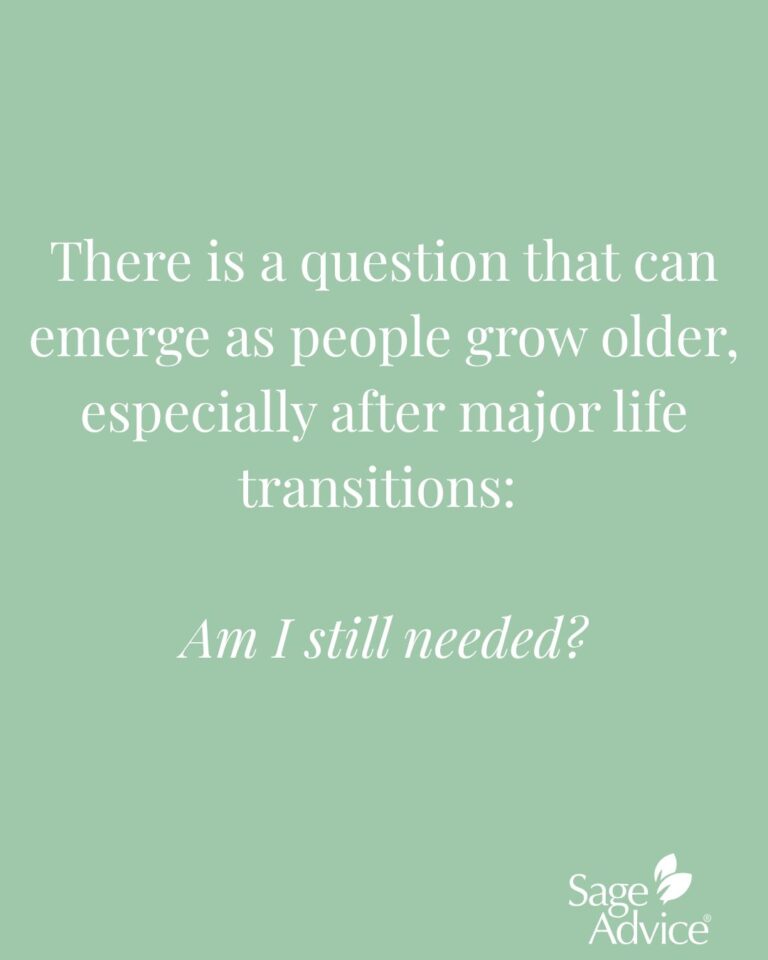
There is a quiet question that can emerge as people grow older, especially after major life transitions like retirement, relocation, or the loss of familiar routines: Am I still needed?

It is a tender question, but also a profoundly important one. Because to feel needed is to feel connected to life beyond ourselves. It is to know that our presence carries weight, that our wisdom has value, and that our contribution — whether large or small — still matters. At Sage Collective®, we believe this feeling is not peripheral to vibrant living. It is central to it.

Purpose in later life doesn’t require launching a new career, writing a memoir, or becoming busier than ever. More often, it reveals itself in smaller, steadier ways: mentoring someone younger, checking in on a neighbor, tending a garden, joining a choir, volunteering in the community, helping a grandchild with homework, showing up for a friend. These acts may seem ordinary, but they create the threads that keep us tied to meaning. And meaning has power.

When we feel connected to something larger than ourselves, we are often more motivated to care for our bodies, protect our peace, and remain engaged with the world around us. Purpose can help create structure. It can give shape to the day. It can remind us that we’re still growing, still contributing, still part of the larger human story. Research on volunteering in older adulthood has linked it with better well-being and a range of healthier outcomes, reinforcing what many people know intuitively: contribution nourishes the contributor, too, and is just as important as mindset.

How we speak to ourselves about aging matters. If aging is seen only as decline, loss, or narrowing possibility, it becomes harder to imagine a future filled with joy, relevance, and discovery. But when aging is understood as an ongoing season of becoming — one that still holds room for curiosity, creativity, and connection — we create space for a different experience altogether. Research highlighted this spring found that positive views of aging were associated with better physical and cognitive trajectories over time.

We’re not advocating to deny life’s challenges or pretend that optimism erases difficulty. Rather, we recognize that our need to belong, to contribute, and to be seen doesn’t fade with age. In many ways, it becomes even more essential. At Sage Collective®, we celebrate aging as a dynamic, creative, deeply human stage of life. — not a closing chapter. To age well is to remain in relationship with possibility, and to keep finding ways to offer what only you can offer.


› Back to top
« back
02.25.26 | Fitness & Activity

Healthspan is the Goal. Joyspan is the Engine.

In recent times, the national conversation around aging has sharpened its focus. We’re hearing more about brain health. About mobility. About dementia prevention. About anti-inflammatory diets and strength training and sleep optimization.

The word of the moment is healthspan — the number of years we live in good health. It’s an important shift. But at Sage Collective®, we’ve been asking a parallel question for some time now:

What makes those healthy years feel worth living?

Last year, we named it joyspan — measuring life in moments, not years. And now, as longevity science evolves, something beautiful is becoming clear: Joy isn’t separate from healthspan.  Joy may be one of its strongest predictors.

The Science is Catching Up to the Spirit
Research increasingly confirms what many older African Americans already know intuitively:

  • Social connection protects cognitive function.
  • Purpose reduces risk of decline.
  • Movement boosts mood and memory.
  • Laughter lowers stress hormones.
  • Optimism correlates with longevity.

In other words, joy isn’t decorative. It’s neurological. When we speak about preventing dementia, we’re also speaking about engagement. When we speak about mobility, we’re also speaking about dignity. When we speak about nutrition, we’re also speaking about culture and memory.

Healthspan may be measured in years. Joyspan is measured in vitality. And the two are deeply intertwined.

Joy as a Brain-Healthy Practice
Consider this:

  • A walking group isn’t just fall prevention. It’s friendship.
  • A dance class isn’t just cardio. It’s expression.
  • Learning to use new technology isn’t just cognitive training. It’s confidence.
  • Cooking a traditional meal isn’t just nutrition. It’s continuity.

Joy stimulates the brain’s reward system. It encourages participation. It builds resilience against stress — one of the quiet accelerants of aging. A life that feels meaningful is a life we stay engaged in. And engagement is protective.

From Prevention to Participation
The modern longevity movement often emphasizes avoidance:  Avoid decline. Avoid disease. Avoid frailty. But what if we shifted toward participation? Participate in curiosity. In creativity. In community.

Participation builds joy. Joy builds resilience. Resilience supports healthspan. This isn’t wishful thinking. It’s behavioral science.

Joyspan as a Design Principle
If healthspan asks, How long can I remain healthy?  Joyspan asks, What makes me want to?

That question reframes everything. It moves us beyond metrics into meaning. Beyond survival into significance. Beyond prevention into presence.

At Sage Collective®, vibrant living has never been about chasing youth. It’s about expanding aliveness, so that joy becomes the infrastructure, not the icing.

A New Longevity Equation
Perhaps the future of aging is not lifespan vs. healthspan vs. joyspan. Perhaps it’s this:

Lifespan gives us time.
Healthspan gives us capacity.
Joyspan gives us reason.

And when all three align, aging becomes a deepening, not a narrowing.

› Back to top
« back
02.18.26 | Sage Advice®

It’s Never Too Late to Tell Your Story

There comes a moment in life when you realize that your story is not behind you—it is within you. Every lesson learned, every obstacle overcome, every joy experienced, and every unexpected turn has shaped a narrative unlike any other. At Sage Collective®, we believe that telling your story is one of the most powerful acts of vibrant living. And perhaps most importantly, it’s never too late to begin.

For older African Americans, storytelling carries an even deeper significance. For generations, stories have been a way to preserve truth, transmit wisdom, and affirm identity in a world that did not always document—or honor—those lived experiences. Stories were shared at kitchen tables, on front porches, in barbershops, in beauty salons, and in places of worship. They carried history forward when history books did not.

Your story is part of that continuum.

Your Story Has Value—Right Now
It is easy to assume that storytelling belongs to the past—that it is something reserved for professional writers, public figures, or historians. But storytelling is not about performance. It is about presence. It is about honoring your life as it has been lived. You do not need to have lived a famous life to have lived a meaningful one.

The courage it took to navigate segregation. The pride of building a career or raising a family. The quiet reinventions. The risks taken. The losses endured. The dreams pursued. These experiences are rich with wisdom—not only for younger generations, but for yourself. Telling your story allows you to see your life more clearly. It reveals patterns of resilience, growth, and strength that may have been invisible while you were busy living them. And sometimes, in the act of telling, we discover that our story is still unfolding.

Storytelling Is an Act of Legacy
When you tell your story, you offer a gift that extends beyond your lifetime. Your children, grandchildren, and community members may never fully know what it was like to live in your time—to witness the changes you witnessed, to carry the responsibilities you carried, or to experience the world through your eyes. Your story becomes a bridge between generations. It preserves not only what happened, but how it felt.

This is how legacy is built—not only through accomplishments, but through reflection, honesty, and voice.

And storytelling today takes many forms. It can be spoken, written, recorded, or shared through conversation. Some people journal. Others record video messages. Some participate in oral history projects or simply share memories during family gatherings. There is no single right way to begin. There is only the decision to start.

Telling Your Story Strengthens Your Sense of Self
Storytelling is not only about looking back—it is about understanding who you are now. When you reflect on your life, you reconnect with your strength. You remember how much you have overcome. You reclaim moments that shaped you. You honor the younger version of yourself who kept going, even when the path was uncertain. This process can bring clarity, healing, and renewed purpose.

It can also inspire others. Your story may give someone else permission to persevere. To begin again. To believe that growth does not end with age.

Your Voice Matters
At Sage Collective®, we believe that vibrant living includes honoring your voice and your lived experience. Your story is not complete simply because time has passed. In many ways, it becomes more powerful with age—tempered by wisdom, perspective, and truth.

You do not need to wait for the “right time.” You do not need perfect words. You only need to begin. Because it’s never too late to tell your story, and the world is better when you do.

› Back to top
« back
01.15.26 | Spirituality & Religion

The Courage to Rest

Rest is often misunderstood. In a culture that prizes productivity and momentum, rest is framed as a reward—something earned only after effort—or worse, as a sign of disengagement. At Sage Collective®, we see rest differently. We see it as an essential practice of vibrant living, and one that requires real courage.

The courage to rest begins with listening. To the body’s signals and emotional needs, recognizing that constant activity is not the same as vitality. For older adults, rest is not an absence from life—it is a way of staying meaningfully present within it.

As we age, rest becomes less optional and more intentional. It supports physical health, cognitive clarity, and emotional resilience. But beyond these benefits, rest carries a deeper wisdom: it allows us to shift from striving to attunement—from doing to being.

Choosing rest often means unlearning a lifetime of messages that equate worth with output. It may mean saying no without justification. Letting a day unfold without a checklist. Sitting quietly with a book, a memory, or a view, allowing time to soften and expand. These choices can feel surprisingly brave.

Rest is also deeply restorative for the mind. In stillness, reflection becomes possible. Thoughts settle. Feelings surface without demand. Creativity often returns—not through effort, but through space. Many people find that their most meaningful insights arrive not while pushing forward, but while pausing.

At Sage Collective®, we believe vibrant living includes honoring rhythm. Just as nature moves through cycles of activity and dormancy, so do we. Rest is the season that allows integration—of experience, learning, and emotion. Without it, even the most meaningful engagement becomes unsustainable.

Importantly, rest is not a solitary act alone. It is supported by environments and communities that value care over constant productivity. Spaces that welcome pause. Relationships that respect limits. Cultures that understand that renewal strengthens participation rather than diminishes it.

Consider the older adult who protects quiet mornings as a form of self-respect. Or the one who schedules rest with the same intention as social time, recognizing both as essential. Or the community that creates room for reflection, conversation, and shared calm.

These acts are not retreats from life. They are investments in it.

As the year begins, Sage Collective® invites a reframing: rest not as a reward for endurance, but as a rhythm that sustains engagement, curiosity, and connection. The courage to rest is the courage to trust that life does not slip away when we pause—that it often becomes clearer.

Rest, practiced with intention, is not the opposite of vibrant living. It is one of its most powerful expressions.

› Back to top
« back
07.17.25 | Community

From Garden to Table: Savoring the Benefits of Your Indoor Herb Garden

At Sage Collective®, we believe that vibrant living is about embracing the cycles of nature, the power of intention, and the small daily joys that nourish the body and spirit. Last summer, we shared the basics of creating an indoor herb garden—a wonderful way to bring greenery into your home, enhance your meals, and stay connected to the rhythms of growth. This season, we invite you to take the next step: harvesting and using your herbs in ways that foster creativity, connection, and mindfulness.

A Mindful Harvest
Tending to your herb garden is certainly about the end result, but it’s also about the quiet, steady practice of care. When you harvest your herbs, do so mindfully. Snip basil leaves or sprigs of thyme in the morning, when the flavors are most concentrated, and take a moment to appreciate the scent that rises from your fingers. Ask yourself: What does this plant teach me about patience or change? What else in my life is ready to be gathered and savored?

Simple Recipes with Heart
Now that you have a bounty of fresh herbs at your fingertips, it’s time to enjoy their flavor in meals that feel both grounding and joyful. Try these easy, herb-forward ideas:

  • Basil Pesto: Blend fresh basil leaves with garlic, olive oil, pine nuts (or walnuts), Parmesan, and a squeeze of lemon. Serve over pasta or spread on toast.
  • Mint Tea: Steep fresh mint leaves in hot water for 5–10 minutes. Add a slice of lemon or a drizzle of honey for added comfort.
  • Herbed Olive Oil: Lightly bruise rosemary, thyme, or oregano and place in a bottle with olive oil. Let sit for 1–2 weeks to infuse. Drizzle over salads, pasta, or roasted vegetables.
  • Thyme-Roasted Veggies: Toss carrots, potatoes, or squash with olive oil, salt, and fresh thyme. Roast at 400°F until golden and tender.

Each recipe is an opportunity to celebrate the labor of your care, and the richness that comes from bringing something to life with your own hands.

Tea for Two (or Ten)
Herbs also offer the chance to create personalized tea blends that comfort and uplift. Consider pairing:

  • Mint + lemon balm for relaxation
  • Thyme + sage for respiratory support
  • Lavender + chamomile for sleep and calm

You can dry your herbs by hanging them in small bunches upside down, or laying them on a mesh screen in a warm, dry spot. Once dried, store them in labeled jars and use them to prepare your own signature blends—perfect for gifting or sharing with a neighbor over conversation.

Sharing the Bounty
One of the most meaningful aspects of herb gardening is the ability to share your harvest. A small bundle of rosemary wrapped in twine, a jar of homemade herbed oil, or a few tea sachets made with love can be beautiful, heartfelt gifts. These gestures carry more than flavor—they carry the story of your care, your intention, and your willingness to nurture both plants and people.

Honoring Growth in All Its Forms
At Sage Collective®, we view these small rituals as part of a larger practice of intentional living. From the first sprout to the final harvest, your herb garden is a reflection of what’s possible when we nurture life with curiosity and compassion. It’s a daily invitation to check in, to take joy in progress, and to savor what you’ve cultivated.

As your herbs grow, so too does your capacity for reflection, creativity, and giving. Let this second season of your herb garden be one of sharing, experimenting, and staying rooted in the pleasure of what you’ve made possible.

There’s no such thing as just a windowsill garden. In the hands of someone who believes in vibrant living, it’s a testament to resilience, nourishment, and joy.

Credit: Anne Nygard on Unsplash
› Back to top
« back
07.10.25 | Community

The Power of Porch Sitting: Mindfulness, Memory, and Connection in the Summertime

At Sage Collective®, we believe in the beauty of everyday rituals—those simple acts that slow us down, bring us joy, and connect us more deeply to ourselves and our communities. One of summer’s most beloved, and often overlooked, rituals is porch sitting.

For older African Americans especially, porch sitting is more than a seasonal pastime—it’s a cultural tradition, a space of wisdom-sharing, and a quiet act of resistance in a world that moves too fast. In this season of sunshine and stillness, we invite you to revisit this powerful practice and reflect on what it offers us today.

Porch Sitting as a Form of Mindfulness
Mindfulness doesn’t always have to look like meditation. Sometimes, it looks like a rocking chair, a warm breeze, and the hum of cicadas in the distance. It looks like watching the light change on the sidewalk, or simply sitting with no agenda.

Porch sitting slows time. It allows us to be present—noticing the color of the sky, the rustle of leaves, the smell of jasmine on the wind. This sensory engagement grounds us in our bodies and our breath, fostering a kind of meditative clarity. In a world that often glorifies productivity, porch sitting is an intentional choice to savor stillness. And that, in itself, is healing.

A Cultural Touchstone of Community and Wisdom
In many Black communities, the front porch has long been a stage for storytelling, music, debate, and neighborly connection. It’s where kids learned how to play spades, where grown folks talked politics, and where elders passed down history and advice. The porch has always been a place of belonging.

For older adults, it can continue to serve as a sacred gathering place—whether that means reconnecting with neighbors, hosting grandchildren, or simply waving to passersby. These everyday interactions build trust, keep us socially engaged, and offer moments of lightness that nourish emotional well-being.

At Sage Collective®, we celebrate the importance of such intergenerational spaces. They are places where the past, present, and future meet—where wisdom is not just shared, but lived out loud.

Porch Sitting as Self-Care
Too often, we think of self-care as something extravagant or out of reach. But true self-care is simple. It’s allowing yourself to pause. To rest your body. To ease your thoughts. To sit without the pressure of fixing or doing or solving.

Porch sitting reminds us that peace is available to us in the quiet moments. A cool drink in hand. A favorite song playing low. A conversation that doesn’t need to go anywhere. This kind of intentional rest helps regulate our nervous systems, reduces stress, and fosters gratitude. Especially in older age, these practices are vital to vibrant living.

Creating Your Summer Sanctuary
Whether you have a traditional porch, a balcony, a stoop, or even a windowsill, you can create your own summer sanctuary. Add a comfortable chair, a potted plant, a wind chime or candle—anything that brings you ease. Make it a place you return to each day, even if just for 10 minutes. Bring a journal, a book of poetry, or simply your presence. Let this be a season of pausing. Of listening to the world around you—and to yourself.

At Sage Collective®, we know that vibrant living isn’t about doing more—it’s about living well. Porch sitting reminds us that joy and wellness don’t always require movement. Sometimes, they require stillness. And presence. And the courage to simply be.

So, this summer, we invite you to step outside. To sit. To breathe. And to let the power of porch sitting reconnect you with what matters most.

Untitled Photo by Dorothea Lange, 1939 July. http://hdl.loc.gov/loc.pnp/fsa.8b33923
› Back to top