« back
04.29.26 | Arts & Culture

International Jazz Day: Improvisation, Connection, and the Art of Vibrant Living

Every year on April 30, International Jazz Day invites the world to celebrate a musical form that has long stood for creativity, resilience, freedom, and connection. UNESCO proclaimed the day in 2011, recognizing jazz not only as an art form, but as a force for peace, dialogue, and mutual understanding across cultures. In 2026, the global celebration takes on special resonance in Chicago, which has been named the host city for the International Jazz Day All-Star Global Concert at the Lyric Opera of Chicago.

At Sage Collective®, International Jazz Day feels especially meaningful. Jazz is a living expression of many values that shape vibrant aging: curiosity, adaptability, collaboration, self-expression, and the confidence to keep discovering something new. Jazz reminds us that mastery and improvisation can coexist. It shows us that structure matters, but so does freedom. And perhaps most importantly, it demonstrates that every voice has a place in the larger composition.

There is something deeply affirming about that idea as we age. Later life is often described in overly fixed terms, as if growth belongs only to the young. Jazz offers another model. In jazz, experience matters. Listening matters. Timing matters. What you have lived through changes what you hear and what you play. The beauty is not in perfection, but in interpretation. A standard played at seventy does not mean the same thing it did at twenty. It carries more memory, more nuance, more feeling. That is not decline. That is depth.

Jazz also speaks to the value of improvisation in everyday life. Aging, like jazz, asks us to remain responsive. Plans change. Circumstances shift. We learn to adjust tempo, find new rhythms, and stay open to surprise. That kind of flexibility is not always easy, but it can be deeply life-giving. Jazz teaches us that improvisation is not chaos. It is presence. It is paying close attention to what is happening now and answering it with creativity.

That is a powerful lesson for older adults, and for all of us.

International Jazz Day was created in part to highlight jazz as an educational tool and as a way to bring people and communities together. UNESCO describes jazz as a universal language that crosses borders and fosters dialogue. That spirit of connection aligns beautifully with Sage Collective®’s commitment to meaningful engagement, lifelong learning, and the rich exchange of ideas across generations.

Jazz is also communal by nature. Even in a solo, someone is listening. Someone is supporting. Someone is preparing to respond. The music depends on relationship. For older adults, that offers a powerful reminder that creative life does not happen in isolation. Whether we are listening to a recording, attending a local performance, sharing favorite songs with friends, or learning more about the history of jazz, we are participating in a cultural conversation that is both personal and collective. And there is joy in that participation.

This International Jazz Day, Sage Collective® celebrates jazz not only for its sound, but for what it represents: lifelong creativity, cultural memory, emotional vitality, and the courage to keep improvising. Jazz tells us that expression can deepen with age. It tells us that listening is as important as speaking. It tells us that individuality and community are not opposites, but partners.

To live vibrantly is not to follow a rigid score. It is to stay awake to possibility, to remain in dialogue with the world around us, and to trust that our voice still belongs in the music. On April 30, that is something worth celebrating.

 

› Back to top
« back
04.22.26 | Health & Wellness

Why Feeling Needed Matters More Than Ever as We Age

Healthy aging is often framed in practical terms: eat well, stay active, get enough sleep, keep your mind sharp. Those habits matter. But a growing body of research suggests that something less tangible may be just as important: the way we think about aging, our sense of purpose, and whether we feel that we still matter in the lives of others. Recent reporting in The New York Times highlighted evidence linking optimism, purpose, and volunteering with better health and longevity outcomes in later life.

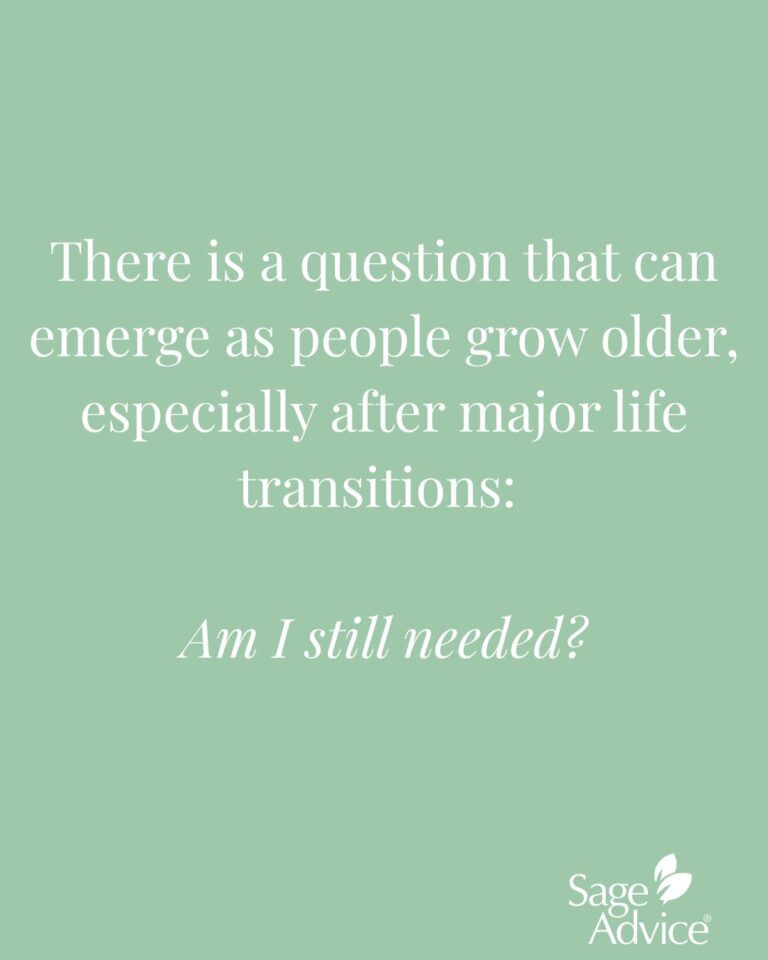
There is a quiet question that can emerge as people grow older, especially after major life transitions like retirement, relocation, or the loss of familiar routines: Am I still needed?

It is a tender question, but also a profoundly important one. Because to feel needed is to feel connected to life beyond ourselves. It is to know that our presence carries weight, that our wisdom has value, and that our contribution — whether large or small — still matters. At Sage Collective®, we believe this feeling is not peripheral to vibrant living. It is central to it.

Purpose in later life doesn’t require launching a new career, writing a memoir, or becoming busier than ever. More often, it reveals itself in smaller, steadier ways: mentoring someone younger, checking in on a neighbor, tending a garden, joining a choir, volunteering in the community, helping a grandchild with homework, showing up for a friend. These acts may seem ordinary, but they create the threads that keep us tied to meaning. And meaning has power.

When we feel connected to something larger than ourselves, we are often more motivated to care for our bodies, protect our peace, and remain engaged with the world around us. Purpose can help create structure. It can give shape to the day. It can remind us that we’re still growing, still contributing, still part of the larger human story. Research on volunteering in older adulthood has linked it with better well-being and a range of healthier outcomes, reinforcing what many people know intuitively: contribution nourishes the contributor, too, and is just as important as mindset.

How we speak to ourselves about aging matters. If aging is seen only as decline, loss, or narrowing possibility, it becomes harder to imagine a future filled with joy, relevance, and discovery. But when aging is understood as an ongoing season of becoming — one that still holds room for curiosity, creativity, and connection — we create space for a different experience altogether. Research highlighted this spring found that positive views of aging were associated with better physical and cognitive trajectories over time.

We’re not advocating to deny life’s challenges or pretend that optimism erases difficulty. Rather, we recognize that our need to belong, to contribute, and to be seen doesn’t fade with age. In many ways, it becomes even more essential. At Sage Collective®, we celebrate aging as a dynamic, creative, deeply human stage of life. — not a closing chapter. To age well is to remain in relationship with possibility, and to keep finding ways to offer what only you can offer.


› Back to top
« back
01.15.26 | Health & Wellness

The Courage to Rest

Rest is often misunderstood. In a culture that prizes productivity and momentum, rest is framed as a reward—something earned only after effort—or worse, as a sign of disengagement. At Sage Collective®, we see rest differently. We see it as an essential practice of vibrant living, and one that requires real courage.

The courage to rest begins with listening. To the body’s signals and emotional needs, recognizing that constant activity is not the same as vitality. For older adults, rest is not an absence from life—it is a way of staying meaningfully present within it.

As we age, rest becomes less optional and more intentional. It supports physical health, cognitive clarity, and emotional resilience. But beyond these benefits, rest carries a deeper wisdom: it allows us to shift from striving to attunement—from doing to being.

Choosing rest often means unlearning a lifetime of messages that equate worth with output. It may mean saying no without justification. Letting a day unfold without a checklist. Sitting quietly with a book, a memory, or a view, allowing time to soften and expand. These choices can feel surprisingly brave.

Rest is also deeply restorative for the mind. In stillness, reflection becomes possible. Thoughts settle. Feelings surface without demand. Creativity often returns—not through effort, but through space. Many people find that their most meaningful insights arrive not while pushing forward, but while pausing.

At Sage Collective®, we believe vibrant living includes honoring rhythm. Just as nature moves through cycles of activity and dormancy, so do we. Rest is the season that allows integration—of experience, learning, and emotion. Without it, even the most meaningful engagement becomes unsustainable.

Importantly, rest is not a solitary act alone. It is supported by environments and communities that value care over constant productivity. Spaces that welcome pause. Relationships that respect limits. Cultures that understand that renewal strengthens participation rather than diminishes it.

Consider the older adult who protects quiet mornings as a form of self-respect. Or the one who schedules rest with the same intention as social time, recognizing both as essential. Or the community that creates room for reflection, conversation, and shared calm.

These acts are not retreats from life. They are investments in it.

As the year begins, Sage Collective® invites a reframing: rest not as a reward for endurance, but as a rhythm that sustains engagement, curiosity, and connection. The courage to rest is the courage to trust that life does not slip away when we pause—that it often becomes clearer.

Rest, practiced with intention, is not the opposite of vibrant living. It is one of its most powerful expressions.

› Back to top
« back
07.10.25 | Sage Advice®

The Power of Porch Sitting: Mindfulness, Memory, and Connection in the Summertime

At Sage Collective®, we believe in the beauty of everyday rituals—those simple acts that slow us down, bring us joy, and connect us more deeply to ourselves and our communities. One of summer’s most beloved, and often overlooked, rituals is porch sitting.

For older African Americans especially, porch sitting is more than a seasonal pastime—it’s a cultural tradition, a space of wisdom-sharing, and a quiet act of resistance in a world that moves too fast. In this season of sunshine and stillness, we invite you to revisit this powerful practice and reflect on what it offers us today.

Porch Sitting as a Form of Mindfulness
Mindfulness doesn’t always have to look like meditation. Sometimes, it looks like a rocking chair, a warm breeze, and the hum of cicadas in the distance. It looks like watching the light change on the sidewalk, or simply sitting with no agenda.

Porch sitting slows time. It allows us to be present—noticing the color of the sky, the rustle of leaves, the smell of jasmine on the wind. This sensory engagement grounds us in our bodies and our breath, fostering a kind of meditative clarity. In a world that often glorifies productivity, porch sitting is an intentional choice to savor stillness. And that, in itself, is healing.

A Cultural Touchstone of Community and Wisdom
In many Black communities, the front porch has long been a stage for storytelling, music, debate, and neighborly connection. It’s where kids learned how to play spades, where grown folks talked politics, and where elders passed down history and advice. The porch has always been a place of belonging.

For older adults, it can continue to serve as a sacred gathering place—whether that means reconnecting with neighbors, hosting grandchildren, or simply waving to passersby. These everyday interactions build trust, keep us socially engaged, and offer moments of lightness that nourish emotional well-being.

At Sage Collective®, we celebrate the importance of such intergenerational spaces. They are places where the past, present, and future meet—where wisdom is not just shared, but lived out loud.

Porch Sitting as Self-Care
Too often, we think of self-care as something extravagant or out of reach. But true self-care is simple. It’s allowing yourself to pause. To rest your body. To ease your thoughts. To sit without the pressure of fixing or doing or solving.

Porch sitting reminds us that peace is available to us in the quiet moments. A cool drink in hand. A favorite song playing low. A conversation that doesn’t need to go anywhere. This kind of intentional rest helps regulate our nervous systems, reduces stress, and fosters gratitude. Especially in older age, these practices are vital to vibrant living.

Creating Your Summer Sanctuary
Whether you have a traditional porch, a balcony, a stoop, or even a windowsill, you can create your own summer sanctuary. Add a comfortable chair, a potted plant, a wind chime or candle—anything that brings you ease. Make it a place you return to each day, even if just for 10 minutes. Bring a journal, a book of poetry, or simply your presence. Let this be a season of pausing. Of listening to the world around you—and to yourself.

At Sage Collective®, we know that vibrant living isn’t about doing more—it’s about living well. Porch sitting reminds us that joy and wellness don’t always require movement. Sometimes, they require stillness. And presence. And the courage to simply be.

So, this summer, we invite you to step outside. To sit. To breathe. And to let the power of porch sitting reconnect you with what matters most.

Untitled Photo by Dorothea Lange, 1939 July. http://hdl.loc.gov/loc.pnp/fsa.8b33923
› Back to top