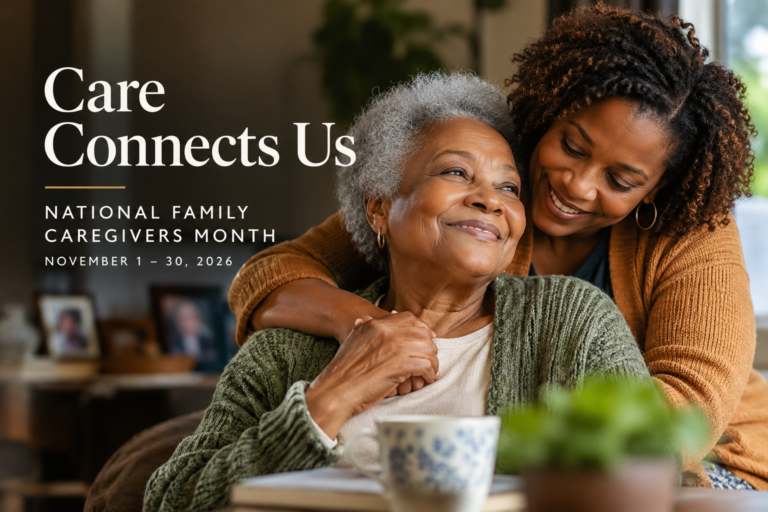
Care Connects Us: Honoring the People Who Care for Others
Caregiving often begins without a formal announcement. A daughter starts accompanying her mother to medical appointments. A husband takes over the household routines his wife once managed. A sister begins calling every evening to make sure her brother has taken his medication. A neighbor starts bringing groceries to someone who can no longer shop easily.
At first, these may seem like small acts of kindness. Over time, they can become the structure around which another person’s daily life is organized.
Throughout November, National Family Caregivers Month recognizes the millions of Americans who provide care to family members, friends, and loved ones. This year’s theme, “Care Connects Us,” chosen by the Caregiver Action Network, celebrates the relationships that sustain caregiving while drawing attention to the information, resources, and community support caregivers need.
At Sage Collective®, we see caregiving as an essential part of vibrant living, not only for those receiving care but also for the people providing it. It is an expression of connection, responsibility, and love. But it is also demanding work, and recognizing its value means acknowledging the needs of caregivers themselves.
A Growing Part of American Life
Family caregiving is far more widespread than many people realize.
According to the 2025 Caregiving in the U.S. report from AARP and the National Alliance for Caregiving, approximately 63 million American adults — nearly one in four — provide ongoing care to someone with a medical condition or disability. That represents an increase of roughly 20 million caregivers since 2015.
The responsibilities involved can be extensive. Caregivers coordinate medical appointments, manage medications, prepare meals, provide transportation, assist with bathing and dressing, handle finances, communicate with healthcare providers, and respond to emergencies. Many are doing this while working, raising children, managing their own health conditions, or navigating the challenges of aging themselves.
The same AARP report found that one in five caregivers reported poor health, while approximately one-quarter were taking on debt because of caregiving. These findings remind us that the benefits of family care often come with significant personal costs. Caregiving may be motivated by love, but love doesn’t eliminate exhaustion, financial strain, or the need for help.
The Strength of Black Caregiving Traditions
Within African American communities, caregiving has long been sustained by networks that extend beyond the immediate household. Grandparents help raise grandchildren. Adult children support aging parents. Siblings share responsibilities. Churches organize visits and meals. Friends and neighbors provide transportation, companionship, and practical assistance. These relationships often reflect traditions of mutual care, collective responsibility, and intergenerational connection.
They also reflect a history in which Black families and communities have often had to create their own systems of support in response to unequal access to healthcare, financial resources, and institutional services.
These networks remain extraordinary sources of strength, but we should be careful not to romanticize the burden they sometimes carry. A family may be deeply committed to caring for an older relative while still struggling to find affordable professional assistance. An adult daughter may take pride in supporting her parents while quietly sacrificing career opportunities or her own retirement savings. A spouse may be devoted to a partner’s well-being while becoming increasingly isolated.
At Sage Collective®, our understanding of community recognizes both sides of this experience. The strength of our relationships matters. So does ensuring that the people holding those relationships together receive care themselves.
When the Caregiver Is an Older Adult
We often picture caregivers as middle-aged adults supporting aging parents. But many caregivers are older adults themselves. A husband in his seventies may be caring for a wife living with dementia. A grandmother may be raising grandchildren while also managing her own chronic health conditions. Two longtime friends may help one another navigate medical appointments, mobility limitations, or the loss of a spouse.
These relationships complicate the familiar distinction between caregiver and care recipient. Someone can be managing a health condition while also providing essential care to another person.
And caregiving relationships can change over time. The person who once provided support may eventually need support. The adult child who was cared for becomes the caregiver. Friends who have relied on one another for decades may find themselves exchanging new forms of help.
This is part of what makes caregiving such a meaningful expression of interdependence. Across the lifespan, most of us will experience both sides of care.
Caregivers Need Care, Too
One of the most persistent challenges in family caregiving is the tendency for caregivers to place their own well-being last. Medical appointments get postponed. Exercise routines disappear. Friendships receive less attention. Sleep becomes fragmented. Personal interests are set aside because there is always something more immediate to do.
These sacrifices can accumulate gradually, often without anyone noticing. This is why respite care deserves particular attention. Temporary relief, whether provided by another family member, a trusted friend, a community program, or a professional caregiver, can give someone time to rest, attend to personal responsibilities, reconnect with others, or simply experience a few hours without being responsible for someone else’s needs.
The same is true of emotional support. Caregivers benefit from having people with whom they can speak openly about frustration, uncertainty, grief, and fatigue without feeling that these emotions somehow diminish their love.
Making Support More Than a Gesture
National Family Caregivers Month offers an opportunity to express appreciation, but appreciation becomes more meaningful when it takes the form of practical support.
Rather than simply telling a caregiver to ask for help, we might offer something specific. Bring dinner on Thursday. Drive a loved one to an appointment. Pick up prescriptions. Spend an afternoon with the person receiving care so the caregiver can take a break. Help research community services or navigate an insurance question.
Faith communities, neighborhood organizations, senior centers, employers, and healthcare providers can also help create stronger networks of support. Caregiving shouldn’t depend entirely on the resources or endurance of one individual.
The Caregiver Action Network’s 2026 campaign offers educational resources, caregiver stories, and a November webinar series addressing the realities of balancing work, family, and long-term caregiving. These resources reinforce the month’s central message: connection should extend beyond the relationship between caregiver and care recipient to include the larger community.
Care Is Something We Share
At Sage Collective®, our commitment to vibrant living rests on the understanding that well-being is shaped by more than individual choices. It is also shaped by the relationships, environments, and communities that make healthy living possible.
Family caregiving brings that understanding into sharp focus. It reminds us that independence and interdependence are not opposites. That receiving care does not diminish dignity. That providing care should not require surrendering one’s own well-being. And that a strong community is one in which responsibility can be shared rather than carried alone.
During National Family Caregivers Month, we celebrate the people who show up, often quietly and consistently, for those who need them.