« back
11.19.25 | Community

Seven Meaningful Questions to Ask the Older Adults You Love

When we ask our aging parents or loved ones how their day was, we often get a familiar answer: “Oh, fine.” But beneath that simple reply, there’s often a world of thought, emotion, and memory waiting to be invited into conversation.

At Sage Collective®, we believe vibrant living isn’t just about activity—it’s about connection. The right questions can turn everyday exchanges into moments of empathy, reflection, and joy. Inspired by therapist Amy Morin’s advice for parents seeking deeper dialogue with their children, we’ve adapted her wisdom for a different kind of relationship: the one between adult children and their aging parents.

Here are seven questions that go beyond “How was your day?”—each designed to spark meaningful conversation and strengthen emotional connection.

  1. What was the best part of your day?
    This simple question invites gratitude. When older adults reflect on moments of joy—whether it’s a morning cup of coffee, a friendly call, or a walk in the sun—it helps strengthen optimism and well-being. You might share your own, too: “The best part of my day was catching up with you.”
  2. What’s something that made you think today?
    Curiosity doesn’t fade with age—it deepens. Asking this question encourages engagement with the world, whether through a news story, a book, or a passing conversation. It reminds your loved one that their insights matter and that you value their perspective.
  3. Who made you smile today?
    This brings relationships into focus. It celebrates social connection—an essential ingredient for emotional health—and can open the door to stories about neighbors, caregivers, or longtime friends. It’s also an opportunity to notice and nurture community.
  4. What challenged you today—and how did you handle it?
    Aging can bring daily obstacles, both big and small. Asking about them with genuine curiosity (not concern) honors resilience. It shows trust in your loved one’s problem-solving and reinforces their sense of agency and self-efficacy.
  5. Who did you help—or who helped you—today?
    Giving and receiving help are both acts of connection. This question reframes independence as interdependence, highlighting the reciprocity that defines healthy relationships. It also provides insight into what support feels meaningful to your loved one.
  6. What’s something new you’d like to try?
    Encouraging experimentation—whether it’s a new recipe, a class, or a simple change in routine—helps keep the spirit of growth alive. It reminds your loved one that curiosity has no age limit and that new experiences remain within reach.
  7. What are you looking forward to tomorrow?
    Hope is a powerful motivator. This question shifts focus toward anticipation and purpose—helping older adults maintain a sense of rhythm, continuity, and excitement about the days ahead.

Small questions can make a big difference. Each one is an act of care, a signal that you’re not just checking in—you’re truly listening. And when we listen deeply, we help the people we love stay connected not only to us, but also to themselves.
› Back to top
« back
11.13.25 | Health & Wellness

Plug-in to Care: Honoring National Family Caregivers Month 2025

Each November, we pause to honor the millions of family caregivers whose compassion, patience, and daily dedication sustain loved ones across generations. This year’s National Family Caregivers Month theme—“Plug-in to Care”invites all of us to connect more deeply: to one another, to resources, and to the networks that make caregiving more supported and sustainable.

At Sage Collective®, we believe that vibrant living thrives on connection. Our mission has always been to inspire older adults to live more fully—through community, creativity, and conscious care of mind, body, and spirit. The “Plug-in to Care” theme beautifully echoes those values, reminding us that no one should walk the caregiving journey alone.

The Meaning Behind “Plug-in to Care”
Caregiving today is more interconnected than ever before. The phrase “plug-in” highlights both the digital and human aspects of connection—using technology, education, and community to empower caregivers and reduce isolation. Whether that means joining a virtual support group, exploring a caregiving app, or simply reaching out for a conversation, the act of plugging in reinforces that support is available and community is near.

At its heart, this year’s theme is about recognition: seeing caregivers not only as helpers, but as vital members of our health and social ecosystems. When caregivers are equipped with tools and support, everyone benefits—from the person receiving care to the broader community around them.

Connection in Action
To “plug-in to care” means finding—and offering—connection in many forms:

  • Access tools and knowledge. Online workshops, educational videos, and caregiving platforms can offer practical skills, emotional reassurance, and inspiration.
  • Tap into networks. Community centers, local nonprofits, and organizations like Sage Collective® create spaces—both virtual and in-person—where caregivers can share stories, advice, and encouragement.
  • Seek emotional and spiritual nourishment. Caregiving can be as emotionally demanding as it is rewarding. Mindfulness, journaling, and meditation—practices we regularly explore at Sage Collective—can restore balance and resilience.
  • Celebrate the caregivers themselves. Recognition matters. Whether through a heartfelt note, shared meal, or public acknowledgment, expressing gratitude honors the humanity and strength behind caregiving.

Join Us: Caregiving & Self-Care — Finding Balance in the Journey
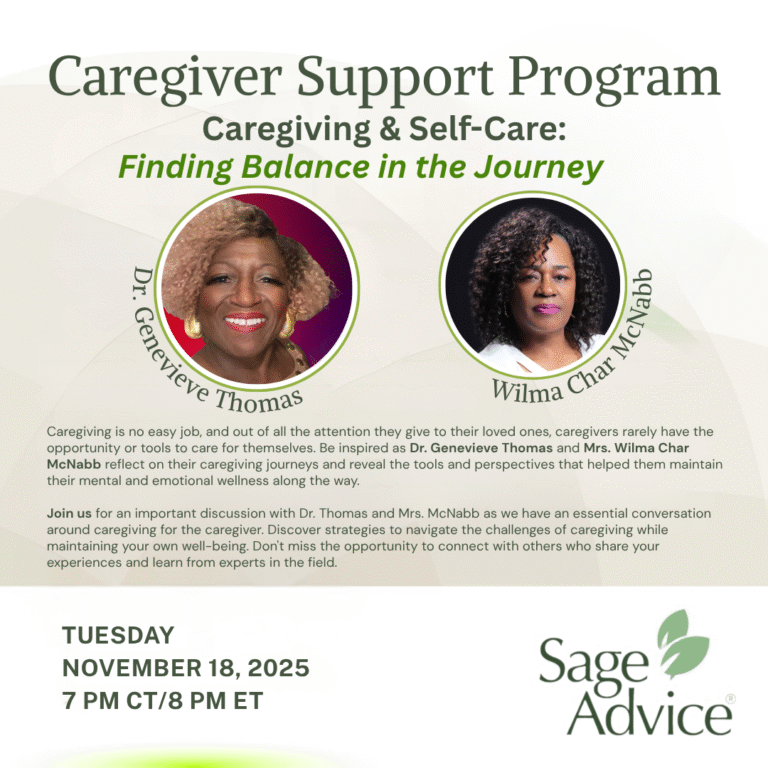
In honor of National Family Caregivers Month, Sage Collective® is hosting a special Facebook Live event: “Caregiving & Self-Care: Finding Balance in the Journey,” on November 18, 2025, at 7:00 PM CT / 8:00 PM ET.

Caregiving is no easy job, and out of all the attention they give to their loved ones, caregivers rarely have the opportunity or tools to care for themselves. Be inspired as Dr. Genevieve Thomas and Mrs. Wilma Char McNabb reflect on their caregiving journeys and share the tools and perspectives that helped them maintain mental and emotional wellness along the way.

Together, we’ll explore how caregivers can sustain their own health while caring for others—learning strategies for managing stress, fostering resilience, and nurturing a balanced sense of self. It’s an evening of connection, understanding, and encouragement—an essential conversation around caregiving for the caregiver.

Don’t miss the opportunity to connect with others who share your experiences and learn from experts in the field. RSVP today to join us for this meaningful dialogue on reflection, balance, and well-being.

Living the Message
Family caregivers are the quiet heroes who hold our communities together. “Plug-in to Care” reminds us that support, learning, and connection are not luxuries—they’re lifelines. This month and beyond, let’s honor caregivers by extending compassion, sharing knowledge, and building community.

At Sage Collective®, we celebrate caregivers as living embodiments of vibrant living—people whose strength, grace, and generosity reflect the very best of us all.

This November, and in every season that follows, may we each find new ways to plug in—to care, and to one another.

› Back to top
« back
10.29.25 | Sage Advice®

The Grace in Grit: A Reflection on Resilient Living

In the language of vibrant living, grittiness is not about being hard or unyielding. It’s about staying soft enough to keep growing, steady enough to keep moving, and brave enough to keep beginning again. At Sage Collective®, we believe that living vibrantly isn’t about avoiding friction — it’s about finding meaning and movement within it.

Redefining Grit
Psychologist Angela Duckworth, a University of Pennsylvania professor and 2013 MacArthur “Genius Grant” recipient, popularized the concept of grit through her groundbreaking research and her 2016 book, Grit: The Power of Passion and Perseverance. Her studies explored why success so often depends not on raw talent, but on sustained effort — on the ability to stay committed to long-term goals even in the face of difficulty.

But within the context of aging and community, grit takes on a more soulful dimension. It’s less about ambition and achievement, and more about endurance — the quiet, daily persistence that allows us to continue living with purpose, even when life’s terrain becomes steep or uncertain.

For older adults, grit can mean returning to watercolor painting after years away from a studio, walking daily despite arthritis, or learning to navigate new technology to stay connected with family. These acts may seem ordinary, but they are, in truth, acts of courage — small, repeated commitments to staying engaged in life.

Grit and Grace
At Sage Collective®, we see grit and grace as twin forces that shape the experience of vibrant living. Grace provides the softness that tempers determination; grit gives structure to hope. Together, they allow us to persist with compassion — toward ourselves and others.

In our community, we often see how these qualities intertwine: when someone finds new purpose through volunteering, returns to a beloved craft after loss, or steps back into connection after a season of solitude. These moments reveal the essence of grit — not stoicism, but re-engagement. Not merely endurance, but renewal.

The Everyday Practice of Grit
Grittiness can also be cultivated through daily habits that reinforce purpose and connection. In community gardens, residents learn patience with the soil and the seasons. In movement or yoga classes, they rediscover balance through repetition and release. In book clubs or creative workshops, they flex mental and emotional resilience — staying open to new ideas, new people, and new ways of seeing.

Grit doesn’t always roar. Sometimes, it whispers — “keep going.” It shows up in consistency, in curiosity, in the willingness to show up for oneself and for community, even on days when energy feels low. It’s persistence paired with perspective, a refusal to let difficulty define the horizon.

The Texture of Vibrant Living
Vibrancy, after all, isn’t a glossy state of perpetual joy. It’s a textured one — full of contrast, light and shadow, rest and renewal. Grittiness gives that texture its depth. It helps transform obstacles into opportunities for growth and creativity. It keeps us engaged with life’s dynamic rhythms, and reminds us that living fully means participating in the full spectrum of experience — the easy and the hard, the known and the unknown.

At Sage Collective®, we often say that vibrant living is a choice. Grit makes that choice sustainable. It allows us to meet the moment — whatever it brings — with heart, humor, and faith in our own capacity to adapt and thrive.

Closing Thought
Grit, then, is not about hardening. It’s about fortifying — strengthening our inner life so that we can continue to live outwardly with vibrancy, curiosity, and joy. It is the quiet strength behind every act of creative resilience, every step toward connection, every renewed commitment to live life fully — no matter our age.

› Back to top
« back
07.17.25 | Community

From Garden to Table: Savoring the Benefits of Your Indoor Herb Garden

At Sage Collective®, we believe that vibrant living is about embracing the cycles of nature, the power of intention, and the small daily joys that nourish the body and spirit. Last summer, we shared the basics of creating an indoor herb garden—a wonderful way to bring greenery into your home, enhance your meals, and stay connected to the rhythms of growth. This season, we invite you to take the next step: harvesting and using your herbs in ways that foster creativity, connection, and mindfulness.

A Mindful Harvest
Tending to your herb garden is certainly about the end result, but it’s also about the quiet, steady practice of care. When you harvest your herbs, do so mindfully. Snip basil leaves or sprigs of thyme in the morning, when the flavors are most concentrated, and take a moment to appreciate the scent that rises from your fingers. Ask yourself: What does this plant teach me about patience or change? What else in my life is ready to be gathered and savored?

Simple Recipes with Heart
Now that you have a bounty of fresh herbs at your fingertips, it’s time to enjoy their flavor in meals that feel both grounding and joyful. Try these easy, herb-forward ideas:

  • Basil Pesto: Blend fresh basil leaves with garlic, olive oil, pine nuts (or walnuts), Parmesan, and a squeeze of lemon. Serve over pasta or spread on toast.
  • Mint Tea: Steep fresh mint leaves in hot water for 5–10 minutes. Add a slice of lemon or a drizzle of honey for added comfort.
  • Herbed Olive Oil: Lightly bruise rosemary, thyme, or oregano and place in a bottle with olive oil. Let sit for 1–2 weeks to infuse. Drizzle over salads, pasta, or roasted vegetables.
  • Thyme-Roasted Veggies: Toss carrots, potatoes, or squash with olive oil, salt, and fresh thyme. Roast at 400°F until golden and tender.

Each recipe is an opportunity to celebrate the labor of your care, and the richness that comes from bringing something to life with your own hands.

Tea for Two (or Ten)
Herbs also offer the chance to create personalized tea blends that comfort and uplift. Consider pairing:

  • Mint + lemon balm for relaxation
  • Thyme + sage for respiratory support
  • Lavender + chamomile for sleep and calm

You can dry your herbs by hanging them in small bunches upside down, or laying them on a mesh screen in a warm, dry spot. Once dried, store them in labeled jars and use them to prepare your own signature blends—perfect for gifting or sharing with a neighbor over conversation.

Sharing the Bounty
One of the most meaningful aspects of herb gardening is the ability to share your harvest. A small bundle of rosemary wrapped in twine, a jar of homemade herbed oil, or a few tea sachets made with love can be beautiful, heartfelt gifts. These gestures carry more than flavor—they carry the story of your care, your intention, and your willingness to nurture both plants and people.

Honoring Growth in All Its Forms
At Sage Collective®, we view these small rituals as part of a larger practice of intentional living. From the first sprout to the final harvest, your herb garden is a reflection of what’s possible when we nurture life with curiosity and compassion. It’s a daily invitation to check in, to take joy in progress, and to savor what you’ve cultivated.

As your herbs grow, so too does your capacity for reflection, creativity, and giving. Let this second season of your herb garden be one of sharing, experimenting, and staying rooted in the pleasure of what you’ve made possible.

There’s no such thing as just a windowsill garden. In the hands of someone who believes in vibrant living, it’s a testament to resilience, nourishment, and joy.

Credit: Anne Nygard on Unsplash
› Back to top
« back
02.20.25 | Sage Advice®

Love at Any Age: A Guide to Healthy Relationships for Older Adults

Love knows no age. Whether you’re re-entering the dating world, nurturing a long-term relationship, or seeking companionship, building and maintaining a healthy relationship in your later years can be a deeply rewarding experience. As we explored in the launch of Season 2 of Sage Advice® Vibrant Living, The Podcast, we believe in fostering vibrant living, which includes meaningful relationships that bring joy, companionship, and emotional fulfillment.

If you’re looking for love or hoping to strengthen your current partnership, here are some key insights to help cultivate healthy, lasting relationships in this chapter of life.

Prioritize Open Communication
Clear and honest communication is the foundation of any successful relationship. Whether discussing personal values, expectations, or day-to-day activities, open dialogue fosters understanding and trust between partners.
Try this:

  • Share your thoughts and feelings openly, without fear of judgment.
  • Actively listen to your partner, acknowledging their concerns and perspectives.
  • Use “I” statements, such as “I feel appreciated when we spend quality time together.”

Healthy relationships thrive on mutual respect and communication, allowing both partners to feel heard and valued.

Be Patient—Good Things Take Time
Whether you’re dating after a long break or adjusting to new relationship dynamics, remember that love is a journey, not a race. Developing trust and deep emotional connections takes time.

❤️ Keep in mind:

  • If you’re dating, allow relationships to unfold naturally—there’s no rush.
  • If you’re in a long-term relationship, embrace the ebbs and flows of love, knowing that every relationship evolves.

Patience is a gift that allows relationships to flourish at their own pace.

Embrace Change Together
As we age, our lives continue to evolve—whether through health changes, family dynamics, or personal growth. The key to maintaining a strong relationship is learning to navigate these changes as a team.

🔑 How to adapt together:

  • View challenges as opportunities for growth rather than obstacles.
  • Be supportive and flexible as life circumstances shift.
  • Approach the future with curiosity and optimism.

When couples embrace change together, they strengthen their emotional connection and ability to face life’s ups and downs.

Engage in Shared Activities
One of the best ways to bond with a partner is through shared experiences. Whether it’s a new hobby or a favorite pastime, engaging in activities together strengthens your connection and keeps the relationship exciting.

🎨 Ideas to explore:

  • Take a dance class or explore gentle movement exercises together.
  • Join a book club or read the same novel and discuss it.
  • Cook meals together, try new recipes, or dine at new restaurants.
  • Travel—whether it’s a weekend getaway or exploring a nearby museum.

Shared experiences create lasting memories and reinforce your emotional bond.

Maintain Physical Affection
Physical touch is an important aspect of intimacy at any age. Holding hands, hugging, or simply sitting close can foster feelings of closeness and security.

💞 Ways to keep the spark alive:

  • Express affection through small gestures—a gentle touch, a smile, or a kind note.
  • Don’t be afraid to discuss intimacy needs with your partner.
  • Explore new ways to connect physically, whether through dance, massage, or romantic gestures.

A strong emotional and physical connection enhances relationship satisfaction and emotional well-being.

Be Honest About Your History & Keep an Open Mind
Honesty is key when it comes to building trust in any relationship. Be transparent about your past experiences, health, family dynamics, and personal needs. At the same time, stay open-minded to new possibilities—every relationship is unique!

💡 Tips for openness:

  • Share your personal journey and listen to your partner’s experiences.
  • Acknowledge past relationships but focus on creating new memories together.
  • Embrace differences and approach love with curiosity rather than comparison.

By being honest and open, you create a safe and supportive environment for love to thrive.

Love Is for Every Stage of Life
At Sage Collective®, we believe that love and connection are essential to vibrant living. Whether you’re rediscovering romance, nurturing a long-term partnership, or seeking companionship, healthy relationships bring joy, support, and fulfillment.

💖 Remember:

  • Communicate openly and embrace patience.
  • Adapt together as life evolves.
  • Engage in shared activities to strengthen your bond.
  • Express affection and keep an open heart.

No matter where you are on your journey, love remains one of life’s most beautiful experiences. Here’s to finding, nurturing, and celebrating love—at any age!

Would you like to learn more about vibrant living and relationships in later life? Follow Sage Collective® for resources, community, and inspiration! 🌿💫

https://www.freepik.com/free-ai-image/black-white-kissing-portrait_138545376.htm#fromView=keyword&page=1&position=17&uuid=08b3d115-4a7a-4b42-a815-088b9072cfdf&query=Elderly+Black+Couple
› Back to top
« back
09.21.23 | Community

Understanding the Japanese Philosophy of Nagomi

Words have the power to evoke profound feelings, emotions and connections. Much like the warmth captured by Hygge, or the humanistic beliefs shared in Ubuntu, there are countless philosophies from across the globe that make life more vibrant for all. Today, we’re diving into an ancient philosophy that embodies everything calm – Nagomi. 

What it means
Nagomi, pronounced “na-go-mi”, is derived from the Japanese verb “nagomu”, which means to calm down or to be comforted. At its heart, Nagomi is all about finding a sense of calm, peace, and tranquility within oneself, and by extension, with the world around. It signifies a harmonious balance between the inner self and the outer environment.

This philosophy emphasizes the importance of feelings over thoughts, promoting the idea that our emotions often harbor deeper truths about our well-being than our minds. For the Japanese, Nagomi is not just a fleeting feeling but an art of living that involves deeply respecting oneself and others and finding serenity even in the presence of chaos.

How you can practice Nagomi
Much like Hygge’s invitation to enjoy the cozy and comfortable, Nagomi encourages us to cultivate moments of introspection and inner calm in our lives. Here’s a few ways you can incorporate Nagomi into your daily routine:

  • Nature Walks: Japan has always held a deep reverence for nature. Take a quiet walk in nature, in a garden, forest or along the beach. Breathe in the fresh air, observe the colors and textures and let nature’s symphony soothe your soul.
  • Mindful Breathing: Spend a few minutes each day focusing on your breath. Deep, conscious breathing can instantly bring a feeling of calmness and clarity. 
  • Traditional Arts: Engage in traditional Japanese arts like flower arranging or tea ceremonies. These activities require patience and concentration, allowing you to be fully present in the moment. 
  • Minimalist Living: Embrace simplicity in life. Declutter your living spaces and keep only what is truly essential. The external calm will reflect internally. 
  • Connection: Like Ubuntu’s focus on human connection, Nagomi also values the serenity that comes from harmonious relationships. Regularly engage in meaningful conversations and activities with loved ones, cultivating a space of mutual respect and understanding. 

At Sage Collective®, we believe that life’s beauty lies in its intricacies. From the vibrant moments of togetherness that Hygge brings to the profound interconnection embodied by Ubuntu, and now, the tranquil harmony of Nagomi, there’s a world of philosophies awaiting to enrich our lives. Embrace them, and find your own path to a vibrant life.

› Back to top
« back
08.03.23 | Sage Advice®

The Benefits of Chair Dancing for Older Adults: Fitness, Fun, and Flexibility

In our pursuit of vibrant living, physical activity plays an increasingly crucial role. At Sage Collective, we’re dedicated to promoting fun, engaging, and accessible ways to keep moving. One such practice that has been gaining popularity among older adults is chair dancing. Today, we’re explore the fascinating world of chair dancing and how this fun fitness routine can enhance physical health, mental clarity, and overall well-being.

What is Chair Dancing?

Chair dancing is a dynamic and enjoyable form of exercise that integrates the rhythms and movements of dance into a seated routine. This low-impact activity is designed to accommodate all ages and fitness levels, making it a superb choice for older adults. Using a chair for support, individuals can savor the joys of dancing without concerns about balance or mobility. It allows everyone, regardless of physical ability, to engage in an energetic activity that promotes cardiovascular health, strength, flexibility, and coordination.

Health Benefits of Chair Dancing

Chair dancing provides a comprehensive workout that engages various muscle groups, enhancing cardiovascular health, increasing muscle tone, and promoting better coordination and balance. This low-impact activity also promotes joint mobility and flexibility, critical elements in maintaining a vibrant and active lifestyle.

Beyond its physical benefits, chair dancing can significantly improve mental well-being. The invigorating music and engaging movements stimulate cognitive activity, encouraging memory recall and enhancing focus. By naturally lifting your mood and reducing stress, chair dancing helps foster a happier, more positive mindset.

Chair dancing also has social benefits. Participating in a group setting can create a sense of community and connection. Joining a chair dancing class offers a fun, social way to stay active, contributing to an overall sense of well-being and joy as part of a vibrant lifestyle.

Getting Started with Chair Dancing

Starting your chair dancing routine requires some planning and gradual progression. Ensure you have a sturdy chair and enough space to move your arms and legs freely. Wearing comfortable clothing that facilitates easy movement is also essential. You can customize chair dancing to match your fitness level. If you’re new to the practice, start with slower, gentler routines and progressively build up to faster, more robust dances.

Community centers or gyms often offer chair dancing classes. If you prefer the comfort of your home, there are numerous online resources, including tutorials on YouTube and other platforms, catering to various skill levels. Most importantly, chair dancing should be fun and enjoyable. Use this time to express yourself, embrace the rhythm of the music, and immerse yourself in the joy of movement.

Chair dancing offers a host of physical, mental, and social benefits for older adults, contributing to a vibrant, fulfilling life. With such a fun and accessible form of exercise, it’s an excellent time to get moving and embrace an active lifestyle. At Sage Collective, we’re committed to nurturing a balanced, vibrant lifestyle that combines physical activity, mindfulness, and joy. With chair dancing, older adults can integrate all these elements, enhancing their well-being, and fostering a positive, active lifestyle.

› Back to top
« back
02.23.23 | Community

Habit Making: Finding Fun

Not all things are ‘fun and games’…Or are they? Well, it depends on who you ask. One person might enjoy mountain biking down steep slopes, while another might find falling to their impending doom — i.e. bungee cord jumping — fun because of the risk involved. That isn’t to say that all fun warrants some kind of risk, because that would be further from the truth. So when we strip away the performative act involved with the idiom of ‘having fun,’ how do we instead — find it?

True fun begins with having your basic needs met. It then becomes a choice when we give ourselves permission to stop judging ourselves — giving us the ability to walk away with energy that will buoy us up long after the music has stopped, the book is finished, and the movie credits have started to roll. Finding fun doesn’t have to mean searching for it on a vacation, or within things and other people. It can be summed up as the embodiment of three things: playfulness, connection, and flow.

Playfulness

Playfulness isn’t about the act of playing as much as it is about the act of embracing freedom and lightheartedness. It means letting go of the idea that the moment has to be right or that you have to achieve something for you to play and find fun. 

Connection

Finding fun involves having a connection with the activity you’re doing. Perhaps it’s a physical activity that involves other people such as swimming, basketball, or tennis. It could even be a mental activity such as reading, or writing that you do by yourself. If the connection is clear, so is your journey to establishing what fun means to you.

Flow

Flow is the last piece to finding fun, it’s the feeling you have when you’re totally immersed in your activity. Sometimes you may even lose track of time doing it. All things are fun and games depending on the framing of an individual’s own fun. In order to establish a life purpose, and to engage more with yourself and live a fulfilling life you must be willing to embrace freedom, make your connections clear, and allow yourself to flow effortlessly from one fun activity to another!

Old Couple
› Back to top
« back
10.20.22 | Community

Transform Your Kitchen into a Vibrant Gathering Space

Kitchens are made for more than just cooking, which is one of the many reasons why the room can draw in family, friends and everyone in between. Although often referred to as the heart of the home today, not every modern kitchen is set up for family gatherings or entertaining. Luckily, there are countless ways you can transform your kitchen into a warm and welcoming gathering place fit for anyone!

Open the Space

One of the best ways you can make your kitchen space more functional is by opening it up. This is one of the easiest methods you can take to bring new life to your kitchen. By rearranging the room in a more open layout, the space immediately becomes more accessible for any size crowd you bring into your home. And, if your kitchen space is inherently small, don’t be afraid to expand the gathering space into nearby rooms like your dining area.

Fill the Room with Memorabilia

Nothing makes a home space more inviting than personalizing it with family photos and other memorabilia items that hold a special place in your household. And, since the kitchen is the heart of the home, there’s no better room to use as a display! Not only does it help with creating positive energy in the room, but they also work as conversation starters. Whether you create a dedicated wall to hang your favorite framed pictures or keep a favorite photo album on a side table, everyone is sure to appreciate the memories. 

Make it Kid-Friendly

Often kids don’t spend as much time interacting in the kitchen as adults do because of sharp knives or hot stoves. However, the kitchen can’t be the heart of the home unless everyone is welcome, which is why it’s imperative to make the room as kid-friendly as possible. Begin by removing sharp tools from sight and storing them in secure drawers or cabinets. Other ways you can transform the space is by investing in a stepping stool or other kid-size tools and furnishings for the room. 

With only a few changes, your kitchen can transform into the vibrant gathering space it’s meant to be, and soon it’ll become the most beloved area in the house. 

› Back to top
« back
04.07.22 | Sage Advice®

The Importance of Knowing Your Family History

For many, digging into family histories may sound like a wholly worthwhile experience, while others may find it too time-consuming and extensive of a process – a common misconception. However, it’s more important than ever for all of us to learn, record and preserve the rich history connected to each of our lineages for our well-being and the well-being of future generations.

Our family histories are more than just birthdates and family tree charts; they’re full of rich information that helps each of us gain a stronger understanding of who we are. The information tied to family history has the ability to empower identities and build self-worth, especially for those who might not currently have access to information tied to their family’s past. 

As we collaborate with family, community members and other resources that may help us discover our family history, we not only build connections with people in the present but also from the past and into the future. 

Along with empowering identities, family history knowledge can have dramatic effects on your health and others in your family. Have you ever had a blank mind when the doctor asks if certain health conditions run in your family? Taking the time to reach out to family, and learn more about their medical history, is the best way to avoid this and discover what you might be at risk for. Knowing this history can help you make informed choices concerning your health to live a more vibrant life

There are countless resources online and in-person that you should take advantage of when starting your genealogical journey. The first resources everyone should look to are the ones you might already have, like family trees, scrapbooks and other family history basics. If you don’t have any yourself, connect with distant relatives to gather materials that you believe would be helpful to you. 

Websites like FamilySearch.org are perfect for those of us who want to dive even deeper into their identity and background, and it’s free to use. Another way to stay involved online is by joining the family history conversation online. Social media sites like Facebook, Twitter and blogs are perfect for making connections and expanding your resources through a network of family historians. 

Whether you already have a great deal of knowledge related to your family history or you’re new to the ancestry trend, having access to genealogy can change your life. Try taking an hour out of the day to poke around and see what you can discover for yourself.

› Back to top